

You may ask if microalgae cultivation can really improve growth rates. New research in microalgae cultivation shows that small changes can almost double the yield. For example, scientists observed that mixotrophic growth nearly doubles production. Additionally, using special signal peptides in microalgae cultivation can increase protein yields by up to 94%. The numbers below highlight the impressive potential of microalgae cultivation:
| Metric | Value/Range | Units |
|---|---|---|
| Lipid productivity | 2.3 to 136.9 | m³·ha⁻¹·y⁻¹ |
| Biomass yield | 13 to 15 | g·m⁻²·d⁻¹ |
| Fuel supplementation | Up to 30% | % of transport |
Key Takeaways
- Changing the color and pattern of light can help microalgae grow faster. Using pulsed red and blue LEDs can make growth three times better and increase how much is made. Keeping the temperature between 19°C and 30°C helps microalgae grow well. Keeping pH between 6 and 8 also helps them make more biomass. It is important to balance nutrients like nitrogen and phosphorus. Sometimes, using less of these nutrients can help make more lipids for biofuels. Adding more CO2 and changing salt levels can help microalgae grow and make more pigment. But, the results are different for each species. New ways like hybrid systems, fed-batch culture, AI monitoring, and genetic engineering can make yields and efficiency much higher.
Optimizing Microalgae Cultivation
Light Strategies

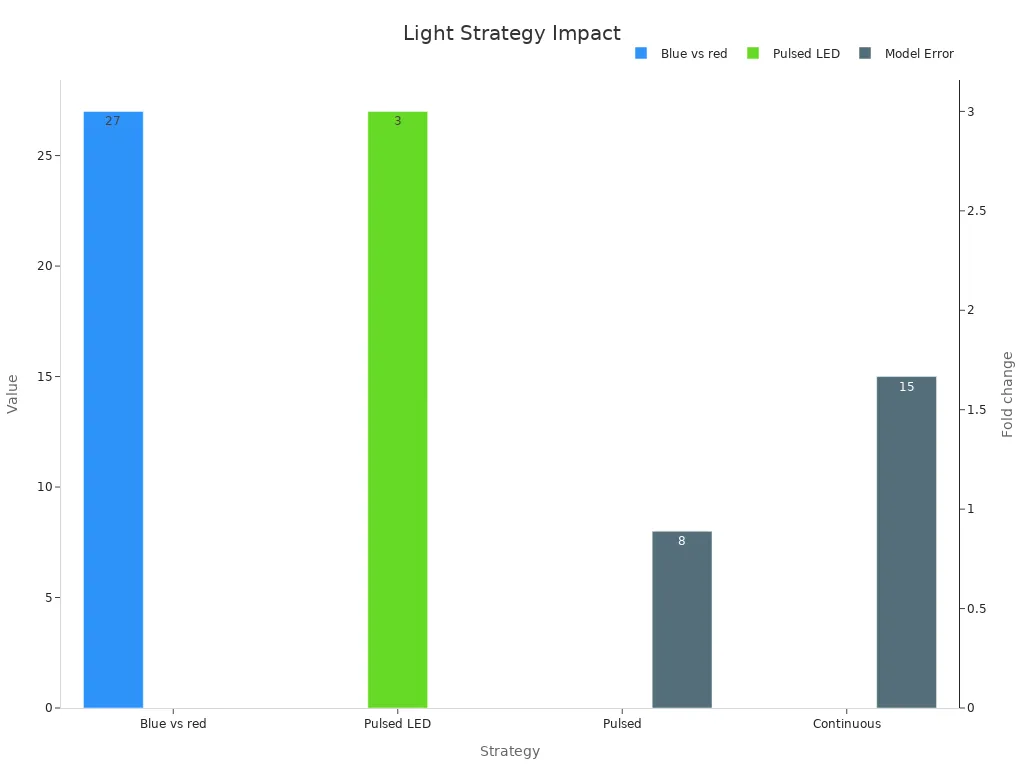
You can help microalgae grow by changing the light’s color, strength, and timing. Microalgae need light for photosynthesis, but not all colors work the same way. Red light helps microalgae grow faster than blue light. Blue light alone gives about 27% less biomass than red light. If you use both pulsed blue and red LED lights, you can get up to three times more biomass than with steady light. So, changing the color and pattern of light can really help.
| Parameter/Condition | Numerical Evidence | Effect on Microalgae Cultivation |
|---|---|---|
| Photon Flux Density (PFD) | 500–2 µmol m−2 s−1 | Stable cell density and productivity |
| Growth under blue vs red light | Blue light yields ~27% less biomass | Red light enhances growth rates |
| Pulsed blue-red LED light | Up to 3-fold biomass increase | Significant productivity boost |
| Artificial light vs sunlight | Artificial light yields higher growth rates | Overcomes natural light limits |
| Use of fluorescent dyes | Converts unusable light to PAR | Improves light quality and biomass |
Artificial lights can keep the light level steady, even when the sun changes. Some people use special tools to keep light at 180 ± 5 μmol m⁻² s⁻¹. This helps microalgae get just the right amount of light for photosynthesis.
Tip: Try using pulsed lighting or mix red and blue LEDs. Your microalgae might grow faster with these changes.
Temperature and pH
Temperature and pH are very important in microalgae cultivation. Most microalgae grow best between 19°C and 26°C. Some, like Chlorella vulgaris, like it warmer, around 28–30°C. Keeping the temperature steady helps microalgae avoid stress and keeps them growing well. For pH, most microalgae do best between 6 and 8. If pH gets too low or too high, microalgae may stop growing or lose nutrients.
Outdoor tests show that controlling both temperature and pH can give you up to 60% more biomass. For example, keeping pH at 6.5 stops ammonia from escaping and helps microalgae use nutrients better. You can use sensors and heating rods to keep the water just right for your microalgae.
| Environmental Parameter | Optimal Range / Condition | Effect on Microalgae Growth or Composition |
|---|---|---|
| Temperature | 19–21°C (Tetraselmis, Nannochloropsis), 24–26°C (Isochrysis), ~23°C general | Higher biomass production; temperature control essential |
| pH | 6–8 | Optimal nutrient uptake and photosynthesis; pH outside this range causes stress and reduces growth |
Note: Even small changes in temperature or pH can change how much microalgae grow and what nutrients they make.
Nutrient Balance
Microalgae need the right mix of nutrients to grow well. Nitrogen and phosphorus are the main nutrients, but others like calcium, magnesium, iron, and zinc also help. Scientists use machines to test many nutrient mixes to find the best one for each microalgae strain. The right balance can make microalgae grow faster and change what they produce, like more lipids or starch.
| Aspect | Description |
|---|---|
| Experimental Design | High-throughput screening of nutrient concentrations and their effects on growth |
| Number of Experiments | Over 180 experiments with multiple strains |
| Key Nutrients | Nitrogen, phosphorus, calcium, magnesium, iron, zinc, manganese |
| Growth Rate Metric | Specific growth rate measured by optical density |
| Outcome | Optimal nutrient mixes boost growth and change biochemical output |
A kinetic model with 35 parts helps predict how microalgae will grow with different nutrients. This model shows that if you limit both nitrogen and phosphorus, you can sometimes get more lipids. This is good if you want to make biofuels.
Tip: Try changing nutrient levels and see how your microalgae react. Sometimes, less nitrogen or phosphorus makes them store more energy as lipids.
CO2 and Salinity
CO2 is needed for photosynthesis. Raising CO2 levels to about 9% can give you more biomass, protein, and lipids. Microalgae have special ways to use extra CO2, which helps them grow faster. You can add CO2 to your system or use special cultures to keep levels steady.
Salinity also matters for microalgae cultivation. Some species, like Dunaliella tertiolecta, make more pigments like β-carotene when you raise the salt level, even up to 3 M. Others, like Desmodesmus sp., can make 2.7 times more carotenoids when stressed by salt. But not all microalgae like high salt, so you need to test what works for your type.
- Microalgae use CO2-concentrating mechanisms to help photosynthesis.
- CO2 levels change how fast microalgae grow and which enzymes work.
- Changing salt levels can help some microalgae make more pigments or lipids, but too much salt can slow growth.
- Climate change may change sea temperatures and salt levels, so you may need to change your setup later.
Callout: If you want more pigments or lipids, try changing CO2 or salt levels. Always check how your microalgae react, since each species is different.
By watching light, temperature, pH, nutrients, CO2, and salinity, you can get the most from microalgae cultivation. Small changes in these areas can lead to big improvements in how much you grow and the quality.
Cultivation Techniques

Bioreactor Design
You can help microalgae grow by using new bioreactor designs. These bioreactors have sensors and smart controls. They change nutrients and light right away when needed. For example, scientists used a closed-loop control system with Chlorella vulgaris. This system checked nutrient levels and changed them as needed. It helped microalgae use nutrients better and made more biomass than old ways. Some bioreactors can also clean water by removing heavy metals. If you set the pH to 6.34 and keep the temperature near 28°C, you can remove over 97% of lead from water. These features make bioreactors good for clean water and high microalgae yields.
| Parameter | Optimized Value | Outcome/Result |
|---|---|---|
| Initial solution pH | 6.34 | Pb(II) removal efficiency > 99% |
| Temperature (°C) | 27.67 | High biosorption performance |
| Biomass dose (g/L) | 1.5 | Maximum Pb(II) removal efficiency |
| Removal efficiency | N/A | 97.37% Pb(II) removal, <5% error rate |
Open Pond Methods
Open ponds are easy and cheap to use. They work well for growing a lot of microalgae. But microalgae do not grow as fast in open ponds as in closed systems. When you compare open ponds, closed photobioreactors, and hybrid systems, hybrid systems work best. Hybrid systems use both open and closed setups together. They split the growth and lipid making steps. This gives more microalgae at the end.
| Cultivation System | Growth Rate (average) | Biomass Productivity (g/m²/day) | Productivity Normalized to Solar Irradiance | Statistical Significance (P-value) |
|---|---|---|---|---|
| Open Raceway Pond | Lower | Moderate | Lower than hybrid system | Reference baseline |
| Closed Photobioreactor | Intermediate | Moderate | Similar to hybrid system | No significant difference |
| Two-Stage Hybrid System | Highest | Higher | Significantly higher | P < 0.05 |
Tip: Try hybrid systems if you want to get more microalgae than with open ponds.
Mixotrophic Biofilm Cultivation
Mixotrophic biofilm cultivation lets microalgae use light and organic matter. This method helps close the gap between lab and real-world results. For example, Galdieria sulphuraria grows better with mixotrophic conditions. It uses both photosynthesis and respiration at once. This gives more microalgae than using just light or just organic matter. You can even use this method in open ponds with lots of organic stuff. This makes it useful for real-world growing.
Fed-Batch Culture
Fed-batch culture means you add nutrients slowly over time. You do not give all the nutrients at once. This stops problems like too much nutrient at one time. Studies show fed-batch cultures give more microalgae, faster growth, and more products like β-glucans. For example, Microchloropsis salina grows faster and makes more product in fed-batch than in batch cultures. You use nutrients better and reach the most microalgae sooner.
| Parameter | Batch Culture | Fed-Batch Culture |
|---|---|---|
| Biomass Productivity | 0.0533 ± 0.0001 g/(L·day) | 0.0800 ± 0.0020 g/(L·day) |
| Specific Growth Rate (µmax) | 0.00336 ± 0.00004 h⁻¹ | 0.00463 ± 0.00005 h⁻¹ |
| β-glucans Productivity | 0.00410 ± 0.0002 g/(L·day) | 0.00596 ± 0.0002 g/(L·day) |
| Nitrate Yield | 2.88 | 3.10 |
| Time to Maximum Biomass | 40 days | 30 days |
- You can get about 1.25 times more microalgae with fed-batch than with batch culture.
- Fed-batch also helps stop problems from too much substrate.
Note: Try fed-batch culture if you want your microalgae to grow faster and give higher yields.
Monitoring and Automation
Real-Time Sensing
You can get more microalgae by using real-time sensing. This technology helps you check things like light, temperature, and nutrients often. Sensors can collect data every 15 minutes. This gives you the best predictions for how your microalgae will grow. If you wait longer to check, your predictions are not as good. For example, checking every 15 minutes gave an R² value of 0.77. But if you check every 240 minutes, the R² drops by 36%. The errors also get bigger when you check less often.
| Monitoring Interval (minutes) | R² (Prediction Accuracy) | RMSE (Error) | MAE (Error) |
|---|---|---|---|
| 15 | 0.7668 | 1.9901 | 1.5081 |
| 60 | Lower | Higher | Higher |
| 120 | Lower | Higher | Higher |
| 180 | Lower | Higher | Higher |
| 240 | 36.1% lower than 15 min | Highest | Highest |
Tip: Use sensors that check your system a lot. You will find problems early and keep your microalgae healthy.
AI and IoT
Artificial intelligence (AI) and the Internet of Things (IoT) help you run your microalgae systems better. These tools watch your equipment and control pumps. They can even change CO2 levels for you. AI can tell you the best time to harvest and warn you about problems. IoT devices send data to your phone or computer. You always know what is happening.
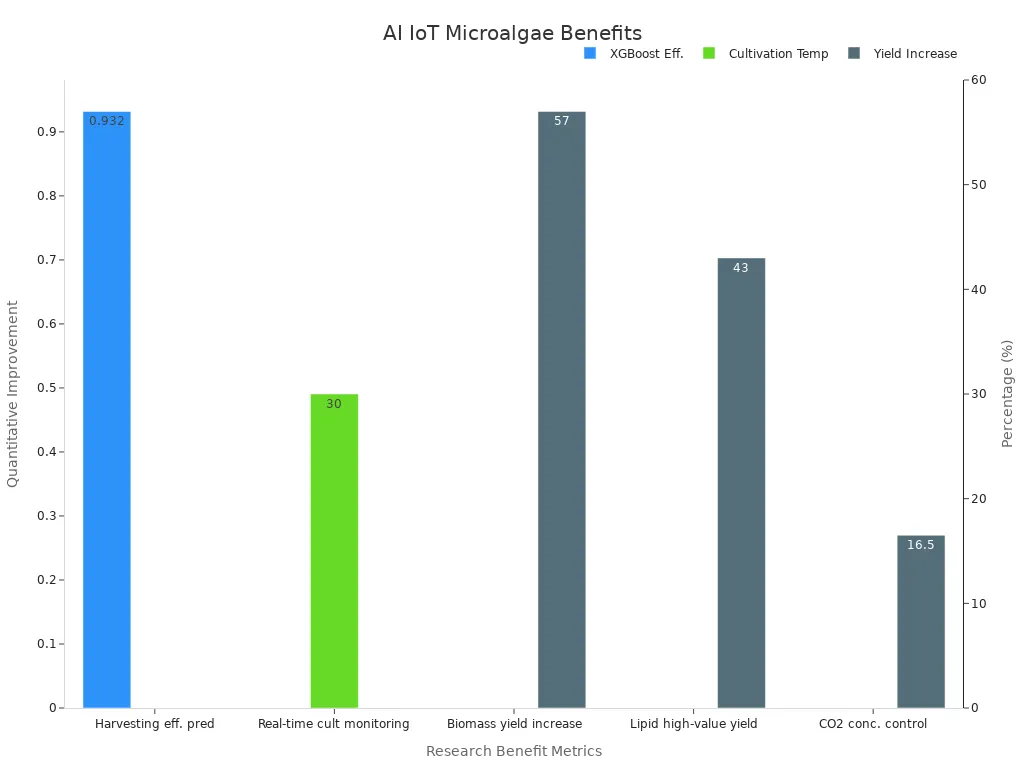
Studies show that AI and IoT can lower your maintenance costs by up to 40%. They can also cut equipment downtime in half. Your machines can last 20% longer. These systems help you use less water and fewer nutrients, so you save money. AI can help you get up to 57% more biomass by making your process better.
| Benefit Metric | Improvement/Value | Impact |
|---|---|---|
| Maintenance cost reduction | 12–40% | Lower expenses |
| Equipment downtime reduction | 50% | More efficient operations |
| Machinery lifespan extension | 20% | Fewer replacements needed |
| Production input reduction | 30% | Less water and nutrients used |
| Production output increase | 9–20% | Higher yields |
| Biomass productivity improvement | Up to 57% | Much more microalgae produced |
| Predictive model accuracy | R² = 0.932 (XGBoost) | Accurate harvest predictions |
Note: AI and IoT make your job easier and your results better. You can focus on growing while the system does the hard work.
| Metric | Improvement/Value | Description/Context |
|---|---|---|
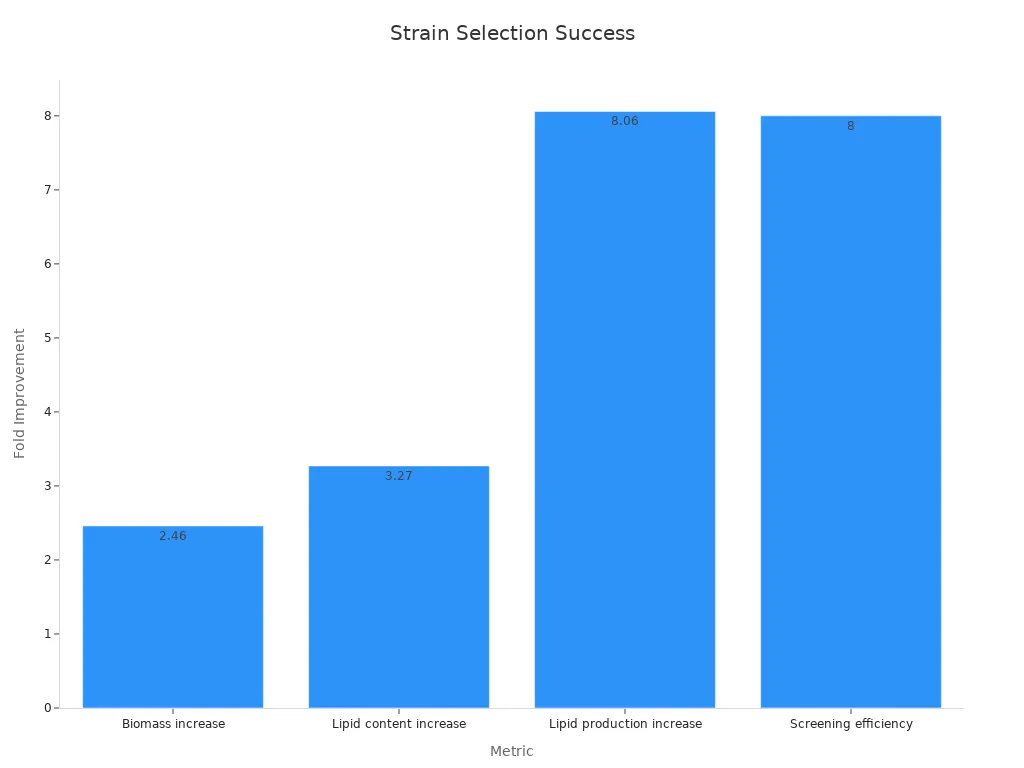
| Biomass increase | Up to 2.46-fold | Under nitrogen starvation compared to parental strain |
| Lipid content increase | Up to 3.27-fold | Under nitrogen starvation |
| Lipid production increase | Up to 8.06-fold | Combined biomass and lipid content |
| Screening efficiency | Over 8-fold improvement | Phototaxis-assisted vs traditional methods |
| Screening duration | 3 weeks vs 4-5 months | Time to isolate improved mutants |
Some strains can handle changing light better. After 160 days, one strain grew 77% more. It had better pigment control and used light well.
Metabolic Engineering
Metabolic engineering lets you change how microalgae use energy. You can make them create more lipids or other products. If you overexpress two genes (FAT1 and DGAT2d) in Coccomyxa, you get 1.4 times more lipids. This means you get more lipids faster. Mutagenesis and genome shuffling can also boost protein or pigment production. One study showed a 15 times increase in GFP expression without slowing growth.
| Methodology | Microalgae Strain/Target | Numerical Outcome |
|---|---|---|
| Laser mutagenesis | Chlorella strains FACHB 9 and FACHB 31 | Significant biomass increase |
| Chemical mutagenesis (EMS + FACS) | Chlorella sp. HS2 | Higher lipid content and productivity |
| Mutagenesis + genome shuffling | GFP expression in microalgae | 15-fold increase in GFP expression |
| Microalgae Species | Genetic Modification | Yield Improvement (Numerical Data) |
|---|---|---|
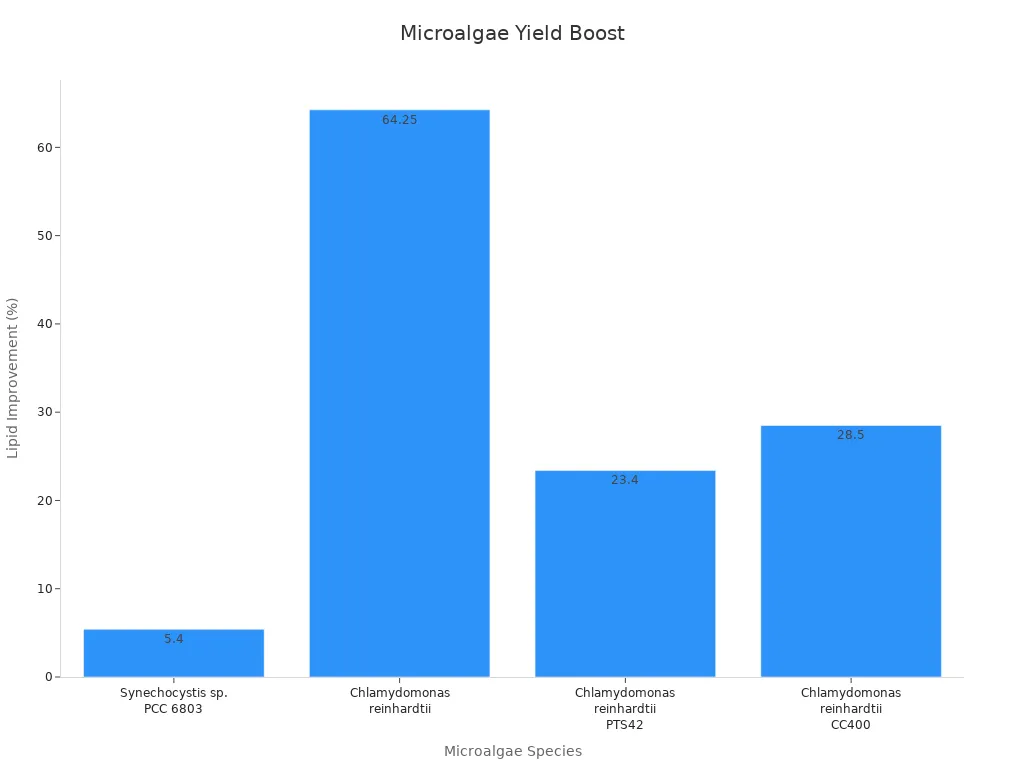
| Synechocystis sp. PCC 6803 | Overexpression of Acyl-ACP synthetase (aas) | Lipid production increased by 5.4% |
| Chlamydomonas reinhardtii | Knock-out/CRISPR/Cas9 of Phospholipase A2 (PLA2) | Lipid production improved up to 64.25% |
| Chlamydomonas reinhardtii PTS42 | Overexpression of Malic enzyme isoform 2 (ME2) | Lipid rate increased by 23.4% |
| Chlamydomonas reinhardtii CC400 | Down regulation of PEPC1 by CRISPRi/Cas9 | Lipid content 28.5% dry cell weight (DCW); productivity 34.9 mg/L/day |
Tip: Try metabolic engineering if you want your microalgae to make more lipids or proteins. Even small genetic changes can give big results.
Synthetic Biology
Synthetic biology gives you new ways to design microalgae for special jobs. You can add genes from other organisms to help microalgae survive stress or clean up pollution. For example, if you overexpress three Mrp antiporters in Synechococcus elongatus, you get 57.7% more growth under salt stress. Adding a cyanase gene from cyanobacteria to Chlamydomonas reinhardtii helps remove up to 150 mg/L of potassium cyanide and gives more cyanide resistance.
| Study / Author(s) | Organism / System | Genetic Modification / Approach | Numerical Benefit / Result |
|---|---|---|---|
| Cui et al., 2020 | Synechococcus elongatus | Overexpression of 3 Mrp antiporters (ion transporters) | 57.7% increase in cellular growth under salt stress |
| Sobieh et al., 2022 | Chlamydomonas reinhardtii | Incorporation of cyanobacterial cyanase gene | Phytoremediation of up to 150 mg/L potassium cyanide; increased cyanide resistance |
| Ismaiel et al., 2019 | Chlamydomonas reinhardtii | Expression of glutathione-S-transferase enzyme | 93.6% removal of herbicide penoxsulam vs. 52% by wild type |
| Li et al., 2021 | Chlorella vulgaris | Cultivation on membrane-treated distillery wastewater | Removal efficiencies: 80% N, 94% P, 72% COD; 99% Ca, 85% Mg, 42% Mo |
| Hussein et al., 2017; Piccini et al., 2019; Goswami et al., 2022 | Chlorella vulgaris | N/A (natural or engineered) | 96-99% removal of pesticides and heavy metals |
| Ibuot et al., 2020 | Chlamydomonas reinhardtii | Transgenic expression of plant Cd and Zn transporter (AtHMA4) | Increased Cd and Zn tolerance demonstrated |
Synthetic biology can also help microalgae clean water. Some engineered strains remove up to 99% of heavy metals and pesticides. This makes microalgae cultivation good for both making products and cleaning the environment.
Process and Harvesting Innovations

Continuous vs. Batch
You can pick batch or continuous systems for growing microalgae. In batch cultivation, you add nutrients at the start. You harvest everything at the end. In continuous systems, you keep adding new nutrients. You also remove some culture often. This lets microalgae keep growing without stopping.
Here is a table that compares both methods:
| Parameter | Batch (Lab) | Semi-continuous (Lab) | Batch (Outdoor) | Semi-continuous (Outdoor) |
|---|---|---|---|---|
| TAG Productivity (g/L/day) | Up to 0.23 | Up to 0.21 | 0.97–2.46 | 0.35–0.85 |
| TAG Content (%) | Up to 35% | Around 22% | 15–25% | 10–13% |
| Biomass Productivity | Lower | Higher | Not specified | Not specified |
In the lab, both systems work about the same. Outside, batch systems usually give more lipids and higher yields. It is important to time your harvest and manage nitrogen well.
Tip: Use batch systems outside if you want more lipids. Try semi-continuous systems in the lab for steady growth.
Smart Harvesting
Smart harvesting helps you collect more microalgae with less waste. You can use cold to keep your harvest fresh. Scientists found that storing microalgae at 4°C keeps more biomass and lipids. High temperatures make you lose more product. Cold storage slows down enzymes that break down cells and fats. This helps you keep more of what you grow.
- Store your harvest cold to stop biomass loss.
- Cold keeps lipids from breaking down.
- Low temperatures help microalgae cells live longer.
- Less oxygen and cold slow cell damage.
- Smart harvesting with cold means more product and better quality.
Note: Use cold storage right after harvest. This keeps your microalgae healthy and full of lipids.
Environmental Stress Application
You can get more lipids by stressing your microalgae. Stress like changes in temperature, pH, salt, or nutrients makes microalgae store more fats. Some species grow better and make more lipids when you limit nitrogen or change pH. Adding a little zinc oxide nanoparticles can also help, but too much is bad.
- Changes in temperature, pH, and salt help make more fats.
- Some microalgae do better under stress and give more lipids.
- Using stress at the right time makes your process work better.
- Limiting nitrogen is a great way to boost lipid content.
- Changing pH is easy and works for many species.
Callout: Be careful with stress. Too much can slow growth or hurt your culture. Start with small changes and watch your microalgae closely.
You learned that new ways can help microalgae grow more. Weather models and prediction tools help you plan and deal with changes. Research shows that better media and new reactors can give more microalgae and useful products.
- Industry reports say you can get twice as much by trying new strains, making process control better, and stopping contamination.
Keep asking questions, join groups of growers, and talk about what you find. Your tests can help make the future of microalgae better!
FAQ
What is the best light for microalgae growth?
You get the best results with a mix of red and blue LED lights. Red light helps microalgae grow faster. Pulsed lighting can boost your yield even more. Try different light settings to see what works for your strain.
How do you prevent contamination in microalgae cultures?
You can keep your cultures clean by using sterile tools and containers. Co-cultivating with helpful bacteria also helps. Regularly check your cultures for unwanted growth. Quick action stops problems before they spread.
Can you use wastewater to grow microalgae?
Yes! You can use treated wastewater as a nutrient source. Microalgae clean the water by removing nitrogen and phosphorus. This method saves money and helps the environment.
Tip: Always test the water first to make sure it is safe for your microalgae.
How often should you harvest microalgae?
You should harvest when your culture reaches peak density. Many growers check cell density daily. Harvesting at the right time gives you more biomass and better quality.
What is the easiest way to boost lipid content?
You can limit nitrogen in your culture. This stress makes microalgae store more lipids. Try small changes and watch how your microalgae respond.
| Method | Effect on Lipids |
|---|---|
| Nitrogen limit | Increases |
| Salt stress | Increases |
| Temperature | Varies |