

You can help plants grow better in commercial vertical farms by using smart, adjustable, and energy-saving lighting systems. New research shows that artificial lighting can take the place of sunlight and give crops the best growing conditions. LED technology saves energy and costs less to run. Tunable lighting lets you change the color and strength of light for better plant growth. AI-driven systems help set the best times for lights and use less energy. Wireless integration lets you control everything from one place and saves on labor costs.
| Aspect | Impact |
|---|---|
| Artificial Lighting | Takes the place of sunlight and gives the best light for many crops. |
| LED Technology | Saves energy, costs less to run, and lets you pick different light colors. |
| Tunable Lighting | Lets you change light color and strength to help plants grow more. |
| AI-Driven Systems | Sets the best times for lights, saves energy, and works better. |
| Wireless Integration | Lets you watch and control lights from one place, saving work and money. |
Lighting Design needs smart planning, the right mix of technology, and good cost control for the best results.
Key Takeaways
- Use smart LED lights that you can adjust. This helps save energy and helps plants grow better in vertical farms. Plan where you put the lights very carefully. This stops expensive mistakes and makes sure all plants get the same amount of light. Pay attention to Daily Light Integral (DLI) instead of only PPFD. This helps crops grow more and saves energy. Change the length of the fixtures and how high they are. This uses space well and helps you get more money back. Check your lighting system often and make changes when needed. This keeps plants healthy and growing strong.
In vertical farms, low-wattage, high-uniformity lighting almost always outperforms high-power fixtures
PPFD alone is misleading — DLI and uniformity matter more in multi-layer systems
Some people think more light always helps plants grow. This is not true in vertical farms. PPFD shows how much light is there at one time. But plants need the right amount of light over a whole day. Daily Light Integral (DLI) mixes how strong the light is and how long it shines. DLI links to how much you harvest and how much energy you use. If you only look at PPFD, you might not get the best results. Using special lighting helps plants grow better and stronger. Uniformity is important too. If some plants get more light than others, they will not grow the same.
- DLI mixes light strength and time, so you can control it better.
- Special lighting plans help you get more crops and better quality.
- Changing how you use light can give you better results.
Lighting layout mistakes are expensive and difficult to fix after installation
If you make mistakes in your Lighting Design, it costs you later. Fixing problems after you put in the lights is hard and expensive. It is best to plan your lighting before you build. Vertical farms use more energy than fields or greenhouses. For example:
- Lettuce in open fields uses about 1–5 kWh for each kilogram.
- Lettuce in greenhouses uses 20–40 kWh for each kilogram.
- Vertical farms use 150–350 kWh for each kilogram of leafy greens, but they save land and water.
Custom fixture length and mounting height are not optional — they directly affect ROI

Custom fixture lengths and adjustable mounting heights help you use space well and save energy. You can match your lights to your racks and crops. This gives even light to all your plants. When you change light strength and color, you get more crops and better quality. Good Lighting Design means you make more money back.
Good lighting design reduces energy cost, labor stress, and crop inconsistency
Lighting can be up to 30% of start-up costs and use 25–65% of your budget. Smart Lighting Design helps you save money and work faster. Automation cuts labor costs, but you need to teach your team. When you keep track of how different lights affect crops, you get steady harvests all year.
| Aspect | Details |
|---|---|
| Start-up Costs | Lighting is 30% of start-up costs. |
| Operating Budgets | Lighting can use 25-65% of your budget. |
| Energy Consumption | Growing all U.S. lettuce indoors would need about 42 terawatt-hours each year. |
| Cost Efficiency | Energy-saving tools and checking your system can lower costs. |
Why Lighting Design Is Different in Commercial Vertical Farms
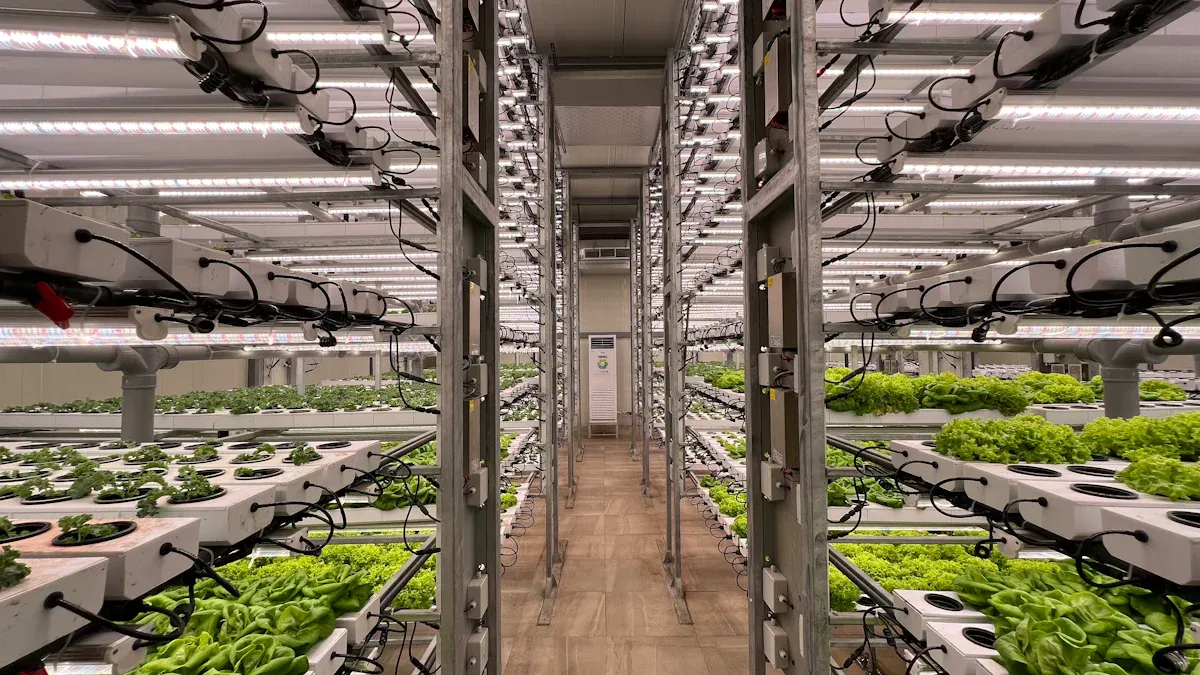
Why Lighting Design Is Different in Commercial Vertical Farms
No sunlight buffer
You do not get free sunlight in a vertical farm. You must use LED lights to give plants the energy they need. This means you pay for every photon that reaches your crops. Unlike open fields or greenhouses, you cannot rely on the sun to fill in gaps. You control the light, but you also pay for it.
- You must use artificial lighting to replace sunlight.
- LED lights let you change the color and strength of light.
- Adjusting red and blue light ratios can help lettuce grow better and use resources more efficiently.
No natural airflow correction
Air does not move on its own in a vertical farm. You need fans and systems to keep air fresh and moving. This costs money and uses energy. If you do not control airflow, humidity and temperature can get too high or too low. Plants need steady conditions to grow well.
- Keeping the right humidity and temperature is hard and expensive.
- You must use machines to move air and keep plants healthy.
Every photon is paid for
You pay for all the light your plants get. This makes energy costs high. If you do not use renewable energy, your farm can have a big carbon footprint. You need to plan your Lighting Design to save energy and money.
- Artificial lights and climate systems use a lot of power.
- Saving energy helps lower costs and helps the environment.
Scale Changes Everything
One rack vs 100 racks
When you grow from one rack to many racks, things get harder. You must keep the climate and lighting the same for all racks. More racks mean more heat from lights. You need better cooling and airflow.
One layer vs six layers
Adding more layers makes it harder to keep light and air even. Each layer needs the right amount of light and cooling. If you do not plan well, some plants get too much heat or not enough light.
Demo performance vs long-term operation
A small demo farm is easy to manage. A big farm needs strong systems to keep everything working. You must check your Lighting Design often to make sure plants grow well over time.
Tip: Plan your lighting and climate systems for the size you want to reach, not just for your first rack.
Common Lighting Design Goals — and Why They Often Conflict
Yield vs Energy Efficiency
Higher PPFD ≠ better economics
You might think that more light always means more crops. This is not always true. If you push light levels too high, you use more electricity without getting more harvest. Electricity costs can make up 25–30% of your total expenses. You need to find the right balance. The type and color of LED lights matter. When you choose the right light spectrum, you can grow more plants and use less energy. This helps you save money and get better results.
Diminishing returns above crop-specific thresholds
Every crop has a limit for how much light it can use. If you go above this limit, you waste energy and money. For example, lettuce only needs a certain amount of light each day. If you give it more, it will not grow faster or bigger. You will just pay more for electricity. Here is a table that shows how energy use can change:
| Key Findings | Details |
|---|---|
| Energy Consumption | 10–18 kWh per kg of lettuce |
| Energy Use Intensity | 850–1150 kWh per m² per year |
| Technical Energy Benchmark | 3.1–7.4 kWh per kg |
| Challenges | High costs and environmental impact |
Uniformity vs Fixture Count
Over-spacing lights creates shadow zones
If you use fewer lights and spread them too far apart, some plants will not get enough light. This creates shadow zones. Plants in these areas will not grow as well. You want every plant to get the same amount of light.
Under-spacing increases CAPEX and wiring complexity
If you use too many lights, you spend more money at the start. You also make your system more complex with extra wires and parts. Large farms often use high-power LED fixtures to cover more space with fewer lights. This can help lower labor costs and make maintenance easier. But you must check that all plants still get even light.
Performance vs Maintainability
Can fixtures be replaced without stopping production?
You need to think about how easy it is to fix or replace your lights. If a light breaks, can you change it without stopping your whole farm? Farms that use energy-efficient technology can lower their running costs. But you still need to plan for repairs.
Can one person service multiple layers safely?
Safety matters. Can one worker reach and fix lights on all layers? Farms use HVAC systems to control temperature and humidity. These systems, along with lighting, use a lot of energy. Good planning helps you keep costs down and makes your farm safer and easier to run.
Tip: When you plan your Lighting Design, think about how each choice affects cost, plant growth, and daily work. Balancing these goals helps your farm succeed.
PPFD vs DLI: What Commercial Operators Often Misunderstand
Why PPFD Alone Is Not Enough
Snapshot measurement vs daily reality
You might think that a high PPFD number means your plants will grow well. PPFD shows how much light hits a spot at one moment. This is like checking the speed of a car at one second and thinking it tells you the whole trip. Plants need light over the whole day, not just in one instant. If you only look at PPFD, you can miss problems with your crops. Many growers believe a single high PPFD reading means healthy plants, but this is not true. You need to check how much light your plants get during the whole day.
Edge loss and overlap effects
Light does not spread evenly everywhere. Some parts of your farm, like the edges, get less light. Other spots might get too much if lights overlap. These problems can cause weak or stunted plants. You need to watch for these issues when you plan your Lighting Design. Using sensors and checking your setup helps you find and fix these weak spots.
Designing for Target DLI, Not Maximum Output
Crop-dependent DLI ranges
Each crop needs a certain amount of light each day. This is called the daily light integral, or DLI. Lettuce, herbs, and microgreens all have different DLI needs. If you give too much light, you waste energy. If you give too little, plants do not grow well. Research shows that plants can handle a few days with lower DLI and still grow strong. This means you do not need to push for the highest light every day. You can save energy and still get good crops.
Balancing photoperiod and intensity
You can reach your target DLI by changing how long the lights stay on or how bright they are. Some crops do better with longer light times at lower brightness. Others need shorter, stronger bursts. You need to find the right mix for your plants. This helps you use less energy and get better results.
Uniform DLI Across Layers Matters More Than Peak PPFD

inconsistent growth
If some layers get more light than others, your plants will not grow the same. Uniform DLI across all layers helps every plant grow at the same rate. LED systems help spread light evenly and stop hot spots or shadows from forming.
uneven harvest timing
When light is not even, some plants finish growing before others. This makes it hard to plan your harvest. You want all your crops ready at the same time. Uniform light helps you get a steady harvest.
higher labor cost
If you have to pick crops at different times, your team works harder. You spend more time and money on labor. Sensors and good monitoring tools help you keep light even, so your crops stay healthy and your work stays simple.
Tip: Focus on even light for every plant, not just the highest number on your meter. This leads to healthier crops and easier harvests.
Why Low-Wattage Lighting Works Better in Vertical Farms
Heat Is the Hidden Cost of High-Power Fixtures
Thermal stress
High-power fixtures give off a lot of heat. When you use these lights, plants can get too warm. This extra heat causes thermal stress. Plants may wilt or grow slowly. You want to avoid this problem to keep your crops healthy.
Increased HVAC load
More heat from lights means your cooling system must work harder. You spend more money on air conditioning. Your energy bills go up. If you use low-wattage fixtures, you lower the need for cooling. This saves you money and helps the environment.
Shortened component lifespan
Heat does not only hurt plants. It also damages your lights and other equipment. High temperatures make parts wear out faster. You may need to replace fixtures more often. Using low-wattage lights helps your system last longer.
Low-Wattage Fixtures Enable Closer Spacing
- Low-wattage LED fixtures produce very little heat. You can place them close to your plants without causing heat stress.
- The compact design of LEDs helps you spread light evenly across the plant canopy.
- You can arrange LEDs in groups to create a surface that gives uniform light to all plants.
- Linear fixtures or modular assemblies in multi-layer systems help you achieve high uniformity of light distribution.
When you use low-wattage fixtures, you can fit more lights into your racks. This means every plant gets the same amount of light. You do not see shadow zones or dark spots. Your crops grow evenly from edge to edge.
Better uniformity
Uniform light helps all plants grow at the same rate. You get a steady harvest. Your crops look and taste better.
Lower shadow ratio
Closer spacing means fewer shadows. Plants do not compete for light. You see less wasted space and more healthy growth.
Easier multi-layer optimization
Low-wattage fixtures make it simple to set up many layers. You can adjust the lights for each layer. This helps you use your space well and grow more crops.
More Fixtures, Lower Stress
Continuous lighting with low-wattage fixtures lets you use fewer units. You spend less money at the start and save on energy costs. These fixtures run cooler and create less moisture. Your cooling system does not need to work as hard. This lowers plant stress and improves crop quality.
Low-wattage LED fixtures also let you pick the best light wavelengths for your crops. You can help plants grow strong and healthy. This targeted light reduces problems like pests and diseases. Your crops stay healthy, and you get better results. The energy efficiency of LEDs means less heat, so your plants stay comfortable and grow well.
Lighting Design with low-wattage fixtures gives you more control. You save money, reduce stress for your plants, and improve your harvest.
Fixture Length, Mounting Height, and Spacing: The Design Triangle
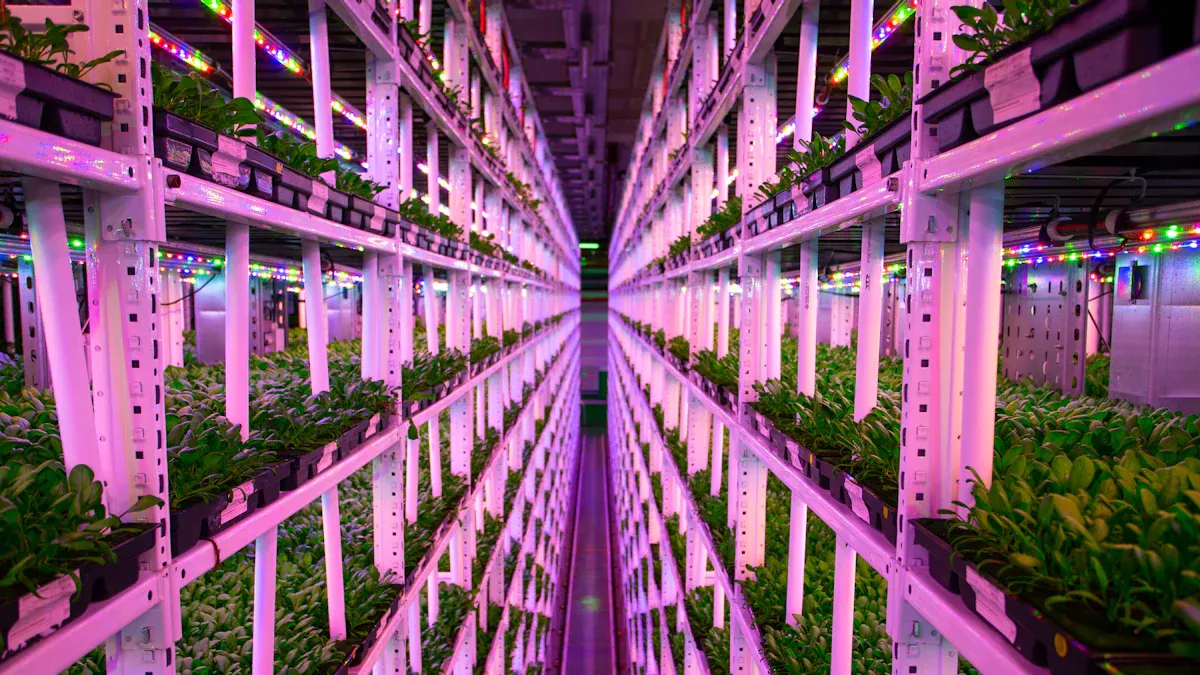
Mounting Height Is a Design Decision, Not an Afterthought
Mounting height shapes how well your plants receive light. If you set lights too high, you waste energy and create shadow zones. If you set them too low, you risk hot spots and uneven growth. You must adjust the distance between your lights and the plant canopy to match the needs of your crops. Leafy greens grow best when lights sit 12–18 inches above the canopy. Fruiting crops may need more space. When you keep the right height, you help every plant get the same amount of light.
Dead zones at rack edges
Dead zones appear when light does not reach the edges of your racks. Plants in these areas grow slower and may look weak. You can fix this by planning your lighting layout to cover every part of the rack. Using reflective materials also helps spread light to the edges, so no plant gets left out.
Overlap inefficiencies
Overlap happens when lights cover the same area too much. This wastes energy and can cause some plants to get too much light. You should space your fixtures to avoid overlap. When you plan your layout, you save energy and help your crops grow evenly.
Tip: Adjustable mounting systems let you change the height of your lights as your plants grow. This keeps the distance between the lights and the leaves just right.
Custom-Length Fixtures Improve Both Yield and ROI
Custom-length fixtures give you better control over your lighting. You can match the length of your fixtures to the size of your racks. This helps you cover every inch of your growing area. You use fewer fixtures and save money on electricity.
Better coverage
Custom fixtures fit your racks perfectly. You avoid gaps and shadow zones. Every plant gets the light it needs to grow strong.
Fewer fixtures needed
When you use fixtures that match your rack size, you do not need extra lights to fill in gaps. You spend less money on equipment and wiring.
Lower long-term electricity cost
Custom-length fixtures use energy more efficiently. Farms that use spectrum optimization with custom fixtures report up to 60% energy savings. You also use less water and fertilizer, which helps you save money over time.
- Custom-length fixtures let you pick the best light spectrum for each crop and growth stage.
- Farms using these fixtures see improved yields and healthier plants.
- You help the environment by using less energy and water.
| Benefit | Impact on Your Farm |
|---|---|
| Spectrum Optimization | Higher yields, healthier crops |
| Energy Efficiency | Up to 60% energy savings |
| Water Savings | Up to 80% less water used |
| Fewer Fixtures | Lower equipment and maintenance costs |
Why Standard-Length Fixtures Waste Space
Standard-length fixtures do not always fit your racks. You may end up with lights too close together or too far apart. Both problems hurt your crops and waste energy.
Too close: hot spots
When fixtures sit too close, some plants get too much light. This creates hot spots. Plants in these areas may burn or grow unevenly. You want to avoid this by spacing your lights correctly.
Too far: wasted photons
If fixtures are too far apart, light misses parts of your rack. You waste photons and energy. Some plants do not get enough light and grow poorly. You must plan your spacing to make sure every plant gets the right amount of light.
Note: Optimizing fixture length, mounting height, and spacing helps you achieve uniform light distribution. You minimize energy waste and support healthy, even growth across your vertical farm.
Lighting Layout Mistakes That Are Hard to Fix Later
Designing the Rack First and Lighting Second
You might want to design your racks before thinking about lighting. This can lead to big problems. If you do not plan your lighting with your racks, you may end up with shadows or uneven light. You could waste energy and money. You should always design your lighting and racks together. This helps you get the best results for your plants and your budget.
Tip: Start with your crop needs. Match your rack size, fixture length, and mounting height to your lighting plan. This makes your system work better from the start.
Ignoring Edge and Corner Loss
Plants don’t grow in the center only
You need to remember that plants grow everywhere on the tray, not just in the middle. If you ignore the edges and corners, those plants will not get enough light. They may grow slower or look unhealthy. You want every plant to get the same amount of light.
Commercial harvest depends on full-tray consistency
You rely on every tray for your harvest. If some plants do not grow well, you lose money. Uneven lighting can cause weak spots. You should use a layout that covers the whole tray. Reflective materials can help spread light to the edges. This gives you a better harvest and less waste.
No Allowance for Crop Change
Lettuce today
You may grow lettuce now, but you might want to switch to herbs or microgreens later. If your lighting system cannot adjust, you will have problems. Different crops need different light spectrums and strengths.
Herbs or microgreens tomorrow
You can prepare for change by using LED technology. LEDs let you change the color and strength of light. Tunable LEDs and smart controls help you adjust lighting for each crop. You can use more blue light for leafy growth or more red for flowering. Some farms use Quantum Dot LEDs for even more control and energy savings. AI systems can help you change light settings based on what your plants need in real time.
- Choose lighting that lets you change spectrum and intensity.
- Use smart controls to adjust for new crops.
- Plan for flexibility so you can grow many types of plants.
Note: Planning for crop changes saves you time and money. You can switch crops without rebuilding your whole system.
How to Approach Lighting Design the Right Way
Start With Crop Targets, Not Fixture Specs
You should always begin your planning by thinking about your crops. Each plant has its own needs for light, growth, and harvest timing. If you focus on what your crops need, you can set up your lighting for the best results.
DLI
Daily Light Integral (DLI) tells you how much light your plants get each day. DLI combines how strong the light is and how long it shines. When you match DLI to your crop, you help your plants grow faster and healthier.
| Aspect | Description |
|---|---|
| Daily Light Integral | DLI is a measure that combines light intensity and duration, crucial for optimizing plant growth. |
| Growth Cycle Stages | Understanding light needs at different growth stages helps in adjusting light for better outcomes. |
| Impact on Yield | Proper DLI influences growth rates, yield, and quality, making it essential for effective lighting design. |
Growth cycle
Plants need different light at each stage of growth. For example, blue light (400-450 nm) helps roots and leaves grow. Red light (600-660 nm) helps flowers and fruits develop. You can change the light spectrum as your plants grow to get the best results.
| Light Spectrum Range (nm) | Color Perception | Impact on Plant Growth |
|---|---|---|
| 400-450 nm | Blue | Encourages vegetative growth, influences root development, affects plant size and shape |
| 600-660 nm | Red | Essential for photosynthesis, promotes flower and fruit development, can enhance branching and stem elongation |
Harvest consistency
When you give your plants the right light at the right time, you get a steady harvest. Your crops will grow at the same rate, so you can plan your harvests and meet your goals.
Tip: Automated systems can adjust light intensity, duration, and spectrum based on real-time data. This helps you keep your crops healthy and your harvests reliable.
Design Lighting Together With Racks and Power Layout
You should plan your lighting, racks, and power systems at the same time. This helps you save energy, reduce costs, and make your farm easier to run.
Electrical load planning
LED lights use up to 60% less energy than old-style lights. You can save money and lower your carbon footprint. When you plan your power needs, you avoid overloading your system and keep your farm safe.
| Advantage | Description |
|---|---|
| Energy Efficiency | LEDs use up to 60% less energy than traditional lighting, leading to substantial savings in vertical farms. |
| Customization | High-efficiency LED grow lights can be tailored for specific crops, enhancing growth and yield. |
| Environmental Impact | Reduced energy consumption lowers the carbon footprint of vertical farming operations. |
Maintenance access
LED grow lights last longer and need less fixing. They also give off less heat, so you do not need as much cooling. This means you spend less time and money on repairs.
| Advantage | Description |
|---|---|
| Longer Lifespan | LED grow lights last longer, reducing maintenance costs and minimizing disruptions in the growing process. |
| Reduced Heat Emission | LEDs emit less heat, decreasing the need for cooling systems and further saving energy. |
Expansion readiness
If you plan your layout well, you can add more racks and lights later. This helps your farm grow without big changes or extra costs.
Note: Integrating LED lighting with your environmental control systems makes your lighting more effective. You can control everything from one place and adjust settings as your farm grows.
Validate With Lighting Simulation Before Installation

Before you install your lights, you should use simulation tools. These tools help you see how light will spread across your racks and plants. You can fix problems before they cost you money.
PPFD maps
Simulation tools create maps that show how much light each part of your farm gets. You can spot dark spots or areas with too much light. This helps you adjust your setup for even growth.
| Metric | Calibration R² | Validation R² | RMSE (µmol m-2 s-1) |
|---|---|---|---|
| PPFD Prediction | 0.76 | 0.82 | 158 (calibration) |
| Light Distribution on Shelves | 0.87 | N/A | 268 (validation) |
Uniformity analysis
You want every plant to get the same amount of light. Uniformity analysis checks if your lighting is even. If you find problems, you can move your lights or change their height.
Risk flags early
Simulation tools help you find risks before you build. You can fix issues with power, heat, or shadows early. This saves you time and money.
Tip: In Controlled Environment Agriculture, using artificial grow lights and climate controls lets you fine-tune every part of your farm. You can customize the light spectrum for each stage of plant growth and get the best results.
By following these steps, you set up your Lighting Design for success. You help your crops grow strong, save energy, and make your farm easier to manage.
Final Thoughts: Lighting Is a System, Not a Product
The Most Expensive Lighting Mistakes Happen Before Installation
Wrong assumptions
You might think that buying the best lights will solve all your problems. This is not true. If you make the wrong assumptions about your crops or your space, you can waste a lot of money. For example, you may believe that more light always means better growth. In reality, too much light can harm your plants and raise your energy bills. You need to understand what your crops need before you choose your lights.
Incomplete layout planning
If you skip careful planning, you can run into big problems later. You may find dark spots on your racks or discover that your lights do not fit your space. Fixing these mistakes after installation costs much more than getting it right the first time. You should always plan your Lighting Design with your racks, power, and crops in mind.
Remember: The most expensive mistakes happen before you even turn on the lights.
Getting Lighting Right Early Is the Cheapest Optimization
Lower CAPEX waste
When you plan your lighting as a system, you spend less on equipment you do not need. You avoid buying extra fixtures or making changes later. This saves you money at the start of your project.
Lower OPEX forever
Good planning also lowers your operating costs. You use less energy and get better results from your crops. You spend less on repairs and replacements. Over time, these savings add up.
- Enhanced energy efficiency through optimized lighting systems.
- Improved crop growth by integrating lighting with other systems.
- Reduced operational costs by maximizing the potential of lighting.
Treating lighting as a system, not just a product, gives you long-term benefits. You help your plants grow better, save money, and make your farm easier to manage.
You can make your vertical farm better with smart lighting choices. First, think about what plants you want to grow. Next, look at your space and how much money you have. Pick lights that you can adjust as your needs change. Plan ahead so you can switch crops later if you want.
- Check your lighting setup often to make sure it works well.
- Try using computer tools to see how your lights will work.
- If you are not sure, ask someone who knows more for help.
Tip: Look for online guides and stories from other farms to learn about good lighting ideas for vertical farms.
FAQ
What is the best type of light for vertical farms?
You should use LED grow lights. LEDs save energy, last longer, and let you adjust color and brightness. This helps your plants grow strong and healthy.
How close should I place lights to my plants?
Keep lights 12–18 inches above leafy greens. Adjust the height for other crops. This distance gives even light and avoids hot spots.
Why does light uniformity matter?
Uniform light helps every plant grow at the same rate. You get steady harvests and better quality. Uneven light causes weak spots and wasted energy.
Can I use the same lighting for all crops?
You need to adjust light color and strength for each crop. Lettuce, herbs, and microgreens all need different light. Use tunable LEDs for easy changes.
How can I lower energy costs in my vertical farm?
Pick energy-saving LEDs. Use smart controls to adjust light times and strength. Check your system often to find ways to save more power.