

Are you ready to make your lettuce vertical farming better? You can get great results by using some easy tips. Hydroponic systems help you grow lettuce all year. They use less water and give you up to 20 times more lettuce than soil farming. These systems also save space and use fewer pesticides. They help you make the best place for healthy plants. Want the best results? Use these smart ideas and see your crops do well.
- Multi-layer racks let you grow more lettuce in small spaces.
- Artificial lights, like LEDs, help plants grow and save energy.
- The market for hydroponic lettuce vertical farming is growing quickly.
Key Takeaways
- Pick lettuce types like Green Oak and Baby Cos. These give lots of lettuce and fight off diseases well in hydroponic systems. Use racks with many layers and LED lights. The lights should have deep red and far-red colors. This helps you use space better and makes lettuce grow faster. Keep the temperature between 72 and 77°F during the day. Keep humidity between 40% and 60%. Make sure the light is about 244 µmol·m⁻²·s⁻¹. Watch nutrient levels closely. Keep pH between 5.5 and 6.5. Keep electrical conductivity (EC) between 1.4 and 1.8 mS/cm. This helps plants stay healthy. Check your system every day. Do not put too many plants together. Use automation tools to save time. This also helps your lettuce grow better and gives you more lettuce.
Lettuce Varieties
Best Types
Choosing the right lettuce makes a big difference in your vertical farm. Some types just do better in hydroponic systems. If you wonder what lettuce grows best in hydroponics, you should look at varieties like Green Oak, Baby Cos, and Red Salad Bowl. These types give you high yields and strong plants.
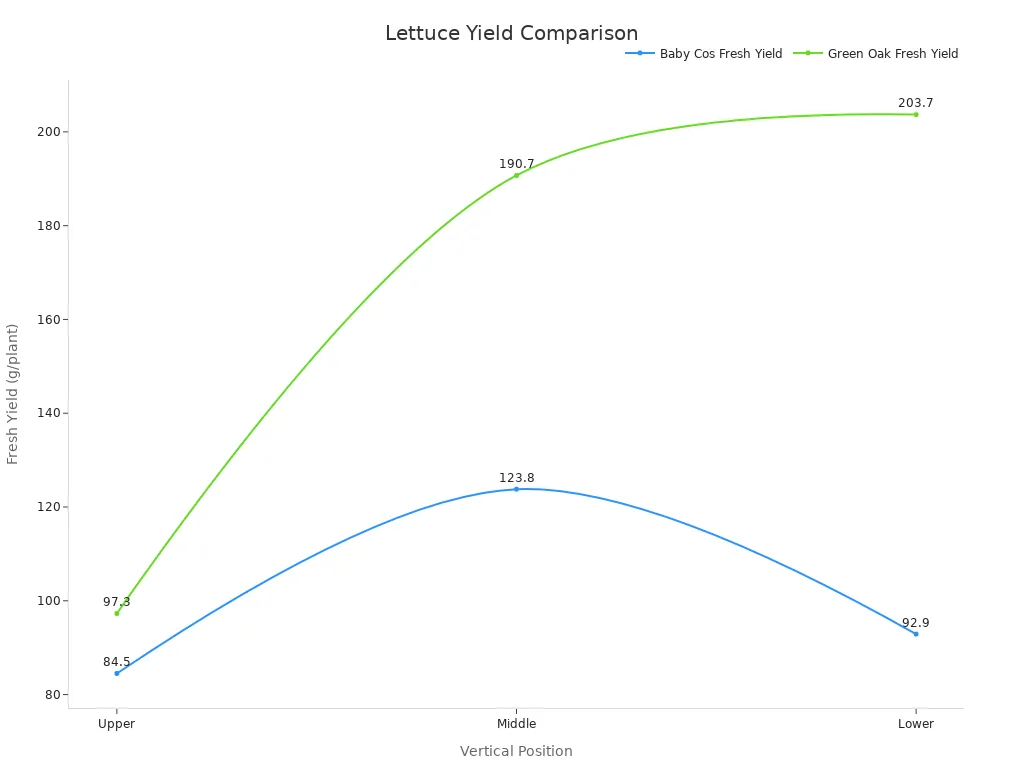
Check out this table to see how different varieties perform in vertical farming:
| Lettuce Variety | Vertical Position | Fresh Yield (g/plant) | Light Use Efficiency (g mol⁻¹) | Notes |
|---|---|---|---|---|
| Baby Cos | Middle | 123.8 | 0.28 | Best yield for Baby Cos |
| Green Oak | Lower | 203.7 | 0.57 | Best yield and efficiency |
| Red Salad Bowl | – | 62.55 | – | Top yield at low nutrients |
| Oak Leaf | – | 14.05 | – | Lowest yield |
Tip: Place Green Oak on the lower racks for the highest yield and best light use.
Disease Resistance
You want lettuce that stays healthy. Some varieties resist common diseases better than others. Green Oak and Baby Cos often show strong resistance to root rot and mildew. Red Salad Bowl also stands up well to pests. Picking these types helps you avoid problems and keeps your plants growing strong.
- Green Oak: Good resistance to mildew
- Baby Cos: Handles root issues well
- Red Salad Bowl: Less likely to get leaf spots
Growth Rate
Fast growth means quicker harvests and more lettuce for you. Most hydroponic lettuce takes about 30 days from seed to harvest. If you ask, “how long does it take lettuce to grow hydroponically?”—the answer is usually four to five weeks. Green Oak and Baby Cos both grow quickly, especially when you give them the right light and nutrients. Red Salad Bowl also matures fast, so you can plan for steady harvests.
Remember: Faster growth lets you plant more cycles each year and boost your profits.
Lettuce Vertical Farming Environment

Spectrum
You want your hydroponic lettuce to get the right kind of light. Not all light is the same. White LED lights work well, but you can boost growth by adding deep red and far-red light. Deep red light helps your lettuce build more leaves and get bigger. Far-red light makes photosynthesis even better. When you mix these lights, your hydroponic system gives you stronger, healthier lettuce. Try to match the light to each stage of growth. This way, your plants get what they need from seed to harvest.
- White LED plus deep red (660 nm) and far-red (700–800 nm) light gives the best results.
- Far-red light increases photosynthesis.
- Deep red light helps your lettuce grow more biomass.
- Adjust the light mix for each growth stage.
Light Intensity
Light intensity matters a lot in hydroponic farming. If you use too little light, your lettuce grows slowly. Too much light can stress your plants. Aim for a photon flux density (PPFD) of about 244 µmol·m⁻²·s⁻¹. This level helps your hydroponic lettuce grow fast and stay healthy. LED lights with the right intensity make your lettuce look better and taste fresher. You can use timers to keep the light on for 14–16 hours each day. This keeps your hydroponic system running smoothly.
Temperature and Humidity
Lettuce likes cool air. The best temperature for hydroponic lettuce is around 60°F (about 15.5°C). If you keep the temperature steady, your plants avoid stress and disease. During the day, try to keep it between 72–77°F (22–25°C). At night, drop it to 59–64°F (15–18°C). Humidity should stay between 40–60%. This range stops water stress and keeps mold away. Check the table below for a quick guide:
| Parameter | Recommended Range | Notes |
|---|---|---|
| Daytime Temperature | 22-25°C (72-77°F) | Good for leafy greens |
| Nighttime Temperature | 15-18°C (59-64°F) | Cooler at night helps growth |
| Relative Humidity | 40-60% | Stops water stress and disease |
Air Circulation
Good airflow is key in any hydroponic setup. Stale air leads to condensation and mold. You want fans moving air across your lettuce. This keeps leaves dry and healthy. Air movement also helps your hydroponic system keep even temperatures. Place fans so every rack gets fresh air. Clean your fans often to stop dust and mold. If you keep air moving, your hydroponic lettuce will stay crisp and green.
Tip: Avoid letting water drip or pool on leaves. Dry leaves mean fewer problems with disease.
FY Hydroponic Lettuce Systems

System Types
You have a few choices when it comes to hydroponic lettuce systems. The most popular system is the Nutrient Film Technique (NFT). This system lets water flow in a thin layer over the roots. You can also try Deep Water Culture (DWC). In DWC, the roots float in water with nutrients. Some growers use an aeroponic tower. This system sprays the roots with a fine mist. Aeroponic towers save water and space. If you want to try growing soilless lettuce, you can mix hydroponics and aeroponics for even better results.
Here’s a quick table to help you compare:
| System Type | Water Use | Space Needed | Maintenance | Best For |
|---|---|---|---|---|
| NFT | Low | Medium | Easy | Fast harvests |
| DWC | Medium | Large | Simple | Beginners |
| Aeroponic Tower | Low | Medium | Medium | Advanced growers |
Tip: Try different systems to see which one fits your space and goals.
Seed Germination
Getting your hydroponic lettuce off to a strong start means focusing on the whole propagation process. You want healthy seeds and a good propagation strategy. Use clean trays and fresh water. Place seeds in rockwool cubes or sponges. Keep the cubes moist but not soaked. Good airflow helps seeds sprout. Most seeds pop up in two to three days. You can use a propagation dome to keep humidity high. This step is key for strong hydroponic lettuce plants.
- Use a propagation tray for even growth.
- Keep light gentle during early propagation.
- Check for mold every day.
Plant Spacing
Plant spacing matters a lot in hydroponic lettuce farming. If you crowd your plants, they fight for light and air. Give each plant enough room to grow big and healthy. Most growers use 6 to 8 inches between plants. This spacing works for both hydroponic and aeroponic systems. If you use an aeroponic tower, follow the maker’s guide for spacing. A good propagation strategy includes planning your spacing from the start. You want your hydroponic lettuce to get enough light and airflow. This helps you avoid disease and get better yields.
Remember: Smart spacing is one of the best ways to boost your hydroponic lettuce harvest.
Hydroponic Lettuce Nutrient Requirements
To grow strong hydroponic lettuce, you must give plants the right nutrients. Watch what you put in the water. The right mix helps lettuce grow fast and taste good. It also keeps the leaves looking fresh. Here is what you should know about hydroponic lettuce nutrient needs.
Nutrient Solutions
Plain water is not enough for hydroponic lettuce. Plants need a special mix of nutrients to do well. Most people use a store-bought hydroponic nutrient solution. You can also make your own mix. Lettuce needs macronutrients and micronutrients. These are things like nitrogen, phosphorus, potassium, calcium, magnesium, and trace minerals.
Check the electrical conductivity (EC) of your water. EC shows how strong your nutrient mix is. Experts say to keep EC between 1.4 and 1.8 mS/cm for hydroponic lettuce. This range gives plants enough food but does not hurt the roots. If you use a recirculating system, watch EC often. Nutrient levels can change as lettuce grows. Change your mix as plants get bigger. This stops problems like tip burn or slow growth.
Tip: Use a lower EC for small seedlings. Raise it as your hydroponic lettuce grows.
A study showed that steady EC does not always mean the right nutrient balance. Some nutrients, like potassium and calcium, can fight each other. You may need to change your mix as lettuce grows. Try to match your nutrient solution to each growth stage.
pH and Calcium
pH is just as important as your nutrient mix. If pH is wrong, lettuce cannot take in nutrients. Keep pH between 5.5 and 6.5. This range keeps nutrients ready for the plants. It also stops tip burn and brittle leaves. If pH is too high, calcium and magnesium can form solids and leave the water. If pH is too low, lettuce cannot get enough calcium.
Check pH every day. Hydroponic systems can change pH quickly. Use a digital pH meter for best results. If leaf tips turn brown, lettuce may need more calcium. Add calcium nitrate to fix this. Some people use Epsom salt if they see signs of magnesium problems.
Here is a table to help you remember the best ranges:
| Parameter | Recommended Range/Practice |
|---|---|
| pH Range | 5.5 to 6.5 |
| EC Level | 1.2 to 1.8 mS/cm |
| Calcium Management | Add calcium nitrate to prevent tip burn; use water with balanced hardness |
Note: If you see tip burn, check both pH and calcium right away.
Water Quality
Water is the base for every hydroponic system. Dirty water will hurt your hydroponic lettuce. Start with filtered or reverse osmosis water if you can. This removes chlorine, heavy metals, and other bad things. Hard water adds extra calcium and magnesium. This can change your nutrient mix. Soft water may not have enough minerals, so you might need to add more.
Check your water’s EC before adding nutrients. If your water has high EC, use less nutrient mix. Always test your water for pH, EC, and hardness. Good water helps lettuce take in nutrients and stay healthy.
- Use clean water for every batch of nutrient solution.
- Test your water often for pH and EC.
- Watch for yellow leaves or slow growth, which can mean nutrient lockout.
Clean water helps roots stay healthy and lettuce stay crisp and tasty.
If you pay attention to nutrient solutions, pH, calcium, and water quality, your hydroponic lettuce will do well. These steps help you meet all the hydroponic lettuce nutrient needs and keep your plants strong.
Space and Automation

Rack Layouts
You want to grow more hydroponic lettuce in less space. The secret is smart rack layouts. When you use vertical racks, you stack your hydroponic lettuce plants on top of each other. This way, you fit more plants in your hydroponic greenhouse or indoor farm. You save space and boost your harvest. Multi-layer racks help you use every inch of your room. You can grow hydroponic lettuce on three, four, or even more levels.
These racks do more than just save space. They help your hydroponic lettuce get better air and light. When you stack your plants, you let air move around each level. This keeps your hydroponic lettuce dry and healthy. Good airflow stops mold and helps your plants grow faster. You also get better light for every plant. Some farms in big cities like New York and Tokyo use these racks to grow hydroponic lettuce all year. They show that you can get high yields even in small places.
Tip: Use modular racks so you can move or add layers as your hydroponic lettuce farm grows.
Automation Tools
You can make your hydroponic lettuce farm even smarter with automation tools. These tools help you save time and keep your hydroponic lettuce healthy. Use timers to turn lights on and off. Try sensors that check water, light, and air for your hydroponic lettuce. Some systems even add nutrients or adjust pH by themselves. This means you do not have to guess what your hydroponic lettuce needs.
Automated irrigation gives your hydroponic lettuce the right amount of water. Smart lighting systems make sure every plant gets enough light. You can use apps to watch your hydroponic lettuce from your phone. If you see a problem, you can fix it fast. Automation helps you grow more hydroponic lettuce with less work. You also waste less water and energy.
Here’s a quick list of helpful automation tools for hydroponic lettuce:
- Timers for lights and pumps
- Sensors for pH, EC, and temperature
- Automated nutrient dosing systems
- Remote monitoring apps
Note: Automation lets you focus on growing the best hydroponic lettuce, not just checking equipment.
Energy Management
Lighting Efficiency
Lighting uses a lot of energy in vertical lettuce farms. You want to get the most out of every watt. High-efficiency LED systems help you save money and grow better lettuce. Some farms use moving lights and mobile beds to boost photon capture. This means more light reaches your plants and less goes to waste. When you switch from static lights to advanced systems, you can cut your electricity bill by up to 20%. That’s a big deal for your bottom line.
Here’s a quick look at how different lighting setups compare:
| Lighting System Design | Photon Capture (%) | Annual Electricity (kWh) | Cost per kg Lettuce (Euros) |
|---|---|---|---|
| Static Lighting | ~50 | N/A | N/A |
| Moving Light + Mobile Bed (CML-LPM) | 80 | 2,595,000 | 1.19 |
| Moving Light + Mobile Bed (CML-QM) | 85 | 2,442,000 | 1.12 |
Tip: Upgrading your lighting can save you thousands each year and help your lettuce grow faster.
Cooling Systems
Keeping your lettuce cool is just as important as lighting. Advanced HVAC systems use smart sensors and special technology to control temperature and humidity. These systems can save you up to 50% on cooling costs. They adjust the climate in real time, so your plants always get the best conditions. This means less wasted energy and healthier lettuce. Microclimate control also helps stop pests and keeps your leaves crisp.
- Variable refrigerant flow (VRF) and heat recovery features boost efficiency.
- Smart sensors let you fine-tune your farm’s climate.
Energy Monitoring
You need to know how much energy your farm uses. Real-time monitoring tools track electricity, water, and even carbon emissions. This helps you spot problems fast and fix them before they cost you money. Most lettuce farms use between 6.2 and 12.0 kWh of energy for every kilogram of fresh lettuce. Water use ranges from 2.0 to 9.8 liters per kilogram. Carbon emissions can be as low as 0.6 kg CO₂ per kilogram of lettuce.
| Metric | Range | Unit |
|---|---|---|
| Energy Consumption | 6.2–12.0 | kWh per kg lettuce |
| Water Consumption | 2.0–9.8 | Liters per kg lettuce |
| Carbon Emissions | 0.6–3.9 | kg CO₂ per kg lettuce |
Keep an eye on your numbers. Small changes can lead to big savings and a greener farm.
Harvest and Storage
Harvest Timing
Knowing when to harvest makes a big difference in lettuce quality. You want to pick your lettuce at just the right time for the best taste and texture. Most lettuce in vertical farms reaches harvest size in about 40 days. That’s much faster than growing in a field, which can take up to 120 days. Here are some quick facts to help you decide when to harvest:
- Lettuce in vertical farms grows faster and gives you more yield per square meter.
- Iceberg lettuce takes longer to mature but gives you a bigger harvest than looseleaf types.
- Waiting a bit longer can increase yield, but the best timing depends on your lettuce variety and how dense your plants are.
- Winter and greenhouse conditions often give you higher yields, so adjust your harvest schedule if you can.
Tip: Check your lettuce every day as it nears maturity. Look for full, crisp leaves and a firm head.
Techniques
Gentle handling is key when you harvest your aeroponic lettuce. Use clean, sharp scissors or knives to cut the base of each plant. Hold the leaves softly so you don’t bruise them. If you’re harvesting hydroponic lettuce, lift the plant by the base and let extra water drip off before packing. For aeroponic systems, remove the roots carefully to avoid damaging the leaves. Always work in a cool area to keep your lettuce fresh.
- Harvest in the morning when leaves are crisp.
- Wear gloves to keep everything clean.
- Place lettuce in clean bins right away.
Storage Tips
Keeping lettuce fresh after harvest takes a little planning. The way you store your lettuce can make it last much longer. Studies show that the right pre-harvest lighting and storage conditions slow down water loss and keep lettuce crisp. Lettuce stored at room temperature (about 22°C) with 60% humidity stays fresh longer, especially if you use the right lighting before harvest.
| Pre-harvest Lighting | Water Loss at 6 Days (%) | Water Loss at 12 Days (%) |
|---|---|---|
| TS (Top + Side) | 33.17 | 70.69 |
| TB | 44.17 | 78.07 |
| T | 56.37 | 82.99 |
| TSB | 62.08 | 85.21 |
| SB | 66.16 | 87.66 |
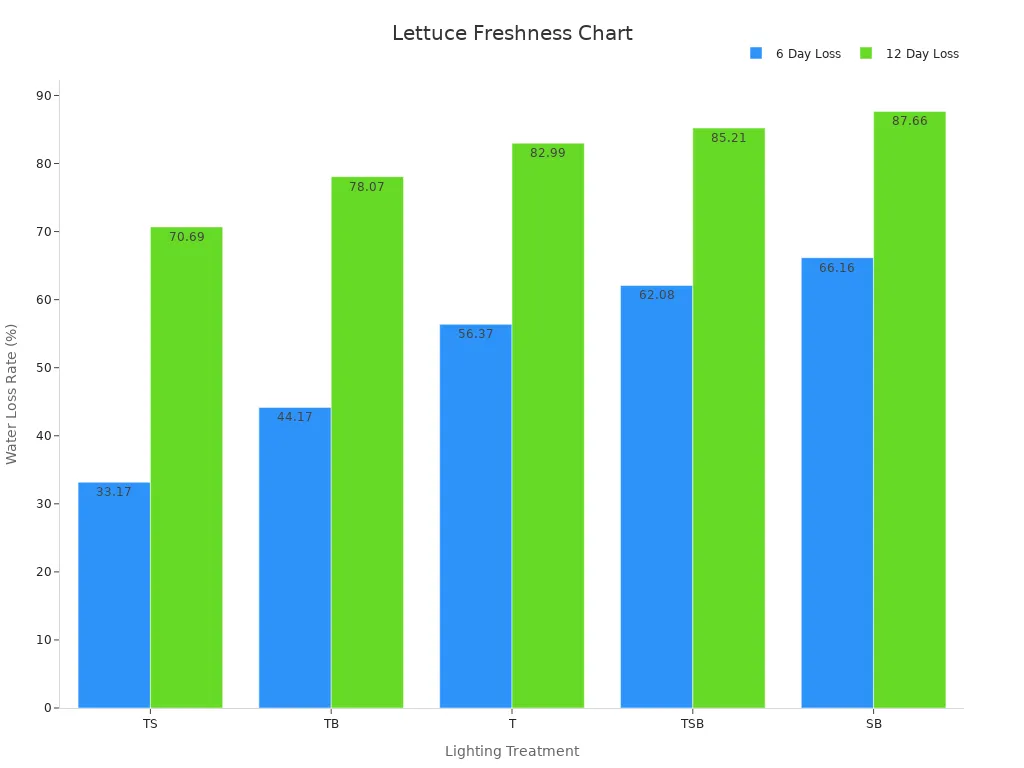
Note: Water loss above 70% means your lettuce will wilt quickly. Store your lettuce in a cool, humid place and use gentle lighting before harvest to keep it fresh.
Common Mistakes
Overcrowding
You might think packing more plants into your hydroponic system means bigger harvests. That sounds good, but it often leads to trouble. When you put too many lettuce plants close together, they fight for light and air. Your hydroponic lettuce can get weak and start to wilt. Crowded plants also trap moisture, which helps mold and disease spread fast. If you want strong, healthy hydroponic lettuce, give each plant enough space. Check your rack layout and plant spacing before you start.
Tip: Use a simple rule—if the leaves touch before harvest, you need more space in your hydroponic setup.
Inconsistent Checks
Hydroponic farming needs regular attention. If you skip daily checks, small problems can turn big fast. Maybe your pump stops working or the water level drops. Your hydroponic lettuce will show stress right away. You should look at your hydroponic system every day. Check the water, lights, and air flow. Write down what you see. This habit helps you catch issues early and keep your hydroponic lettuce happy.
- Make a checklist for your daily hydroponic routine.
- Set reminders on your phone so you never forget.
Ignoring Data
You have lots of data in your hydroponic farm. Sensors track pH, temperature, and nutrient levels. If you ignore this data, you miss out on easy wins. Your hydroponic lettuce depends on the right balance. Watch your numbers and adjust your system when needed. Use the data to spot trends and fix problems before they hurt your crop.
| Data to Watch | Why It Matters |
|---|---|
| pH | Keeps nutrients available |
| EC | Shows nutrient strength |
| Temperature | Prevents plant stress |
| Humidity | Stops mold and disease |
Remember: Your hydroponic data is your best tool for growing better lettuce.
You can get great results in lettuce vertical farming by making smart choices each day. Pay attention to the environment and manage your hydroponic system well. Stop pests early so your plants stay healthy. Use real-time data and new tools to help you grow more lettuce. Machine learning models can help you make better decisions and work faster. These models make your farm more accurate and efficient.
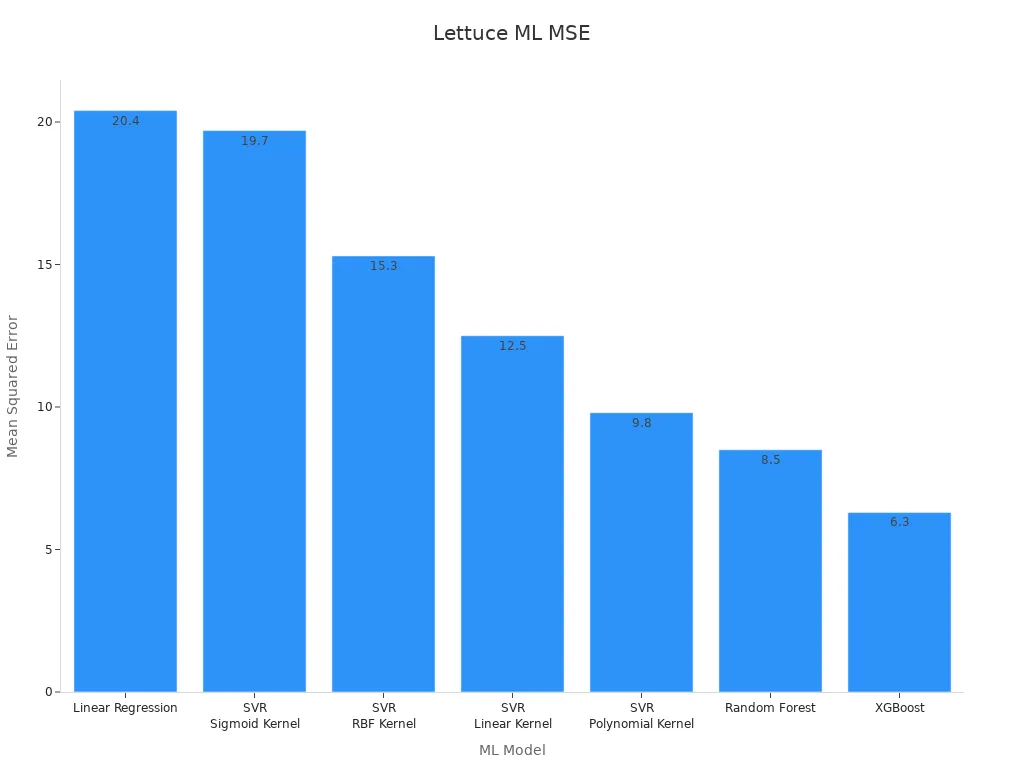
Follow these tips and your lettuce vertical farm will do better. You will see healthier plants and bigger harvests.
FAQ
How often should you check your hydroponic system?
You should check your system every day. Look at water levels, pH, and nutrient strength. Daily checks help you catch problems early and keep your lettuce healthy.
What is the best temperature for growing lettuce indoors?
Keep your growing area between 72°F and 77°F during the day. At night, let it drop to 59°F to 64°F. Lettuce grows best in cool air.
Can you reuse water in hydroponic lettuce farming?
Yes, you can reuse water. Just make sure you filter it and check for nutrient balance. Clean water helps your plants grow strong and stay disease-free.
How do you prevent pests in a vertical lettuce farm?
Keep your farm clean. Remove dead leaves and check for bugs often. Use screens on vents and doors. Healthy plants resist pests better.