

Selecting the right indoor led plant grow light starts with understanding your farm’s needs. You must match the light’s spectrum and intensity to your crops and their growth stages. Many operators make mistakes by rushing into purchases or choosing low-quality lights. Some place lights too close or too far, causing plant stress or weak growth. You should always research thoroughly and focus on technical details, not just price or flashy claims. A careful approach ensures healthy plants and better yields.
Key Takeaways
- Measure your growing area first. Match the number and power of LED lights to cover all plants. Make sure every plant gets light evenly.
- Pick full-spectrum LED grow lights. These lights give the right mix of blue, red, and green light. Each plant type and growth stage needs different light.
- Change the light intensity and spectrum as plants grow. This helps plants stay healthy and grow better. Use dimmable and tunable lights if you can.
- Choose energy-efficient LED lights. These lights save money on electricity. They also make less heat, so your farm stays cooler.
- Do not make common mistakes. Do not use low-quality lights. Do not put lights too far from plants. Clean your lights often. This helps plants grow strong and keeps your equipment working longer.
Farm Assessment

Area and Layout
You need to know the total growing area before choosing your LED grow lights. This step helps you figure out how many lights you need and how much power they should use.
- Measure the length and width of your shelves or planting beds.
- Multiply these numbers to get the total square footage.
- Use this area to calculate the total wattage needed for your plants.
The layout of your farm also affects how you place your lights. If you arrange your plants in rows or on shelves, you must make sure each plant gets the same amount of light. Uneven lighting can cause some plants to grow faster than others. You can solve this by overlapping light from several fixtures and adjusting the distance and angle of each light. Some growers use a ring arrangement, placing more LEDs at the edges and fewer in the center. This setup spreads light more evenly and helps all plants grow at the same rate.
Plant Types
Different plants need different kinds of light. You should match your LED spectrum and intensity to the crops you grow. For example, leafy greens like lettuce need more blue light, while fruiting plants like tomatoes need more red light. Here are some common plant needs:
| Plant Species | Light Intensity (Foot-Candles) | Light Intensity (µmol) |
|---|---|---|
| Philodendron (Pink Princess) | 200 – 400 FC | 40 – 80 µmol |
| Pothos (Epipremnum, Scindapsus) | 100 – 200 FC | 20 – 40 µmol |
| Sansevieria | 100 – 200 FC | 20 – 40 µmol |
| ZZ Plant | 100 – 200 FC | 20 – 40 µmol |
Fruiting plants need higher light intensity and more red light. Leafy greens do better with more blue light and can handle lower intensity. Always check the needs of your specific crops before setting up your lights.
Growth Stages
Plants need different light spectra and intensity at each growth stage. Seedlings need mostly blue light to grow strong roots and compact leaves. During the vegetative stage, a mix of blue and red light helps plants build stems and leaves. When plants start to flower or fruit, they need more red and far-red light to boost bud and fruit production.
| Growth Stage | Spectrum Composition | Light Intensity (PPFD µmol/m²/s) | Photoperiod (hours/day) | Key Effects and Tips |
|---|---|---|---|---|
| Seedling (0-14 days) | Primarily Blue (400-500 nm) | 100-300 | 16-18 | Promotes compact growth, root establishment, avoid red light to prevent stretching |
| Vegetative (2-6 weeks) | 70% Blue, 30% Red (400-500 & 600-700 nm) | 300-600 | 16-20 | Supports leafy growth and structure building |
| Pre-Flowering (6+ weeks) | Balanced 50% Blue, 50% Red | 600-900 | 12-14 | Hormonal shift to flowering, balanced spectrum needed |
| Flowering/Fruiting | 70% Red, 20% Far-Red, 10% Blue | 800-1200 | 10-12 | Maximizes bud and flower production, supports fruiting |
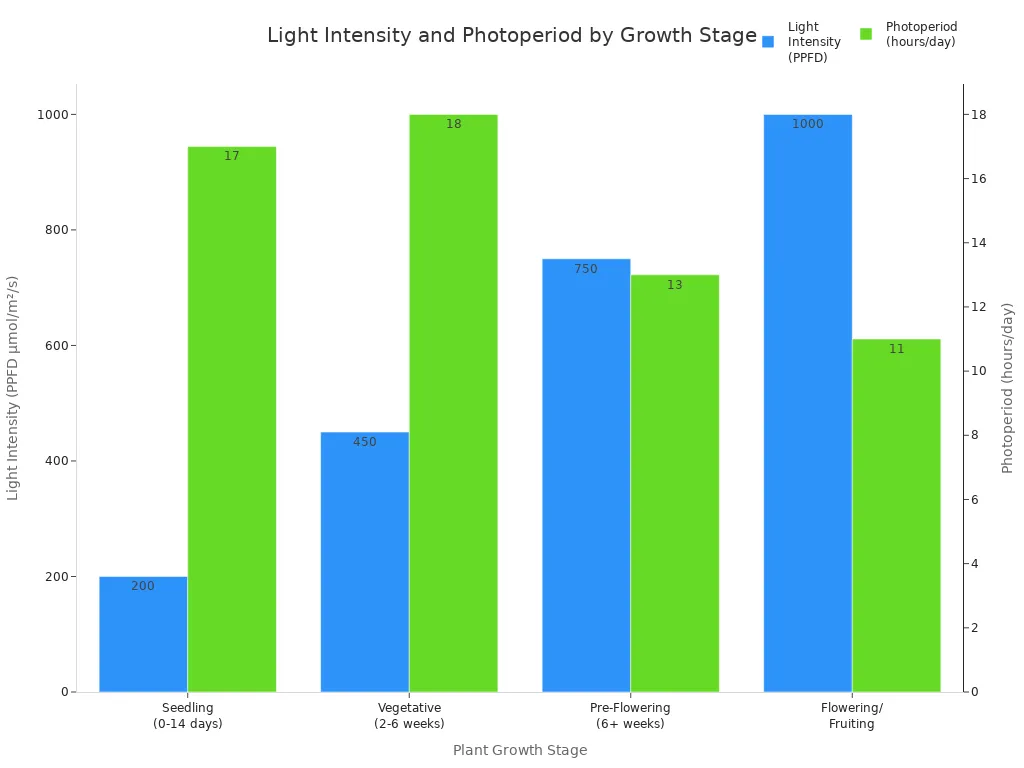
Tip: Adjusting your light spectrum and intensity as your plants grow can improve both yield and quality. Use timers and dimmers to match the right light to each stage.
Indoor LED Plant Grow Light Features

Light Spectrum
You need to choose an indoor led plant grow light that offers a full spectrum of light. Plants use light in the 400-700nm range, called PAR (Photosynthetically Active Radiation). This range covers blue, green, and red light. Each color helps plants in different ways:
- Blue light (400-500nm) helps plants grow strong stems and roots. It makes leaves dense and healthy.
- Red light (600-700nm) supports photosynthesis and helps plants flower and produce fruit.
- Green light (500-600nm) goes deeper into the plant canopy. It helps lower leaves get enough light for photosynthesis.
- White light combines all colors and mimics sunlight. It improves plant shape and quality.
A full-spectrum indoor led plant grow light gives your plants the right mix of colors for every growth stage. You can adjust the spectrum to match what your plants need, from seedlings to harvest. This helps you grow healthier plants and get better yields.
Tip: Full-spectrum LEDs use less energy and produce less heat than older lights. You can fine-tune the spectrum for each crop and growth phase.
PAR and Intensity
PAR measures the light that plants use for photosynthesis. The intensity of this light is called PPFD (Photosynthetic Photon Flux Density), measured in µmol/m²/s. You need to give your plants the right amount of PAR for each growth stage. Too little light slows growth. Too much light can stress plants.
| Growth Stage | Recommended PAR Range (PPFD µmol/m²/s) | Growth Rate Potential / Notes |
|---|---|---|
| Seedlings, Clones, Mother Plants | 200 – 400 | Good for young or weak plants |
| Vegetative Stage | 400 – 600 | Best for leafy growth |
| Flowering, Fruiting, Budding | 600 – 900 | Needed for flowers and fruit |
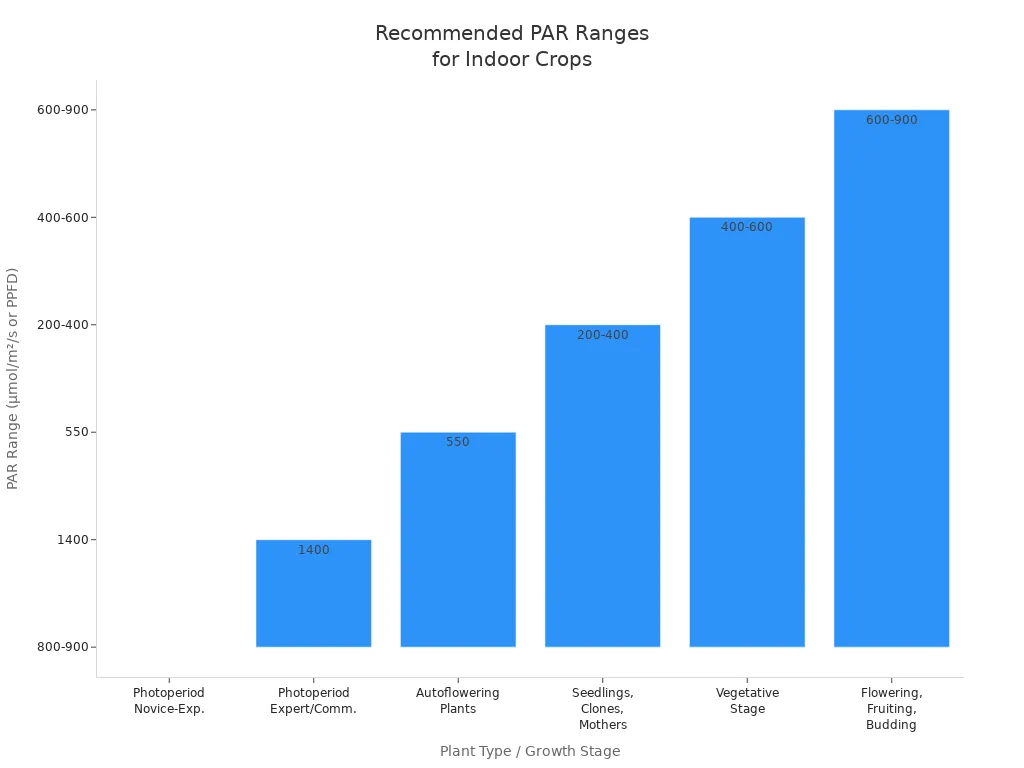
You can use a PAR meter to check light intensity at the canopy level. Dimmable LEDs let you adjust the intensity as your plants grow. This helps you avoid light stress and save energy.
Note: Plants grow best when you match light intensity to their needs. For example, lettuce grows well at lower PAR, but tomatoes need higher PAR for good fruit.
Coverage
You must make sure your indoor led plant grow light covers your whole growing area. If some plants get less light, they will not grow as well. The size and shape of your light fixture matter. Most commercial farms use fixtures that cover at least a 4 × 4 ft (about 1.5 × 1.5 m) area at the right hanging height.
- Use multiple lights or wide panels to cover large spaces.
- Overlap light cones to avoid dark spots.
- Hang lights higher to spread light more evenly.
- Use reflective walls to bounce light into shaded areas.
Tip: Uniform coverage helps all your plants grow at the same rate. Adjust the height and angle of your lights to reach every plant.
Energy Efficiency
Energy efficiency means getting more light for less electricity. High-efficiency LEDs use up to 60% less energy than old HPS or fluorescent lights. This saves you money and reduces heat in your farm.
| Light Type | True Wattage (W) | Monthly Cost @ 18h/day | Yearly Cost (Approx.) |
|---|---|---|---|
| LED 450 W | 450 | $41.36 | $496 |
| LED 800 W | 800 | $73.44 | $656 |
| HID (HPS) 640 W | 640 | $58.51 | $586 |
| HID (HPS) 1080 W | 1080 | $98.76 | $986 |
| Fluorescent 250 W | 250 | $22.95 | $229 |
Plant-specific LEDs have higher photon efficacy (µmol/J) than general-purpose LEDs. This means they turn more electricity into useful light for plants.
| LED Type | Wavelength / Color Temperature | Photon Efficacy (µmol/J) |
|---|---|---|
| Plant-specific LED | 660 nm | 3.84 |
| Plant-specific LED | 730 nm | 3.39 |
| Plant-specific LED | 450 nm | 2.38 |
| General-purpose LED | 5700 K | 2.31 |
| General-purpose LED | 5000 K | 2.08 |
| General-purpose LED | 4000 K | 2.03 |
Note: Choosing efficient LEDs lowers your power bill and helps the environment.
Heat Output
Modern LED grow lights produce much less heat than traditional lights. You can place them closer to your plants, usually 6–12 inches away. This reduces heat stress and lets you stack plants in vertical farms. Less heat means you spend less on cooling and climate control.
High Pressure Sodium Lampabout 55% of energy into light and only 45% into heat. Old lights like HPS turn most energy into heat, which can harm plants and raise costs. With LEDs, you keep your farm cooler and save money on air conditioning.
Tip: Lower heat output lets you grow more plants in a smaller space.
Adjustability
Adjustable LED grow lights help you control both light intensity and spectrum. You can dim the lights or change the color mix to match each growth stage. For example, use more blue light for seedlings and more red light for flowering.
- Dimming prevents light stress and saves energy.
- Spectrum tuning lets you copy natural sunlight or use special recipes for each crop.
- Smart controls and automation make it easy to adjust settings as your plants grow.
You can watch how your plants respond and change the light if you see problems. This flexibility helps you get the best growth and highest yields.
Note: Adjustable lights let you grow many types of crops and adapt to changes in your farm.
Practical Considerations
Installation
Setting up LED grow lights can seem simple, but you may face some common challenges. Many indoor farm operators report issues such as:
- Extra heat that needs more cooling
- High energy use, even with efficient lights
- Needing ladders to move lights by hand
- Poor airflow, which can cause uneven light for your plants
- Not using vertical space well
You might also find that the start-up costs are high and that adjusting the light spectrum for different crops can be tricky. Good planning helps you avoid these problems. Try to design your setup so you can reach all lights easily and keep airflow steady. Using adjustable mounts and smart controls can make installation smoother.
Maintenance
To keep your LED grow lights working well for years, you need to follow some simple maintenance steps:
- Always unplug and let the lights cool before cleaning.
- Dust the lights gently with a soft cloth or compressed air.
- Wipe surfaces with a damp cloth and mild soap or 99% isopropyl alcohol.
- Check for moisture or condensation often.
- Store lights in a cool, dry place when not in use.
- Inspect cables and connectors for wear and replace if needed.
- Wear gloves and goggles during cleaning.
Regular cleaning can prevent dust buildup, which may reduce light output by up to 20%. This also helps avoid overheating and extends the life of your lights.
Durability
You want your investment to last. LED grow lights with solid construction and quality parts can handle the demands of indoor farming. A good warranty from the manufacturer shows they trust their product’s durability and will support you if something goes wrong. While a longer warranty and better build usually mean better durability, always check the product details before buying.
Cost
LED grow lights cost more at first than older lights, but they last much longer—often over 50,000 hours. You save money over time because you replace them less often and use less electricity. Here’s a quick comparison:
| Aspect | LED Grow Lights | HPS Grow Lights |
|---|---|---|
| Upfront Cost | Higher | Lower |
| Lifespan | 50,000+ hours | 10,000–20,000 hours |
| Energy Efficiency | High | Low |
| Maintenance Costs | Low | High |
| Heat Production | Low | High |
Over the years, LEDs help you save on energy and maintenance, making them a smart choice for most indoor farms.
Types and Comparison
Light Types
There are a few main types of LED grow lights. Each type works best for certain farms and plants.
| Type of LED Grow Light | Features | Suitable For |
|---|---|---|
| Panel LED Grow Lights | Wide coverage, full-spectrum light, versatile mounting options | Beginners and experienced growers, general indoor farming |
| COB (Chip on Board) LED Grow Lights | Intense, focused light, deep canopy penetration, energy-efficient | Larger plants, dense foliage, even growth |
| Bar LED Grow Lights | Slim, long shape, precise placement, good for narrow spaces | Vertical farming, supplemental lighting |
Panel LEDs spread light over a big area. They are good for most crops and plant stages. COB LEDs shine strong light deep into thick leaves. They help big plants grow evenly. Bar LEDs are long and thin. They fit in small spaces and add light where you need it.
Tip: Think about your space and plants before picking a light. Make sure the light covers all your plants.
FY RBD Series LED Grow Light
The FY RBD Series is a great pick for new indoor farms. It gives high efficacy up to 3.0 μmol/J. This means you get more light but use less power. Its modular design makes it easy to set up and grow your system. The IP66 waterproof rating keeps the lights safe from water. You can dim the lights from 0-10V and use plug-and-play connectors for easy fixes. The FY RBD Series is better at staying dry, saves more energy, and is simple to care for. You can use it for leafy greens, microgreens, and herbs. It works for both small and big vertical farms. This makes it a flexible and strong choice.
Reading Specs
When you look at LED grow lights, check the specs. Find lights with full-spectrum output and high efficacy in μmol/J. Look for strong PAR or PPF numbers. Do not just look at wattage. Higher efficacy means more useful light for each watt. Check the coverage area, cooling, and warranty too. These things help you choose the best light for your plants and your money.
Selection Checklist
Key Steps
You can follow a clear checklist to choose the best indoor led plant grow light for your farm. These steps help you match your light to your plants and space:
- Assess Plant Needs
Find out if your crops need low, medium, or high light. Different plants have different light requirements. - Measure Your Grow Area
Use a tape measure to get the exact length and width of your growing space. This helps you know how many lights you need and how much area each light should cover. - Check Electrical Setup
Make sure your power supply can handle the lights you plan to use. For larger farms, check for safe wiring and enough outlets. - Set a Realistic Budget
Balance the upfront cost with quality, energy efficiency, and warranty. Good lights save money over time. - Choose Quality LEDs
Pick name-brand lights with proven reliability. Look for full-spectrum LEDs that cover blue (450-470nm) and red (630-660nm) wavelengths. - Understand Light Metrics
Learn about PAR and PPFD. These numbers show how much useful light your plants get. Adjust intensity with dimmable lights for each growth stage. - Install and Position Lights Properly
Hang lights 12 to 18 inches above the canopy. Use timers for correct light cycles. Keep good airflow and control temperature and humidity.
Tip: Regularly clean your lights and check for dust or damage. This keeps your system working well and your plants healthy.
Mistakes to Avoid
Many growers make simple mistakes when picking and using an indoor led plant grow light. You can avoid these problems by staying alert:
- Picking cheap, low-quality lights that lack the right spectrum or power. Trusted brands give better results and last longer.
- Ignoring voltage stability or daisy chaining features. Unstable voltage can cause flickering and harm your plants.
- Mounting lights too high above the plants. This reduces light intensity and lowers yields. Keep LEDs 6-12 inches from the canopy.
- Using lights with only red and blue LEDs. Plants need full-spectrum light, including green and yellow, for best growth.
- Making fast changes to light intensity or height. Always adjust slowly so plants can adapt.
- Forgetting regular cleaning and maintenance. Dust and dirt block light and reduce effectiveness.
- Using regular LEDs instead of grow lights. Only indoor led plant grow light models provide the right spectrum and power for healthy crops.
Note: Protect your lights from water spills and always follow the manufacturer’s instructions for setup and care.
You can select the best indoor led plant grow light by matching light spectrum, intensity, and coverage to your crops and farm layout. Use the checklist to guide your choices and adjust as your farm grows. Smart lighting systems help you monitor plant health and fine-tune light settings for each stage. Review your setup often, since new LED technology and changing farm needs can improve your results and save energy.
FAQ
What is the best spectrum for most indoor plants?
You should use a full-spectrum LED grow light. This type covers blue, red, and white light. It supports all plant growth stages. Full-spectrum lights help your plants grow strong roots, healthy leaves, and more flowers or fruit.
How close should I hang LED grow lights above my plants?
You should keep LED grow lights 6 to 18 inches above the plant canopy. This distance gives your plants enough light without burning them. Always check your plant’s response and adjust the height if you see signs of stress.
How long should I run my LED grow lights each day?
Most plants need 12 to 18 hours of light daily. Seedlings and leafy greens do well with longer hours. Fruiting plants may need less. Use a timer for consistent light cycles.
Tip: Too much light can stress your plants. Watch for leaf curling or yellowing.
Can I use regular LED bulbs for growing plants?
Regular LED bulbs do not give the right spectrum or intensity for plant growth. You should use LED grow lights made for plants. These lights provide the correct wavelengths and power for healthy crops.
How do I know if my plants get enough light?
Look for healthy, green leaves and steady growth. If your plants look tall and thin or have pale leaves, they may need more light. You can use a PAR meter to measure light at the canopy level.