

Hydroponic vertical farming systems are revolutionizing how cities grow food. By 2025, about 65% of urban farms utilize hydroponic vertical farming systems or other indoor methods, highlighting rapid growth in this sector. These systems allow year-round food production indoors, with stacked layers producing up to 390 times more food per square foot compared to traditional farming. Growers rely on hydroponic vertical farming systems and advanced indoor technologies to improve efficiency. Additionally, these systems help conserve resources and address land and water challenges in urban areas. These innovations make city farming more resilient and cost-effective while setting new standards for indoor urban agriculture.
Key Takeaways
- Hydroponic vertical farming grows food inside buildings. It uses water and stacked layers. This saves space and water. It also helps make more food all year.
- Advanced technologies like AI, sensors, and automation help farmers. These tools help crops grow healthier. They also cut down on waste. Urban farming becomes more efficient and green.
- Growing food inside cities makes the supply chain shorter. This cuts down on pollution. It also lowers costs. People get fresh and safe food near their homes.
- Urban farms make city food supplies stronger. They use less water. They avoid problems from bad weather. They help local communities with fresh produce.
- Indoor farming has some problems. It uses a lot of energy and costs more. But new ideas and city support help. This makes it more sustainable and affordable.
Hydroponic Vertical Farming Systems

What Is Hydroponic?
Hydroponic vertical farming systems grow crops indoors using water, not soil. Growers give nutrients straight to the roots with hydroponic methods. This lets them control how plants grow very closely. Crops can grow in layers stacked on top of each other. This works well even when space is small. Hydroponic techniques help save water and stop soil diseases. In city farms, hydroponics keeps crop quality steady all year. Many growers use hydroponic container farming to get more food in cities.
Core Technologies
Hydroponic vertical farming systems use new technology to help indoor city farms. Some important tools are:
- Artificial intelligence and machine learning help plan nutrients and check plant health.
- Robotics and automation do jobs like planting, picking, and fixing systems.
- IoT sensors watch pH, electrical conductivity, and other conditions all the time.
- Blockchain technology tracks products and makes the supply chain clear.
- Environmental footprinting software checks carbon emissions and resource use.
- Satellite-based crop health monitoring helps with watering and giving nutrients.
- API integration lets farms get weather and satellite data automatically.
These tools help growers work better, keep crops good, and make indoor farming greener.
Vertical Stacking
Vertical farming stacks layers to grow more food in one indoor space. Growers put crops on racks that go up, not out. This means they can grow more without needing more land. Vertical stacking is important for city farms because it saves space. It also lets people get fresh food close to where they live. This way, farms do not need to move food far, and they use resources wisely. When growers use hydroponics and vertical farming together, they can feed cities and help indoor farming grow.
Supply Chain Impact

Local Food Production
Growers now use vertical farming to grow food in cities. This brings crops much closer to the people who eat them. Urban agriculture uses places like rooftops, basements, and old warehouses. These spaces let farmers grow food all year long. Fresh produce is always available, no matter the season. Local food means less travel for crops. This lowers both costs and pollution from trucks. Growing food nearby helps people in areas with little fresh produce. It also makes local food systems stronger. Cities do not have to depend only on farms far away. This makes food supplies safer and more reliable.
- Hydroponic vertical farming systems help grow crops all year in city spaces like rooftops, basements, and reused buildings.
- New tools like LED towers, hydroponics, and IoT sensors save 90% of water and do not need soil, making city farms very efficient.
- This way of farming makes the trip from farm to table shorter, which cuts down on pollution and problems from bad weather.
- Urban farms give people fresh, safe, and easy-to-track food, which is what many want.
- Urban farming helps people eat better, brings neighbors together, and makes communities stronger.
- City leaders help these farms by giving rewards, land, and adding them to city plans.
- Hydroponic vertical farming makes city food supplies safer by not needing faraway farms and by building strong, green food systems as cities grow and the climate changes.
Shorter Distribution
Vertical farming lets people grow food where they live. Growers do not need to send food far away anymore. This means food gets to people faster and stays fresher. Urban farming, like hydroponic vertical farming systems, uses fewer trucks and less cold storage. This saves energy and cuts down on pollution. Farms inside cities make things work better and cost less. Local food is easier for everyone to get. This helps keep people healthy and supports the planet. Urban farms can also react quickly if there are problems with food supply.
Note: Urban farming grows food right in the city. This means food does not have to travel far. It makes the food supply chain shorter. This saves money, helps the planet, and gives people in food deserts more fresh food.
Resilience and Security
Hydroponic vertical farming systems make city food supplies stronger. Growers can use many places in cities, like rooftops, basements, and malls. These farms use much less water and do not need soil. This helps when there is not enough water or the soil is bad. Smart tools like IoT sensors help farmers give plants just what they need. This means no waste and better results. Indoor farms protect crops from bad weather, bugs, and diseases. Local food helps cities keep fresh food even during big problems. Governments now support these farms to make food supplies even safer.
- Hydroponic vertical farms grow food in cities, making the food supply chain shorter and less dependent on faraway farms.
- These farms use much less water and no soil, so they are good for the planet and not hurt by bad soil.
- Smart tools like IoT sensors help farmers feed plants exactly what they need, with no waste.
- Urban vertical farms can be built in many city places, making them flexible and safe from outside weather problems.
- Urban farming cuts pollution and helps cities stay strong and green.
- These farms give people fresh, safe, and easy-to-track food, which helps everyone feel safe during hard times.
- Governments help these farms by making rules and plans that support city farming and keep food supplies safe from climate problems.
Resource Efficiency
Vertical farming uses resources very well. By stacking plants, growers can get much more food from the same space. This method uses a lot less water than regular farming. For example, hydroponic tomatoes need only 70 liters of water per kilogram. Regular farming needs 214 liters for the same amount. Aeroponics can use just 20 liters. These savings help cities with little water or land. Indoor farms can grow food in places like deserts or on rooftops. Saving water and land helps nature and keeps the planet healthy. This way, we do not need to cut down forests for new farms. Vertical farming helps people grow food in a way that is good for the earth.
Benefits
For Cities
Vertical farming changes cities by using space better. It helps cities grow food in small places. This way, cities can have fresh food all year. Weather does not stop the crops from growing. Big indoor farms, like the Paris Expo Porte de Versailles, show this works. These farms can give over 2,000 pounds of food each day. Cities do not need to rely on faraway farms as much. Local food systems get stronger. City leaders help by giving rewards and land to these farms. This makes city farming part of city plans. Vertical farming saves water and land. It helps protect nature and the environment.
For Businesses
Businesses get good chances with vertical farming. In 2022, people invested $2.4 billion in indoor vertical farming. This shows many believe in this way of farming. Growers can plan better and meet the need for local food. Many companies make new brands with clean, high-quality crops. Some European companies grow more than just leafy greens. This helps them reach more people and be stronger. Growing food near buyers cuts down on travel costs. It also helps the planet by lowering pollution. Using data helps growers save money and grow more food. Vertical farming is a good and lasting way to do business.
For Consumers
Consumers get safer and healthier food from vertical farming. Indoor farms give crops without harmful chemicals. The food is often fresher and better for you. Urban farms like Cincinnati’s O2 Urban Farms and Miami’s Urban Farming Institute help local people. These farms teach about farming and hold events. People learn how to grow food in a good way. Community gardens and city farms help people know each other. They also make sure healthy food is in every neighborhood. Vertical farming makes food systems safe and strong for all.
Challenges
Energy Use
Hydroponic vertical farming systems need special lights and climate control. Growers use LED lights on each shelf because sunlight cannot reach lower trays. They also use heaters, coolers, and fans to keep the right temperature and humidity. These things use a lot of energy. This makes costs go up and can hurt the environment. Some growers try solar power and better machines to use less energy. Saving energy is important for making indoor farming better for the planet.
- LED lights and climate control are needed for growing food indoors.
- Using lots of energy makes it cost more and is not always good for the earth.
- New companies try solar power and better tools to save energy.
Costs
It costs a lot to start and run hydroponic vertical farms in cities. The table below shows what growers usually pay:
| Cost Category | Description | Typical Cost Range |
|---|---|---|
| Initial Setup Costs | Equipment like lights, pumps, and trays | $500 (small) to $100,000+ (big farm) |
| Systems to watch and control the environment | Up to $10,000 (big farms) | |
| Growing materials like coconut coir or rock wool | Up to $200 (large batch) | |
| Ongoing Operational Costs | Nutrients for plants | Up to $1,000 per year |
| Energy for lights, pumps, and climate control | Up to $5,000 a year (medium farm) | |
| Paying workers to watch and fix things | Changes, includes pay and benefits | |
| Fixing and keeping things working | Thousands of dollars each year |
Growers must think about both starting and running costs. High energy bills and paying workers can make it hard to make money.
Scaling Up
Making indoor farms bigger brings new problems. Growers must go from small tests to big farms with many plants. Machines help with planting, watering, and picking, but cannot do everything, especially with soft crops. It is harder to stop diseases as farms get bigger. Using lots of power for lights and climate can be tough for city systems. Water cleaning and recycling must follow city rules. Keeping crops good and systems flexible is hard when farms grow. Growers need strong supply chains and good markets to sell food fast.
Policy Barriers
Rules and market issues slow down indoor farming. Using lots of energy makes food cost more, so it is hard to beat regular farms. Many people and stores like old ways better. Without better lights or machines, costs stay high and profits are low. Rules about water, waste, and buildings can slow new farms. Growers must work with city leaders to make rules that help safe and local food. Talking about local food, safety, and strong supply chains can help more people accept indoor farming.
Future Trends
Indoor Urban Agriculture
Growers think indoor urban agriculture is the future for city food. Indoor farms use hydroponic vertical farming systems to grow crops inside. These farms can be in warehouses, on rooftops, or even underground. Technology helps growers watch crops and change how they grow. This lets them make fresh, local food all year long. Indoor urban agriculture helps keep food safe by bringing farms closer to people. Many cities spend money on urban agriculture to make food supplies stronger. Indoor farms also give people new jobs and business chances. As more people live in cities, indoor farming will help feed everyone.
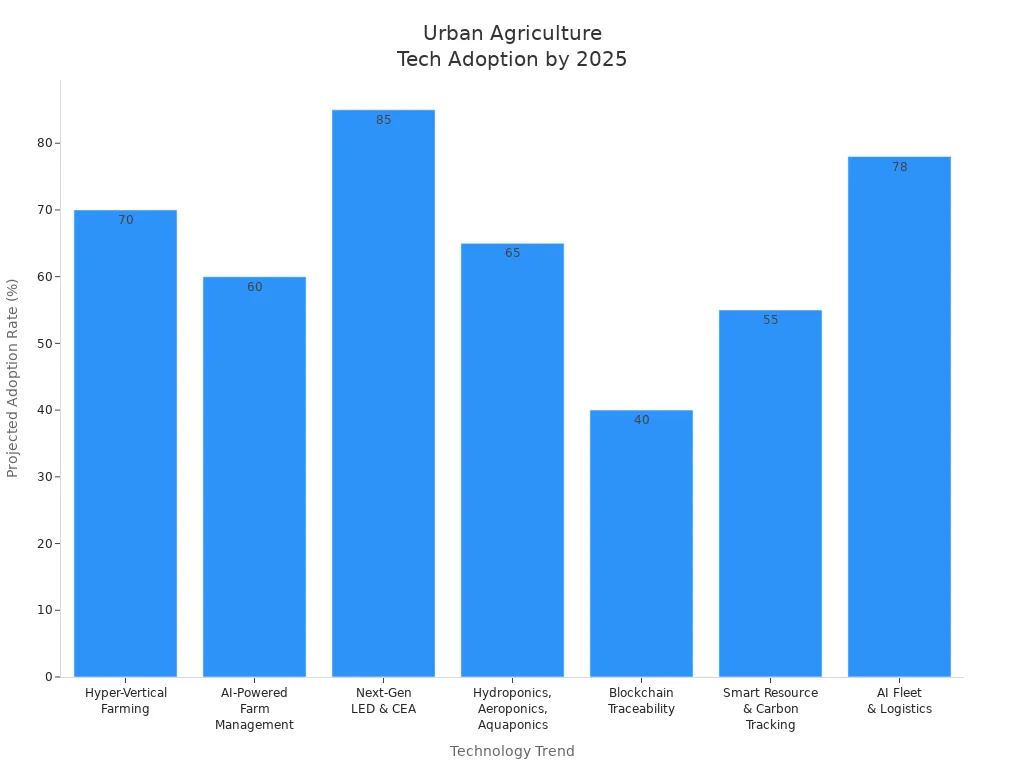
| Technology Trend | Projected Urban Adoption Rate by 2025 | Expected Yield Increase (%) | Average Cost Savings (%) | Environmental Benefits and Resource Efficiencies |
|---|---|---|---|---|
| Hyper-Vertical Farming | ~70% | 40-55% | 30-40% | Up to 95% water savings, reduced land use, lower urban heat islands |
| AI-Powered Farm Management | ~60% | 25-40% | 20-30% | Reduces waste and pesticide/fertilizer use by 30%, early pest detection |
| Next-Generation LED & CEA | ~85% | ~30% | 15-25% | Major energy savings, 70% reduction in emissions from lighting |
| Hydroponics, Aeroponics, Aquaponics | ~65% | 25-50% | 30-45% | Up to 95% less water use, eliminates nutrient runoff |
| Blockchain Traceability | ~40% | 10-20% | ~10% | Increases transparency, reduces fraud, boosts consumer trust |
| Smart Resource & Carbon Tracking | ~55% | 15-25% | 20-25% | Lowers emissions, supports green certifications, fosters sustainability |
| AI Fleet & Logistics | ~78% | 12-18% | 15-28% | Reduces food miles, cuts city traffic emissions, ensures fresher produce |
Sustainability
Sustainability is a big reason indoor urban agriculture is growing. Growers use vertical farming to save water, energy, and land. Indoor farms can use up to 95% less water than regular farms. Urban agriculture also lowers pollution by cutting down on long trips for food. Many growers use clean energy and smart tools to be more sustainable. Indoor urban agriculture helps cities meet their green goals. With hydroponics and special lights, growers waste less and protect nature. Urban indoor farming helps make food in a way that is good for the earth. These ways of farming help cities deal with climate change. Sustainable farming makes urban agriculture important for the future.
Tip: Growers who focus on being green can get special certifications and attract more customers who care about the planet.
Industry Growth
Indoor urban agriculture is growing fast. Growers use new technology like AI, robotics, and blockchain to work better and grow more. Artificial intelligence helps growers watch crops, plan harvests, and spot problems early. Precision tools let growers control every step of growing. Urban indoor farms now use smart sensors and machines to save time and money. Experts think vertical farming and urban agriculture will keep growing for many years. More cities support indoor farms to keep food safe and strong. As the industry gets bigger, growers will find more ways to try new things and make money.
- Artificial intelligence helps growers manage crops and use machines.
- Predictive tools help growers know when to harvest and waste less.
- Smart climate systems keep crops in the best conditions.
- AI image tools find pests and diseases early, so crops stay healthy.
- These new ideas make urban indoor farming better and greener.
Indoor urban agriculture will help decide how cities grow food in the future. Growers who use new technology and care for the planet will help build strong and green city food systems.
Growers think hydroponic vertical farming systems are changing how cities grow food. These systems help make food faster, safer, and more reliable. USDA programs and grants give money to help city farms and hydroponic container farming grow. This support helps people get jobs and makes it easier to find fresh food nearby. It also helps farms use better ways to protect the planet. When there are good rules and enough money, indoor city farms can save resources and help the environment. The future of city food depends on using smart farming and new indoor systems. These ideas help cities get fresh, local food all year.
FAQ
What makes hydroponic vertical farming systems efficient for urban agriculture?
Growers use hydroponic vertical farming systems to save resources. These systems stack crops in layers to use space well. Hydroponics gives nutrients straight to plant roots. This helps grow more food in small places. It also supports sustainable urban agriculture.
How do indoor farming systems improve food safety and supply chain resilience?
Indoor farming systems keep crops safe from bugs and bad weather. Growers control the environment to lower contamination risks. This keeps food safe and steady for people in cities. It also makes the supply chain stronger and more reliable.
Why do growers choose hydroponic container farming for sustainable food production?
Hydroponic container farming uses less water and land. These systems help the environment and support good farming practices. Growers can put containers in cities to help local food systems. This gives people more fresh food close to home.
What role does technology play in urban indoor farming?
Technology helps growers watch crops and manage farms indoors. IoT sensors, automation, and AI make farms work better. These tools help grow more food and waste less. They also help growers meet the needs of city farming.
How does vertical farming contribute to environmental sustainability?
Vertical farming uses less water and land than old ways. Growers cut down on pollution by moving food shorter distances. This helps the environment and supports city green goals.
Note: Growers who use green farming methods can work better and help make city food healthier.