

Hydroponic vertical farming can produce up to 20× more crops per acre than traditional soil farming — while saving up to 90% of water. Whether you grow lettuce, herbs, or microgreens, the right combination of LED lighting, nutrient control, and automation can turn any indoor space into a high-yield farm. In this guide, you’ll learn proven techniques to maximize yields, reduce waste, and keep your crops thriving all year.
| Crop/System | Yield or Growth Statistic | Comparison/Note |
|---|---|---|
| Hydroponic Lettuce | Up to 20 times higher per acre | Compared to soil cultivation |
| Vertical Farming Systems | Greater crop yield per unit space | Outperforms horizontal hydroponics |
Many indoor growers using hydroponic vertical farming systems face challenges such as excess fertilizer salts, root diseases, and maintaining the ideal climate. Urban farming and hydroponic vertical farming systems can be highly productive, but success depends on setting up everything correctly. By applying the best techniques, you can significantly increase your crop yields in vertical farms.
Key Takeaways
- Pick the right LED colors for your lights. Place the lights so they are spread out. Mix sunlight with fake light to help plants grow more. This can make your plants give you more food.
- Give plants the right amount of minerals and water. Check pH and salt levels to keep them balanced. Use clean water so your plants stay healthy.
- Keep your farm’s temperature steady. Watch the humidity and airflow. Make sure CO2 levels are good. This helps plants grow faster and stronger.
- Choose crops that grow fast and people want, like lettuce, herbs, and microgreens. Space your plants well to fit more in. This helps you get a bigger harvest.
- Use sensors and machines to watch your farm from far away. Use data to make smart choices. This keeps your system working well and cuts down on waste.
Lighting for Maximum Yields

Lighting is very important in vertical hydroponic systems. If you manage light well, your plants will grow better. You can also get more crops and better quality. Let’s look at some lighting tips every grower should know.
Light Intensity
Plants need enough light to grow strong and healthy. In vertical hydroponic systems, you can control how much light your crops get. When you give plants the right amount of light, they use more energy to grow. For example, lettuce and tomatoes grow more leaves and fruit with more light. If you spread light evenly, every plant gets enough energy. This helps you get bigger harvests and better crops.
Tip: Use a light meter to check how bright it is on each level. Move your lights if you see dark spots or uneven light.
LED Types
Picking the right LED lights is very important. Different LED colors, like red, blue, green, and white, help plants in different ways. Red and blue LEDs help plants make more protein and chlorophyll. Green light can help crops like wheat and mung bean have more antioxidants and vitamin C. White LEDs have all colors and often give the best yields for lettuce. Some crops, like strawberries, do well with both red and blue light. You should pick the LED type that matches your crop for the best results.
Light Placement
Where you put your lights matters a lot. If lights are too close, plants can burn. If lights are too far, plants may stretch and get weak. A study in Northern Thailand showed that light placement changes plant height and width. By changing shelf design and light angles, you can help every plant get enough light. This helps all layers grow well and stops weak plants.
- Put lights the same distance from each plant layer.
- Change shelves to stop shadows.
- Move crops between layers to help them grow evenly.
Spectrum Choices
The color of light you use changes how plants grow. Some crops need more red and blue light. Others do better with green or white mixed in. The table below shows how different light colors affect popular crops:
| Crop Type | Light Spectrum | Key Metrics Measured | Findings |
|---|---|---|---|
| Lettuce | S1 | Water Use Efficiency (WUE) | WUE reached 75 g FW L⁻¹ H₂O, highest among tested spectra. |
| Baby-leaf kale | S1 | Surface Use Efficiency (SUE), L-SUE | High SUE and L-SUE, with slight drop due to space. |
| Rocket | S1 | WUE, L-EUE | WUE up to 32 g FW L⁻¹ H₂O; L-EUE around 50 g FW kWh⁻¹. |
| Chicory | S1 | WUE | WUE reached 34 g FW L⁻¹ H₂O, showing improved water efficiency. |
| Pak choi | Various S | L-EUE | L-EUE ranged 50.5 to 52 g FW kWh⁻¹; one treatment reached 75 g FW kWh⁻¹. |
Red and blue light together (RB3) often works best for water and energy use. Using only red or only blue light can hurt plant growth. You should pick the right color mix for each crop.
Combining Light Sources

You can get better results by using both sunlight and artificial light. Sometimes, sunlight is not enough, especially indoors or on cloudy days. Adding LED lights helps fill in the missing light. Studies show that mixing sunlight and LED lights helps plants grow, flower, and yield more. For example, roses bloomed faster and had more flowers with both sunlight and red and blue LEDs. You can use timers and sensors to balance sunlight and LED light for the best results.
Note: Using both sunlight and LED lights saves energy. Use sunlight when you can and only add LED light when needed.
If you use these lighting tips, you can control your vertical hydroponic systems better. Good lighting, smart placement, and the right color mix help you get the most from your crops.
Nutrient and Water Management
Getting nutrients and water right is very important. In vertical hydroponic systems, you control what your plants get. This helps crops grow faster and healthier than in soil. Here are some easy ways to get more crops from your system.
Nutrient Dosing
Plants need a solution with the right minerals. You can change the nutrients for each crop and growth stage. When you give the right amount, plants use it well and nothing is wasted. Special tools like ion-selective electrodes or LIBS help you check nutrients quickly. You can find problems early and fix them fast. If you use too much or too little, plants may not grow well. Keeping nutrients in the right range helps plants use water and food better. This means you get more crops and healthier plants.
Tip: Use a dosing system that lets you change nutrients for each crop. This stops problems that can hurt your harvest.
pH and EC Control
You need to keep the pH and EC just right. pH shows if the water is acidic or basic. EC tells you how much salt is in the water. Both help plants take in nutrients. If pH is too high or low, plants cannot get some minerals. If EC is wrong, there may be too much or too little food. Checking EC is a good way to know if plants have enough water and food. When pH and EC are right, plants grow strong and fast. Many growers use sensors to watch these numbers and make changes quickly.
- Keep pH between 5.5 and 6.5 for most crops.
- Change EC for each crop and growth stage.
- Check pH and EC every day for best results.
Water Quality
Clean water is as important as nutrients. Good water helps plants take in food and stay healthy. If water has too much salt, chlorine, or metals, plants can get sick. New water monitors let you check pH, EC, oxygen, and temperature all the time. These tools help you find problems early and keep water safe. Clean water helps you grow more crops and stops diseases. Some people use special filters to clean water before adding nutrients.
Note: Always test your water before you start. This helps you stop problems that can hurt your crops.
Recirculation
Recirculating water is a big part of vertical hydroponic systems. You use water and nutrients again and again. This saves money and helps the planet. Smart sensors and machines give water only when plants need it. This stops waste and helps crops grow their best. Closed systems also reuse water from the air. This makes your system even better. Farms that use real-time data can get up to 26% more crops and more even growth. Recirculation lets you grow food all year, no matter the weather.
| Practice | Benefit |
|---|---|
| Closed-loop recirculation | Saves water and nutrients |
| Precision irrigation | Delivers water only where needed |
| Humidity recycling | Reduces water demand |
| Real-time monitoring | Improves yield and crop uniformity |
Conservation
Vertical hydroponic systems use much less water than farms in soil. You can save up to 90% of water by reusing it. Closed systems send water right to the roots, so almost none is lost. Methods like NFT, DWC, and Ebb and Flow help save water. Watching EC and pH stops waste and makes sure plants use everything. Smart dosing systems can save up to 30% of water and nutrients. Using coco coir helps hold water and food close to the roots. This makes your system work even better. Hydroponic farming saves water, keeps water clean, and helps cities and dry places grow food.
- Recirculating systems use water again and again.
- NFT and DWC stop water from evaporating or draining away.
- Coco coir keeps water and food near the roots.
- Hydroponic farming helps cities and dry places save water.
🌱 If you manage nutrients and water well, your system will do great. You will get more crops, healthier plants, and help the planet too.
Environmental Controls
Keeping the right environment in your hydroponic vertical farm helps your plants grow strong and healthy. You can control temperature, humidity, airflow, and CO2. These factors work together to boost your yield and support sustainable food production.
Temperature
You need to keep your farm at the best temperature for your crops. Research shows that 24 °C gives you the best balance between energy use and crop yield. When you set your system to this temperature, your plants grow faster and you save energy. Use sensors and smart thermostats to keep the temperature steady. This helps you run a controlled environment and avoid sudden changes that can stress your plants.
Tip: Use automated climate controls to keep your temperature stable and save on energy costs.
Humidity
Humidity is the amount of water vapor in the air. It affects how your plants take in water and nutrients. Studies show that crops lose more yield during dry heat than humid heat, especially if they do not get enough water before a heatwave. Irrigation helps protect your plants from dry air. You should watch humidity levels and use humidifiers or dehumidifiers to keep them in the right range. This keeps your controlled environment steady and helps your plants grow better.
- Keep humidity between 50% and 70% for most crops.
- Use sensors to track changes and adjust quickly.
Airflow
Good airflow keeps your plants healthy. It brings fresh air to the leaves and roots. Aeration of the nutrient solution gives roots the oxygen they need. You can use air pumps and air stones to add air to the water. Research shows that airflow around 0.3 m/s at the plant canopy helps prevent problems like tipburn and supports even growth. Fans and vents help move air and keep the temperature and humidity even. This leads to better plant health and higher yields, which supports sustainable food production.
Note: Clean your fans and air pumps often to keep airflow strong and steady.
CO2
Plants need CO2 to grow. In a controlled environment, you can add CO2 to help your crops grow faster and bigger. Crops like lettuce, tomatoes, and peppers show better growth and bigger harvests when you keep CO2 between 1,200 and 1,500 ppm. You can use CO2 tanks or generators to add gas to your farm. Make sure the CO2 spreads evenly so all plants get the same boost. This method shortens growth cycles and increases yield, making your farm more productive all year.
- Use sensors to monitor CO2 levels.
- Keep CO2 in the safe range for best results.
By managing these environmental controls, you create the best conditions for your plants. This helps you get more crops, use less energy, and support sustainable food production in your vertical farm.
Crop Selection & Density

Best Crops
You want to choose crops that give you high yield crop production and strong profits. Microgreens, lettuce, and herbs work very well in vertical hydroponic systems. These crops grow fast and do not need much space. Market research shows that hydroponics yields for microgreens and herbs are high because they grow quickly and can be harvested often. Many urban farming projects focus on these crops because they fit well in small spaces and meet local demand. Microgreens, in particular, offer high-yielding harvests and strong economic returns when you use good marketing and technology.
Spacing
Space optimization is key for increased crop yield in vertical hydroponic systems. You can fit more plants in less area by stacking layers. Studies show that vertical farming systems support up to 20 times more plants per square meter than horizontal systems. Even if each plant is a bit smaller, the total yield per area is much higher. Look at the table below to see how plant density changes your results:
| Parameter | Horizontal System | Vertical System | Notes |
|---|---|---|---|
| Plants per m² | 50 | 1000 | Vertical system fits 20x more plants |
| Yield per m² (kg fresh weight) | 6.9 | 95 | Vertical system gives 13.8x more yield |
You should adjust plant spacing to let light reach all layers. This helps every plant grow well and supports space optimization.
Crop Rotation
Crop rotation helps keep your vertical hydroponic systems healthy. You can switch crops between cycles to prevent disease and pest buildup. For example, after growing lettuce, you can plant basil or mint. This practice keeps your system clean and supports high yield crop production over time. Crop rotation also lets you test which crops do best in your setup.
Profitable Choices
You want crops that bring in good profits and fit your system. Market studies show that herbs, lettuce, and microgreens have high sales prices and low production costs. The table below shows how these crops compare:
| Crop Type | Production Cost (NOK) | Labor & Equipment (NOK) | Sales Price (NOK) |
|---|---|---|---|
| Herbs | 3 | 3.5 | 12 |
| Lettuce | 3 | 3.5 | 11 |
| Microgreens | 6 | 3.5 | 25 |
You can increase profits by choosing crops with fast growth and high demand. Automation also helps lower labor costs. When you select the right hydroponic system for each crop, you boost your economic success and make your vertical farming project more sustainable.
Pruning & Maintenance
Pruning Techniques
You need to prune your plants to help them grow better. Pruning means removing old, yellow, or crowded leaves. This lets light reach all parts of the plant. You also help air move around the leaves. Healthy plants use energy to grow new leaves and fruit. You can use clean scissors or your hands to prune. Always cut above a leaf node. This helps the plant grow new shoots.
Tip: Prune your plants once a week. Remove dead or damaged leaves first. For leafy greens, trim the outer leaves and let the center keep growing.
Routine Checks
You should check your system every day. Look at your plants, roots, and equipment. Healthy roots look white and firm. Leaves should look green and strong. Check for pests, spots, or wilting. Make sure pumps, lights, and fans work well. Use a checklist to help you remember what to look for.
Daily Check List:
- Inspect leaves and roots
- Test water pH and EC
- Check pumps and lights
- Look for pests or mold
Cleaning
Cleanliness keeps your system healthy. Algae, mold, and bacteria can grow fast in wet places. You need to clean trays, tanks, and tools often. Use food-safe cleaners or a mild bleach solution. Rinse everything well before putting plants back. Clean filters and air stones to keep water moving.
Note: Clean your system between crop cycles. This stops diseases from spreading to new plants.
Troubleshooting
Problems can happen in any system. You need to spot them early. If you see yellow leaves, check nutrients and pH. Wilting plants may need more water or better airflow. If roots turn brown, check for root rot or dirty water. Use a table to help you find and fix problems.
| Problem | Possible Cause | Solution |
|---|---|---|
| Yellow leaves | Low nutrients | Adjust nutrient mix |
| Wilting plants | Low water/airflow | Check pumps and fans |
| Brown roots | Root rot/dirty water | Clean system, add air |
| Mold on leaves | High humidity | Improve airflow, prune |
🛠️ Quick action keeps your plants healthy and your yields high.
Automation & Monitoring
Sensors

Sensors help you watch everything in your hydroponic farm. They measure pH, EC, temperature, humidity, light, CO2, and water level. These sensors send data to your phone or computer right away. You can use microcontrollers like Arduino or Raspberry Pi to connect sensors and control things. Sensors help you find problems early and fix them fast. This means your plants stay healthy and you get more crops.
- Sensors keep pH between 6 and 6.4. If pH drops below 6, the system adds pH up. If it goes above 6.4, it adds pH down.
- TDS sensors tell you if plants need more food or water.
- Automated hydroponic systems use these sensors to change things without you being there.
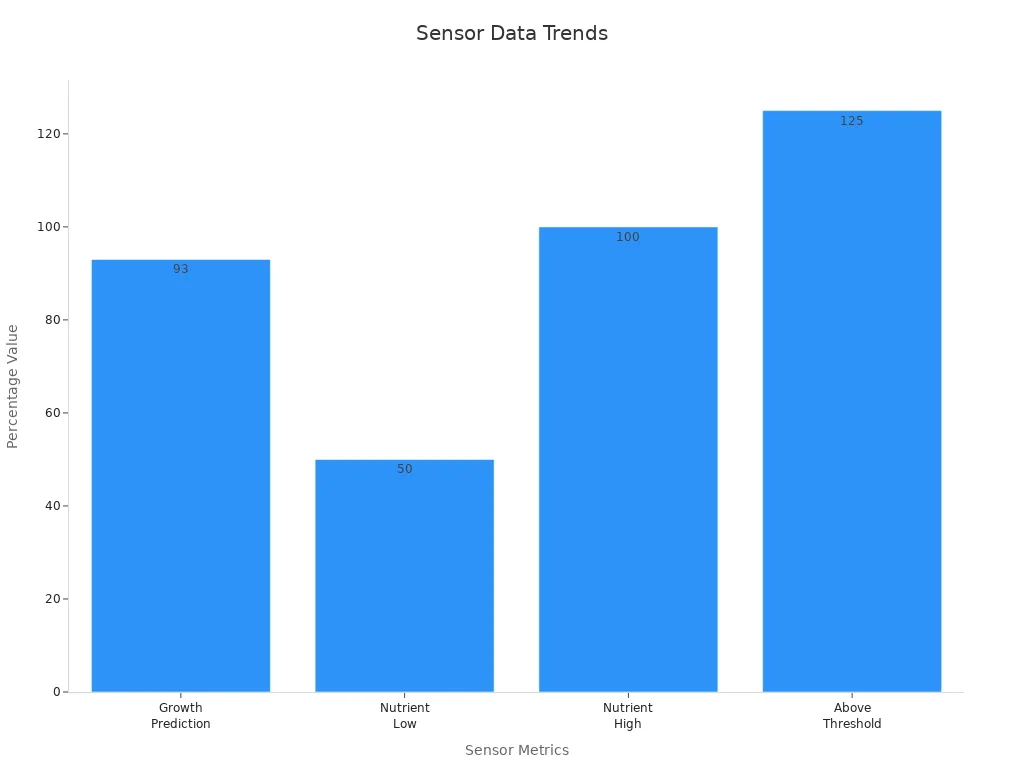
| Parameter / Finding | Quantitative Data / Result | Impact / Explanation |
|---|---|---|
| Crop growth prediction accuracy | 93% | Machine learning models using sensor data accurately predict hydroponic crop growth |
| Nutrient concentration range for optimal yield | 50% to 100% | Yields better qualitative and quantitative results; earlier harvest times |
| Hydroponic vs soil-grown onions yield | Hydroponic onions outperform soil-grown in both quality and quantity | Sensor-monitored hydroponic systems improve yield |
Remote Management

Picture C: FY Intelligent Growing System
You can control your hydroponic farm from anywhere. IoT and cloud platforms let you check your farm on your phone or computer. You can change temperature, humidity, and light settings without being there. AI-powered controls help keep your farm steady. Studies show remote management can boost yields by up to 45%. Robots can pick crops at the best time. This means less waste and better quality. Automated planting systems help you use space well and grow more plants.
- AI and machine learning help your system get smarter over time.
- Automated hydroponic systems with remote management lower mistakes and keep crops growing strong.
Data-Driven Decisions
Using data helps you make smart choices for your farm. You can use analytics to know when to add nutrients, water, or harvest. Machine learning models guess how crops will grow and help you stop problems before they start. You can use data to plan pest control and save money on supplies. Precision agriculture tools collect data from sensors, drones, and cameras. This information helps you use resources wisely and get the best yield.
- Data-driven decisions help you earn more and grow more food with less waste.
- Advanced hydroponic farming technology lets you run a smart, efficient farm.
Tip: Use data from your automated hydroponic systems to watch for patterns and get better results each season.
You can make your hydroponic vertical farm do better by using smart yield hacks. Many growers see their crops grow 10–20% more when they use tricks like bouncing light, stopping algae, and keeping the right temperature. Farms that use machines to give nutrients, special lights, and AI crop tools get bigger harvests and use less water.
- These tricks can help you get 5% more crops each month and make more money every year.
- You can use up to 90% less water, which is good for the planet.
- Farms that use deep-water culture and control the climate can grow food all year.
| Method | Yield (kg/m²/year) | Water Use (L/kg) | Harvests/Year |
|---|---|---|---|
| Traditional Farming | 3–6 | 200–300 | 1–2 |
| Hydroponic Vertical Farming | 60–100+ | 2–6 | 10–12+ |
Keep learning new things, try out new ideas, and check how your farm is doing often. If you keep trying to get better, you will grow more food and have a great vertical farm.
FAQ
What is the best crop to start with in hydroponic vertical farming?
You can start with lettuce or basil. These crops grow fast and do not need much care. They fit well in most vertical systems. You will see results quickly and learn how your system works.
How often should you check pH and EC levels?
You should check pH and EC every day. This helps you catch problems early. Stable levels keep your plants healthy and growing strong. Use a digital meter for quick and easy checks.
Can you use tap water in your hydroponic system?
You can use tap water, but test it first. Some tap water has chlorine or high salts. Use a filter if needed. Clean water helps your plants take in nutrients and grow better.
How do you prevent root rot in vertical hydroponics?
You can prevent root rot by keeping water clean and adding air to the roots. Use air stones or pumps. Clean your system often. Watch for brown roots and act fast if you see them.
Do you need special lights for every crop?
You do not need special lights for every crop, but some crops grow better with certain light colors. Leafy greens like more blue light. Fruiting crops need more red. Use adjustable LEDs to match your crop’s needs.