

Many people who try algae farming face similar mistakes. You might see water quality problems, light that is too weak or too strong, and nutrients that do not match what your algae need. Contamination can also happen, and harvesting often feels difficult. Do not worry. Every grower makes mistakes. You can fix these problems with simple steps and learn as you go. 🌱
Key Takeaways
- Test water often to check oxygen, pH, and nutrients. This helps algae stay healthy and grow well. Give your algae the right kind and amount of light. This helps them grow and keeps them safe from too much or too little light. Balance nutrients like nitrogen and phosphorus with care. This stops harmful blooms and helps algae grow strong. Watch and control the temperature for your algae. This helps them grow faster and stay healthy. Use clean tools and good ways to harvest algae. This helps you collect algae well and keeps it from getting dirty or lost.
Water Quality

Finding Problems
You should check water quality a lot in algae farming. Bad water can slow algae growth or kill your crop. Watch for cloudy water, weird smells, or slow algae growth. Use easy tests to check dissolved oxygen, pH, and nutrients. These results help you find problems early.
Here are some main signs and what they mean for algae:
| Indicator | Description & Impact on Algae Health |
|---|---|
| Dissolved Oxygen (DO) | If DO is low, algae and other life get less oxygen. |
| Turbidity & TSS | Cloudy water stops light, so algae cannot grow well. |
| Bioindicators | If algae amount changes, water might be stressed. |
| Nitrates | Too much nitrate makes too much algae, but lowers oxygen. |
| pH | If pH is too high or low, algae can get hurt. |
| Water Temperature | Warm water makes algae grow faster, but too hot or cold is bad. |
You can also watch how your water changes over time. For example:
- Phosphorus in rivers dropped a lot in 40 years, but algae still grew because other nutrients stayed high.
- In some lakes, chlorophyll-a was about 11.14 μg/L, showing algae grew even when water seemed okay.
- High nitrogen and phosphorus keep algae growing, even if other things look fine.
Making Water Better
You can help algae grow by keeping water in the right range. Change nutrients, oxygen, and temperature to help your algae. Here is a table with the best ranges for healthy algae:
| Water Condition Parameter | Optimal Range/Value | Effect on Algae Growth |
|---|---|---|
| Disturbance Intensity | 100–300 rpm (best at 200) | Most cells and growth at 200 rpm |
| Total Phosphorus (TP) | ≥ 0.05 mg/L | Needed for strong blooms |
| Nitrogen (N) | ≤ 10 mg/L; N:P ratio ~16:1 | Helps growth; NH4+ gives most energy |
| Temperature | 19–25°C | Best for growth; over 20.8°C helps blooms |
| Dissolved Oxygen (DO) | Higher with gentle mixing | More oxygen means more photosynthesis and growth |
| pH | ~8.2–9.0 (best ~8.5) | Alkaline water is good for algae |
| Total Dissolved Solids | Moderate | Too much blocks light; moderate is best |
Tip: Test your water every week. Write down your results. This helps you see changes before they hurt your algae.
By checking these numbers and making small changes, you can stop most water quality mistakes in algae farming.
Light Issues
Detecting Light Problems
You need to watch for signs that your algae do not get the right amount of light. If you see slow growth or pale color, your algae may not get enough light. Too much light can cause bleaching or even stop growth. In dense cultures, light does not reach all algae. About 60% of light can be absorbed in just the first centimeter of a 5 cm deep tank at 1 g/L biomass. This means algae at the bottom get much less light than those at the top.
You can measure light problems in several ways:
- Check how much light passes through the water (transmittance).
- Measure how fast algae make oxygen at different depths.
- Compare growth rates under different types of light, such as right-handed or left-handed polarized light.
- Watch for self-shading, where algae block light from each other.
Some studies show that using special light, like vortex beams, can boost growth. For example, Chlorella cells grew 63.2% faster under vortex light compared to regular LED light. Right-handed light also led to higher growth rates than left-handed light.
Adjusting Light Levels
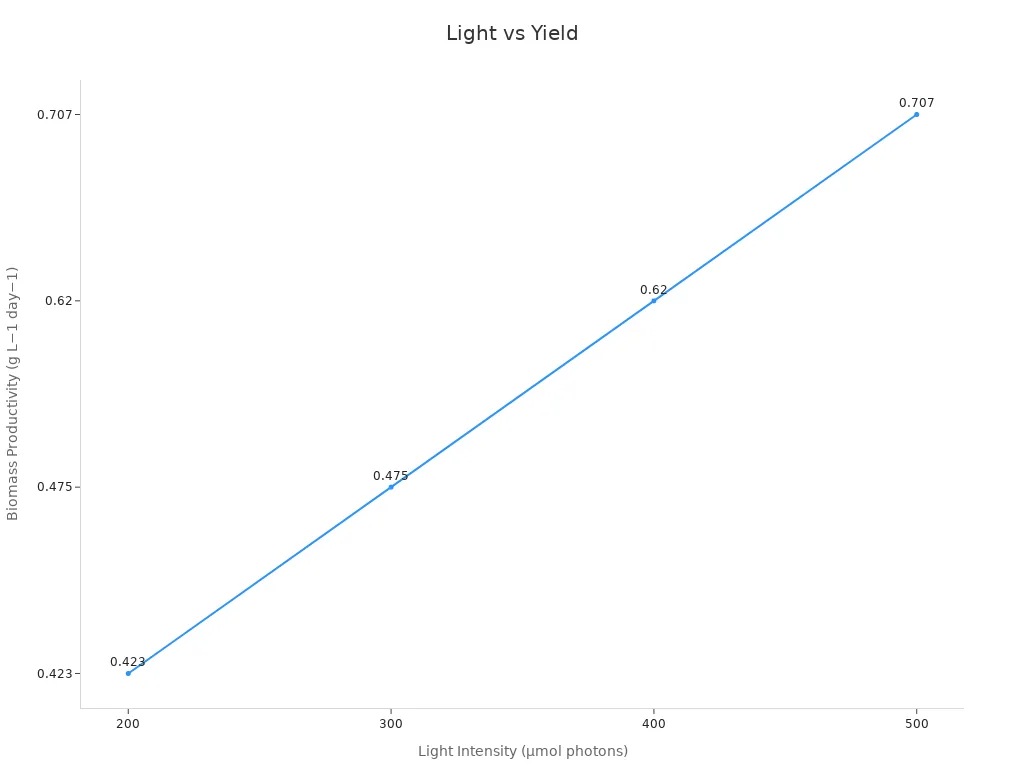
You can help your algae by giving them the right amount and type of light. Each species has its own best light range. For example, Chlorella sp. 800 grows better as you increase light from 200 to 500 µmol photons m−2 s−1. But some species, like Phaeodactylum tricornutum, stop growing well if light goes above 100 µmol photons m−2 s−1. Too much light can cause photoinhibition, which means the algae get damaged and grow less.
| Species / Condition | Light Intensity (µmol photons m−2 s−1) | Biomass Productivity (g L−1 day−1) | Notes on Growth Impact |
|---|---|---|---|
| Chlorella sp. 800 | 200 | 0.423 | Growth increases |
| Chlorella sp. 800 | 300 | 0.475 | Growth increases |
| Chlorella sp. 800 | 400 | 0.62 | Growth increases |
| Chlorella sp. 800 | 500 | 0.707 | Growth increases |
| Phaeodactylum tricornutum | >100 | N/A | Photoinhibition |
| Chlorella vulgaris | >150 | N/A | Photoinhibition |
Tip: Move your lights or mix your culture to spread light more evenly. This helps all algae get enough energy to grow.
Algae can change how they use light. When you give them more light, they shrink their light-harvesting parts to avoid damage. When you lower the light, they make these parts bigger to catch more energy. If you keep light at the right level, you get more algae and better yields. In algae farming, tuning both the amount and quality of light helps you avoid wasted energy and boosts your harvest.
Nutrient Balance
Spotting Imbalances
You need to watch for signs that show your algae do not get the right nutrients. When you spot problems early, you can fix them before they hurt your harvest. Look for these signs in your algae farming system:
- Sudden increases in algal blooms, especially blue-green algae, often mean too many nutrients.
- Water that looks cloudy or has high turbidity can signal dense algae growth.
- Changes in chlorophyll-a levels show shifts in algae amount and health.
- If you see more flagellates and fewer diatoms, your water may have harmful blooms.
- Lower water transparency often means more planktonic algae.
- Oxygen levels below 2 mg/L can harm other water life and show nutrient problems.
- A nitrogen to phosphorus (N:P) ratio that is off can lead to cyanobacteria blooms.
You should check these signs often. Simple tools like test kits or water clarity tubes help you track changes. When you keep good records, you can spot trends and act fast.
Fixing Nutrient Supply
You can fix nutrient problems by adjusting what you add to your algae culture. Start by testing your water for nitrogen and phosphorus. If you see too much algae or cloudy water, lower the amount of fertilizer or nutrient solution. If your algae look pale or grow slowly, you may need to add more nutrients.
Try to keep the N:P ratio close to 16:1. This balance helps most algae grow well and stops harmful blooms. Use a table to track your nutrient levels:
| Nutrient | Target Range | What to Do if Low | What to Do if High |
|---|---|---|---|
| Nitrogen (N) | 5–10 mg/L | Add more fertilizer | Change water or dilute |
| Phosphorus(P) | 0.05–0.1 mg/L | Add phosphate solution | Change water or dilute |
Tip: Always add nutrients slowly and check results after each change. This helps you avoid sudden swings that can stress your algae.
By watching for these signs and making small changes, you keep your algae farming system healthy and productive.
Temperature Control
Monitoring Temperature
Check your algae culture’s temperature every day. Temperature can change quickly, especially outside or near windows. Use a thermometer or digital sensor to check the water. Write your results in a notebook or on your phone. This helps you see patterns and find problems early.
Most algae have a best temperature for growing. Many types like water between 15°C and 30°C. Spirulina grows best in warmer water, from 26°C to 32°C (80–95°F). If water is too hot or too cold, algae slow down or die. Some rare types, like sorokiniana, can live in water up to 40–42°C. Each algae type has its own favorite temperature, so learn what your algae likes.
Tip: Put your thermometer in the middle of the tank. Do not place it at the top or bottom. This gives you the best reading.
Adjusting Temperature
You can change the temperature in a few ways. If water is too cold, use an aquarium heater. Set it to the right temperature for your algae. If water is too hot, move the tank out of sunlight or use a fan. Shade cloths or covers help keep the water cool.
When you keep the temperature right, algae grow faster and look healthier. For example, Chlorella vulgaris grows best between 25°C and 30°C. At these temperatures, you get more algae and greener color. If it gets hotter than 30°C, growth slows and algae get stressed. At the right temperature, algae start growing faster and multiply more. If water gets too hot, algae may shrink or stop growing.
- Photosynthesis gets faster as temperature rises, but only to a point.
- Higher temperatures can help growth during heat waves, but only if safe.
- If temperature drops below 16°C, algae may not grow much.
Note: Change the temperature slowly. Fast changes can shock your algae and hurt your harvest.
Harvesting Challenges

Common Harvesting Mistakes
Harvesting algae can be very hard for many people. It is tough to get tiny algae cells out of the water. Microalgae do not have much biomass, so you must process lots of water for a little algae. If you hurry, you might lose algae or let in contaminants. Using the wrong tools or dirty equipment can cause more problems. Sometimes, you harvest at the wrong time. If you harvest too soon, you get less algae. If you wait too long, the algae may be bad or contaminated.
Watch out for these mistakes:
- Filters that clog or do not match your algae
- Not mixing the culture before you harvest, which makes results uneven
- Forgetting to clean tanks and tools, which can cause contamination
- Not checking water clarity and algae density often
Tip: Make a checklist for harvesting. This helps you remember every step.
Efficient Harvesting Methods
There are many ways to make harvesting easier and better. Sieves or cloth filters work well for bigger algae. For microalgae, you may need centrifuges or special membranes. These tools help you get more algae and waste less. Some farms use new technology to work faster. They track how much algae they get and how much energy they use. Farms can get up to 1.5 kg of algae per cubic meter and use less than 1.5 kWh of energy for each kilogram.
Modern farms use AI and smart sensors to watch and change harvesting as it happens. These systems can help you grow over 50% more algae. They also save water and energy. With these tools, you can finish harvesting in less than 10 days and use under 2 liters of water for each kilogram of algae. If you use good methods and new tools, you lose less algae and keep it clean and healthy.
Algae Farming Sustainability
Water Use
You must watch how much water you use in algae farming. Water is very important, especially if you live where it is dry. Algae need about 1,000 cubic meters of water to make one ton of biomass. This is much less than crops like soybeans or lentils, which need two to five times more water. You can save more water by using brackish or seawater instead of freshwater. Some people mix freshwater and seawater to grow Spirulina. Recycling water in your tanks also helps you use less. If you can get nutrient-rich wastewater, you can use it to grow algae and need less clean water.
Tip: Always check where your water comes from and try to reuse or recycle it. This saves you money and helps the environment.
Resource Efficiency
You can use your resources better by making smart choices in your algae farm. Use synthetic fertilizers only when needed to lower fossil fuel use and greenhouse gas emissions. In the next few years, you could use half as much fossil fuel by following good steps. Try to grow algae in places where food crops do not grow. Algae farms can use land that is not good for other plants. Some studies show that replacing half of Europe’s oil and protein with algae would only use a small part of land that cannot grow food.
Here are some ways to check and improve how sustainable your farm is:
- Track how much energy you use, especially when harvesting and drying.
- Watch for CO2, SO2, and phosphorus emissions.
- Check how much land and water you use.
- Use life cycle assessments to see your farm’s total impact.
- Try to use renewable energy instead of fossil fuels.
- Automate harvesting to save work and energy.
- Use machine learning tools to find the best ways to harvest and process algae.
Note: Keeping good records helps you find problems and make better choices for your farm’s future.
You can avoid many mistakes if you check water, light, nutrients, and temperature often. Using clean tools and careful harvesting helps you get more algae. Watching your algae and fixing problems early really helps:
- Check your algae every week and work with others to keep them healthy.
- Talking with others and teaching people helps stop harmful blooms.
- Acting quickly and sharing what you learn helps you grow more algae.
Keep watching your algae and keep learning new things. Every good choice you make helps you get better results and makes your farm last longer.
FAQ
What is the best way to prevent algae contamination?
You should always clean your tools and tanks before use. Use filtered water and keep your growing area tidy. Check your algae often for signs of unwanted growth.
How often should you harvest algae?
You should harvest algae when the culture looks dense and green. Most growers harvest every 7 to 14 days. This keeps your algae healthy and productive.
Can you grow algae indoors?
Yes, you can grow algae indoors. Use artificial lights and control the temperature. Indoor systems help you avoid weather problems and pests.
What should you do if your algae stop growing?
Check water quality, light, nutrients, and temperature. Fix any problems you find. Sometimes, you need to start a new culture if the old one does not recover.