

You can increase your yield when growing strawberries indoors under lights by using the right type of light. A balanced light spectrum that includes red, blue, and 5–6% far-red light is ideal. Maintain a light intensity of at least 300 µmol/m²/s, and keep the lights on for 14–18 hours each day. Research shows that far-red light encourages longer stem growth, making harvesting easier and reducing the risk of disease. Using LED grow lights is the best way to achieve these results. Whether you’re growing strawberries indoors under lights for fun or as a small business, regularly monitor your light levels and adjust them as needed to maximize your strawberry harvest.
Key Takeaways
- Use a balanced light spectrum with red, blue, green, and 5–10% far-red light. This helps strawberries grow strong and make more fruit.
- Keep light intensity at least 300 µmol/m²/s. Run lights for 14–16 hours each day. This helps strawberries grow better and taste good.
- Pick LED grow lights that you can adjust. You can change the light color and strength for each growth stage. This helps plants stay healthy and gives you more strawberries.
- Put LED lights 12–18 inches above the plants. Spread them out so every strawberry gets enough light. This stops leaves from burning.
- Pinch off early blossoms and take away runners. This helps plants use energy to grow strong roots and bigger, sweeter berries.
Light Spectrum Essentials
A balanced light spectrum is the foundation for healthy strawberry plants and high yields. You need to provide your strawberries with the right mix of red, blue, green, far-red, and UV light. Each part of the spectrum plays a unique role in plant growth, fruit quality, and overall plant health.
Red, Blue, and Far-Red
Red, blue, and far-red light are the most important wavelengths for strawberries. You can see their effects in every stage of growth, from leaf development to fruit ripening.
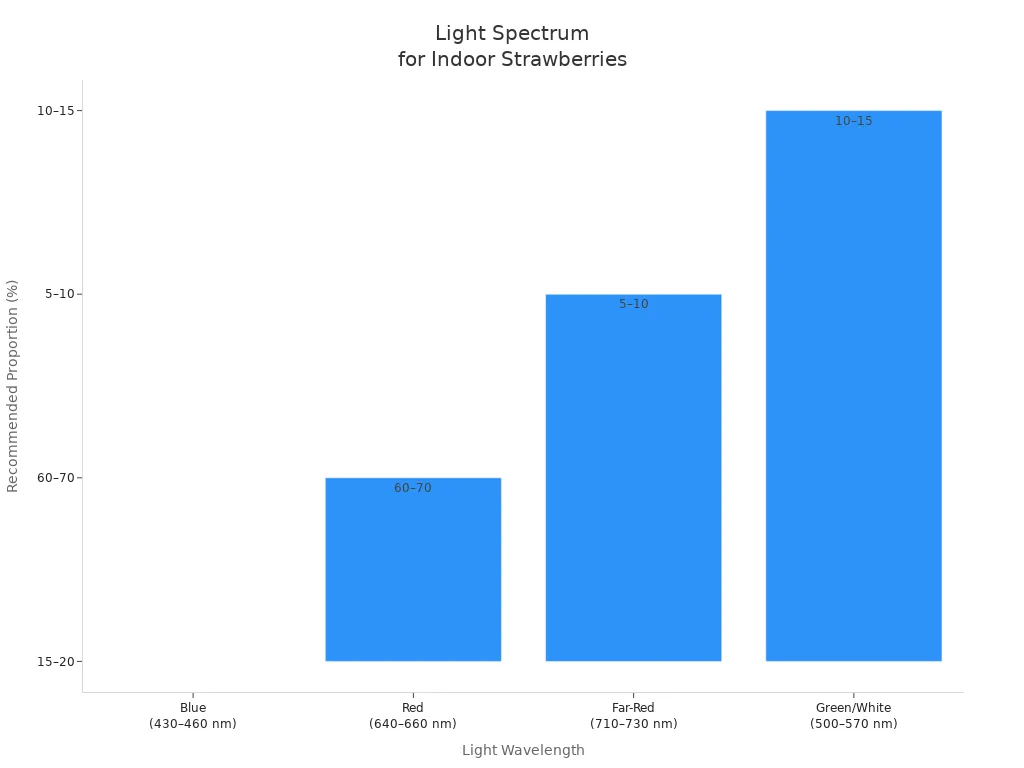
| Wavelength | Role in Strawberry Growth | Recommended Proportion (%) |
|---|---|---|
| Blue (430–460 nm) | Supports vegetative growth, root and leaf health, and helps the plant use water and nutrients efficiently | 15–20 |
| Red (640–660 nm) | Drives photosynthesis, promotes flowering, increases fruit size, and helps berries ripen | 60–70 |
| Far-Red (710–730 nm) | Triggers flowering, stretches stems, improves flower timing, and makes fruit more uniform | 5–10 |
You need both red and blue light for strong, healthy plants. Red light is the main driver of photosynthesis, but if you use only red light, your plants may develop curled leaves or grow in odd shapes. Blue light keeps plants compact and helps them grow thick, healthy leaves. When you combine red and blue light, you get better photosynthesis and higher fruit quality.
Far-red light is a game changer for indoor strawberries. Adding 5–10% far-red light to your spectrum can boost yields by up to 48%. Far-red light encourages earlier flowering and helps your plants produce more fruit at the same time. It also stretches stems, which makes harvesting easier and improves airflow around the plants, reducing disease risk.
Tip: Use LED grow lights that let you adjust the amount of far-red light. This gives you more control over flowering and fruiting.
You can see the recommended proportions for each light color in the chart below:
Green and UV Roles
Green and UV light may seem less important, but they play key roles in plant health and fruit quality.
- Green light penetrates deeper into the plant canopy than red or blue light. This means it reaches lower leaves and helps the whole plant photosynthesize. Green light also increases leaf size and total plant mass. When you add green light to your setup, you can see up to 55% more leaf area and 83% more dry mass in runner plants.
- White LEDs, which include green light, make it easier for you to see your plants and spot any problems early.
- UV light, especially UV-B, boosts the production of healthy plant compounds like flavonoids and anthocyanins. These compounds make strawberries redder, sweeter, and longer-lasting. UV light also helps control disease by making the plant stronger.
Note: In one study, strawberries exposed to UV-B light had brighter color, more sugar, and higher levels of healthy antioxidants. Their shelf life also improved.
A full-spectrum LED that includes red, blue, green, far-red, and a small amount of UV gives you the best results. This balanced approach mimics sunlight and supports every stage of strawberry growth. You get stronger plants, more uniform fruit, and higher yields.
- Switching from traditional lights to full-spectrum LEDs can increase your strawberry yield by 15–30%.
- You will also notice earlier and more even flowering, better fruit color, and improved taste.
By focusing on a balanced spectrum, you set your indoor strawberries up for success. Adjust your light mix as your plants grow, and you will see measurable improvements in both yield and quality.
Light Intensity and DLI
Optimal Intensity Levels
You need to give your indoor strawberries enough light to help them grow strong and produce lots of fruit. The best light intensity for strawberries is at least 300 µmol/m²/s. Many growers see great results when they use intensities between 250 and 350 µmol/m²/s. In one greenhouse study, strawberries grew even better when the total light above the canopy reached 925 µmol/m²/s. Higher light levels can boost plant growth, fruit size, and sugar content.
You can use this table to see how different light intensities affect strawberry growth:
| Light Intensity (µmol/m²/s) | Growth Effect |
|---|---|
| 150–200 | Good for leaf number and stem thickness |
| 250 | Best for fruit size, weight, and runner production |
| 300+ | Maximizes yield and fruit quality |
| 925 | Exceptional growth in controlled experiments |
Tip: Start with 300 µmol/m²/s if you want high yields, but always watch your plants for signs of stress or overheating.
You should also think about energy use. High light intensity means more electricity. LED grow lights help you save energy because they turn more electricity into useful light. Try to find a balance between giving your plants enough light and keeping your energy bills reasonable.
Achieving Ideal DLI
Daily Light Integral (DLI) tells you how much light your strawberries get each day. For the best results, aim for a DLI of 17–20 mol/m²/day. You can reach this target by adjusting both the light intensity and the number of hours your lights stay on.
- Use Adjustable Spectrum LED grow lights with both red and blue light.
- Set your lights to run for 14–16 hours each day.
- Keep the light intensity around 300–350 µmol/m²/s.
Longer photoperiods (more hours of light) help strawberries flower and make more fruit. Increasing DLI by making the day longer works better than just turning up the brightness.
Note: High-efficiency LEDs and good light placement help you reach your DLI goals without wasting energy.
If you follow these steps, you will see healthier plants, bigger berries, and better harvests. Always check your setup and adjust as your plants grow.
Photoperiod and Timers
Best Daily Light Hours
You can boost your indoor strawberry harvest by giving your plants the right amount of light each day. Most day-neutral strawberry varieties, like Albion, San Andreas, Mara des Bois, and Seascape, respond best to a long photoperiod. Research from Michigan State University shows that keeping your lights on for close to 16 hours each day leads to bigger fruit and higher yields. When you set your photoperiod near 16 hours, you help your strawberries grow more flowers and produce more fruit.
If you use less than 12 hours of light, your plants may not flower as much. If you go above 18 hours, you might stress your plants or waste energy. For most indoor setups, a range of 14 to 16 hours of light works well. You can use a simple timer to keep your light schedule consistent every day.
Tip: Set your timer to turn lights on and off at the same time each day. This helps your strawberries stay on a steady growth cycle.
Simulating Sunlight Cycles
You can use Agricultural Automated Planting System to mimic the natural rise and fall of the sun. This helps your strawberries feel like they are growing outdoors, even when they are inside. Timers make it easy to keep your light schedule steady, which supports both flowering and fruiting.
- Agricultural Automated Planting System help you automate light cycles, so you do not have to remember to switch lights on or off.
- Keeping a regular light duration, usually between 12 and 16 hours, encourages your plants to flower and set fruit.
- Some growers use a 12-hour light and 12-hour dark cycle to trigger flowering.
- Gradually changing the light spectrum, such as adding more red light during flowering, helps your plants adapt and produce sweeter fruit.
- Combining natural sunlight with your grow lights can give even better results.

When you control the photoperiod with Agricultural Automated Planting System, you give your strawberries the best chance to grow strong and yield high-quality fruit. You also protect your plants from changes in weather and make sure they get the same amount of light every day. This steady routine leads to healthier plants and bigger harvests.
Light Placement and Coverage
You want every strawberry plant to get the same amount of light. Uneven light can cause some plants to grow faster than others. To avoid this, follow these steps:
- Hang your LED lights so they cover the whole growing area. Use adjustable hangers to set the right height.
- Place lights about 12–18 inches above the plants. This gives good coverage without causing heat stress.
- Arrange your plants in rows or grids. Make sure no plant sits in the shadow of another.
- Use reflective materials, like white walls or mylar, around your grow space. This bounces light back onto your plants.
- Check the light intensity in different spots with a light meter. Move lights or plants if you find dark areas.
Some growers use wireless sensors to track light levels and adjust lights as needed. This helps you save energy and keeps your strawberries healthy. By keeping light intensity steady and avoiding bright or dark spots, you get better results when growing strawberries indoors under lights.
Yield Results

Case Studies
You can get more strawberries when you use better lighting indoors. Many studies show that changing the light spectrum and intensity helps a lot. Here are some important results:
- Using LED lights with red, far-red, and blue light gives you more fruit in most indoor setups.
- The strawberries are better quality. They have more anthocyanins, polyphenols, and higher antioxidant activity.
- These strawberries are also healthier. They help with enzyme inhibition, which may help your digestion.
- Scientists found that using better LED lighting increases both the amount and quality of strawberries you grow inside.
Expected Improvements
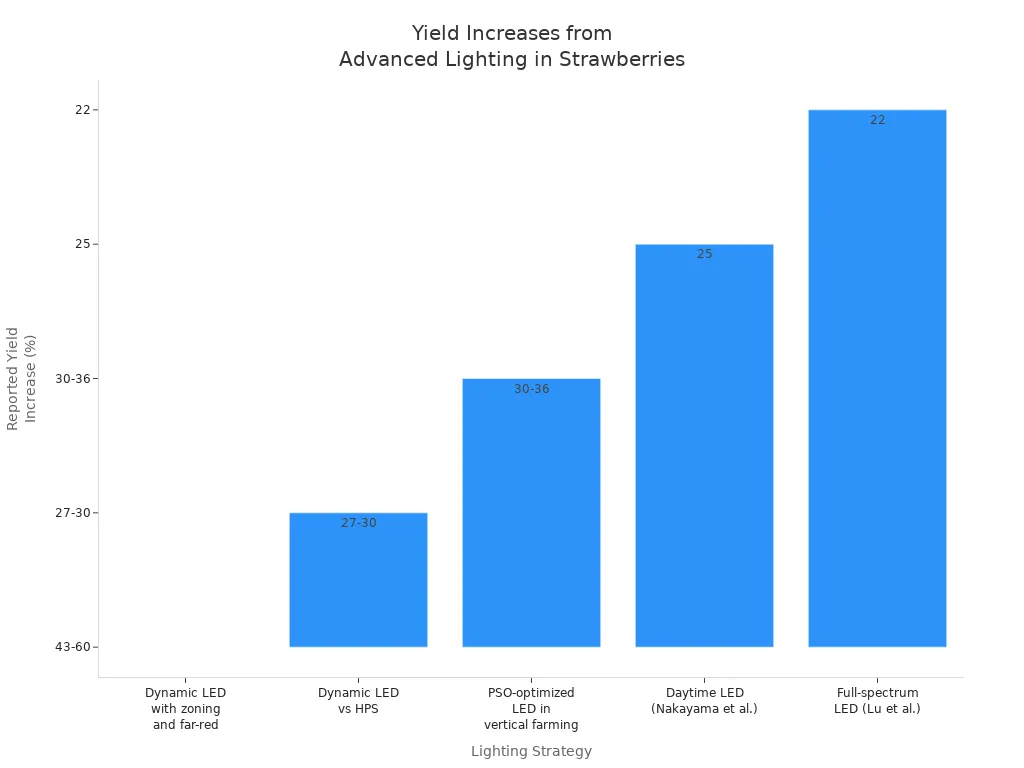
You can expect your plants to grow more and give you more fruit when you use advanced lighting. The table below shows what studies usually find:
| Study / Lighting Condition | Yield Increase (%) | Additional Growth Metrics |
|---|---|---|
| Adjustable Spectrum LED Grow lighting | 30 – 36 | 55% plant height increase, 40% leaf size increase |
| Nakayama et al. (daytime LED lighting) | 25 | ~120 μmol/m²/s PPFD, 200 W power consumption |
| Lu et al. (full-spectrum LED lighting) | 22 | 20% growth rate increase |
You can also see how different lighting methods compare in the chart below:
If you make the light stronger, you usually get a 0.5–1% bigger harvest for every 1% more light. Using a red-to-blue light ratio of 4:1 can give you about 30% more strawberries. You will also get sweeter berries with a deeper color. Red light helps your strawberries make flowers and fruit. Blue light makes the plants stronger and gives them more antioxidants. If you follow these lighting tips, you will get bigger and healthier strawberry harvests.
Adjustable Spectrum Grow Lights
Principles and Benefits of Adjustable Spectrum Lighting

Adjustable spectrum grow lights let you change the color and intensity of light your plants receive. You can use these lights to match the needs of strawberries at each stage of growth. When you use adjustable spectrum LEDs, you can give your plants more blue light during the early vegetative phase. This helps your strawberries grow strong leaves and stems. As your plants move to flowering and fruiting, you can increase the red and far-red light. This shift encourages more flowers and bigger fruit.
Studies show that changing the ratio of blue and red light has a big impact on how strawberries grow. More blue light helps with leaf area and plant strength. More red light boosts flowering and fruit size. When you use the right spectrum at the right time, you get healthier plants and higher yields.
How to Set and Adjust Light Spectrum for Strawberries
You can follow these steps to set up your adjustable spectrum grow lights for growing strawberries indoors under lights:
- Start with more blue light (450-495 nm) during the vegetative phase. This supports leaf and stem growth.
- When your plants begin to flower, increase the red light (610-700 nm) to about 50-60% of the total spectrum. Add 10-15% far-red light to help with flower induction and fruit yield.
- For small grow spaces, set the light intensity between 100-150 µmol/m²/s. For larger areas, use 250-400 µmol/m²/s.
- Add a small amount of UV light to improve disease resistance and plant stress tolerance.
- Watch your plants closely. Adjust the spectrum and intensity if you see signs of stress or slow growth.
Tip: Many smart grow lights have app controls. Use these to fine-tune your settings and track changes over time.

Practical Tips for Using Adjustable Spectrum Grow Lights
- Place your lights evenly above the plants to avoid dark spots.
- Use a light meter to check intensity at different points in your grow area.
- Calibrate your lights regularly, especially if you move them or change settings.
- Make small changes to the spectrum and watch how your plants respond.
- Choose LEDs with a long lifespan and good warranty for reliable performance.
By using adjustable spectrum grow lights, you can give your strawberries exactly what they need at every stage. This approach helps you get the best results when growing strawberries indoors under lights.
Best Practices
Pinching Blossoms
Pinching blossoms is one of the most important steps you can take to help your indoor strawberries grow strong and produce more fruit. When you first plant your strawberries, you will notice small flower stems starting to appear. You should remove these flower stems as soon as you see them during the first month. This practice helps your plants focus their energy on growing healthy leaves and strong roots instead of making fruit too early.
Tip: Use clean scissors or your fingers to gently pinch off each flower stem. Try to do this every few days during the first month after planting.
Removing blossoms early encourages your strawberry plants to grow bigger and stronger. The plants will put more energy into developing a solid base and producing runners. Runners are long stems that help your plants spread and create new growth. When your plants have a strong base, they can support more flowers and fruit later in the season.
You should keep removing any new flower clusters until your plants look healthy and vigorous. Most growers stop pinching blossoms by early August or after about four to six weeks of strong growth. At this point, your plants will be well established and ready to start making fruit.
Here are some key reasons to pinch blossoms in the first month:
- Strengthens the plant’s root system
- Increases runner production for more future fruit
- Helps the plant store energy for bigger harvests later
If you skip this step, your plants may produce a few small berries early, but they will not have the strength to give you a big harvest later. By pinching blossoms early, you set up your strawberries for the best possible yield when it is time to harvest. This simple practice can make a big difference in the health and productivity of your indoor strawberry garden.
Runners
Snipping Runners
Strawberry plants often send out long stems called runners, or stolons. These runners try to grow new plants. If you want more fruit from your indoor strawberries, you should manage these runners carefully. When you let runners grow unchecked, your plants use energy to make new plants instead of making bigger, sweeter berries.
Tip: Removing runners helps your strawberry plants focus on fruit production and stay healthy.
You can follow these steps to handle runners for the best results:
- Use clean, sharp scissors to cut the runners close to the mother plant. Do not tear them off. Cutting prevents damage and keeps the main plant strong.
- If you want to grow new strawberry plants, place the snipped runner tips on a moist growing medium like GrowFoam™ or peat pellets.
- Keep the runner tips in a humid place, such as a misting bench. High humidity keeps the leaves firm and helps roots form.
- Leave the runners under mist for 10 to 14 days. Roots will start to grow during this time.
- Once roots appear, add a gentle fertilizer to help the new plants grow faster.
When you remove runners during the growing season, you help your main plants in several ways:
- Plants keep their energy for making fruit, not new plants.
- Air moves better around the leaves, which lowers the risk of disease.
- Plants grow stronger and produce more berries.
- Regular pruning, including runner removal, keeps your indoor garden neat and productive.
You do not need to remove every runner if you want to make more plants. Just remember, too many runners can lower your harvest. By snipping runners at the right time, you help your strawberries stay healthy and give you a bigger, better crop indoors.
You can get more strawberries if you use the right light. Focus on the best light spectrum, intensity, DLI, and photoperiod. Use LED grow lights with red, blue, green, and far-red light. Set your lights to stay on for 14 to 16 hours each day. Check your plants often to see if they look healthy. Move your lights or change how bright they are as your plants get bigger. Keep track of what works and change things to get better harvests. If you want more tips, read science articles about LED lights and growing strawberries.
FAQ
What is the best light spectrum for indoor strawberries?
You should use a full spectrum that includes red, blue, green, and 5–10% far-red light. This mix helps your plants grow strong leaves, flower early, and produce more fruit. Adding a little UV light can improve berry color and taste.
How close should I place LED grow lights to my strawberry plants?
Keep your LED lights 12–18 inches above the plants. This distance gives even coverage and prevents leaf burn. Use a light meter to check intensity. Adjust the height as your plants grow taller.
Can I use regular household LED bulbs for strawberries?
Regular bulbs do not provide the right spectrum or intensity. You need special LED grow lights that offer red, blue, and far-red light. These lights help your strawberries grow better and produce more fruit.
How do I know if my strawberries get enough light?
Look for strong, green leaves and steady flowering. If you see slow growth, pale leaves, or few berries, your plants may need more light. Use a light meter to check intensity. Adjust your setup if needed.