

Smart greenhouses are transforming farming by using advanced systems that help plants grow more efficiently and improve crop quality. A key feature is the use of grow lights in a greenhouse, which provide the optimal lighting conditions for plant development. Many farmers now earn higher profits thanks to these innovations. Smart greenhouses enable year-round crop production and allow for a higher density of plants in a single space. In 2023, the smart greenhouse market was valued at $1.91 billion, with commercial growers holding 57.3% of the market share. The adoption of grow lights in a greenhouse, particularly LED lights, is rapidly increasing. Additionally, smart greenhouses contribute to energy savings and simplify operations for agricultural businesses.
Key Takeaways
- Smart greenhouse lighting, like LED grow lights, helps plants grow faster. It also helps plants make better crops all year.
- Smart lighting systems save energy and money. They change how bright the light is. They do this by checking sunlight and what plants need.
- LED lights last a long time. They do not get very hot. This lets farmers grow more plants in small spaces. It is safe for the plants.
- Automation and AI help control lighting and climate. This makes farming easier. It also makes it work better and earn more money.
- Starting with smart lighting can cost a lot and be hard. But over time, these systems help farmers get more crops and save energy.
Impact on Smart Greenhouses
Yield and Quality
Smart greenhouses use special lighting to help crops grow better. These lights can make plants produce more food and improve their quality. Studies in Italy and Spain found that using LED lights in greenhouses helps tomatoes grow bigger and healthier. The tomatoes also have more vitamins and better photosynthesis. If growers increase the daily light by 1%, they usually get 1% more crops. These lights let farmers grow food even when there is not much sunlight outside.
A greenhouse in Ohio put in strong LED lights for leafy vegetables. After a year, the farm grew 40% more crops with better quality. The plants grew faster and had more nutrients. Some farmers use smart systems that predict what plants need. These systems use sensors and artificial intelligence to change the lights and other things right away. This helps farmers get more crops that are always good quality.
Note: Smart greenhouses help farmers meet tough rules for quality. This means they can earn more money and grow their business.
Operational Efficiency
Smart greenhouses make work easier by using smart lighting. These lights change based on how much sunlight there is. If the sun is bright, the lights turn down or off. If it is cloudy, the lights get brighter. This saves energy and makes sure plants always get enough light.
Dimmable LEDs let farmers control how bright and how long the lights stay on. This helps save money on energy and grow more crops. For example, a big greenhouse in California used smart lights and machines to cut energy costs by 30%. The farm also picked crops faster and made 25% more money each year.
New studies show smart lights can make plants grow up to 50% faster. Farmers can pick crops more often and grow more each year. By changing the light and how long it shines, farmers can give each plant what it needs. This helps them get more crops and better quality while spending less.
- Key benefits of smart greenhouses for operational efficiency:
- Lower energy bills with smart lighting
- Faster and more harvests each year
- Better and more even crops
- More plants in the same space
Smart greenhouses let farmers grow food all year and fit more plants in one place. LED lights do not get hot, so they can be close to the plants. This helps with vertical farming and lets farmers plant more in a small area.
One example is Acres Farms, which has a 12,000-square-foot greenhouse. They use smart LED lights to grow over 15 crops each year. The farm grows leafy greens, vine crops, herbs, and microgreens using water instead of soil. Their system controls temperature, humidity, air, and CO2 with special LED lights. This lets them grow food all the time and get the most crops in a safe place.
Smart greenhouses use Adjustable spectrum grow lights to copy sunlight. IoT systems let farmers change the light’s strength, time, and color right away. This helps them grow food all year and spend less money running the greenhouse.
Grow Lights in a Greenhouse

LED Technology
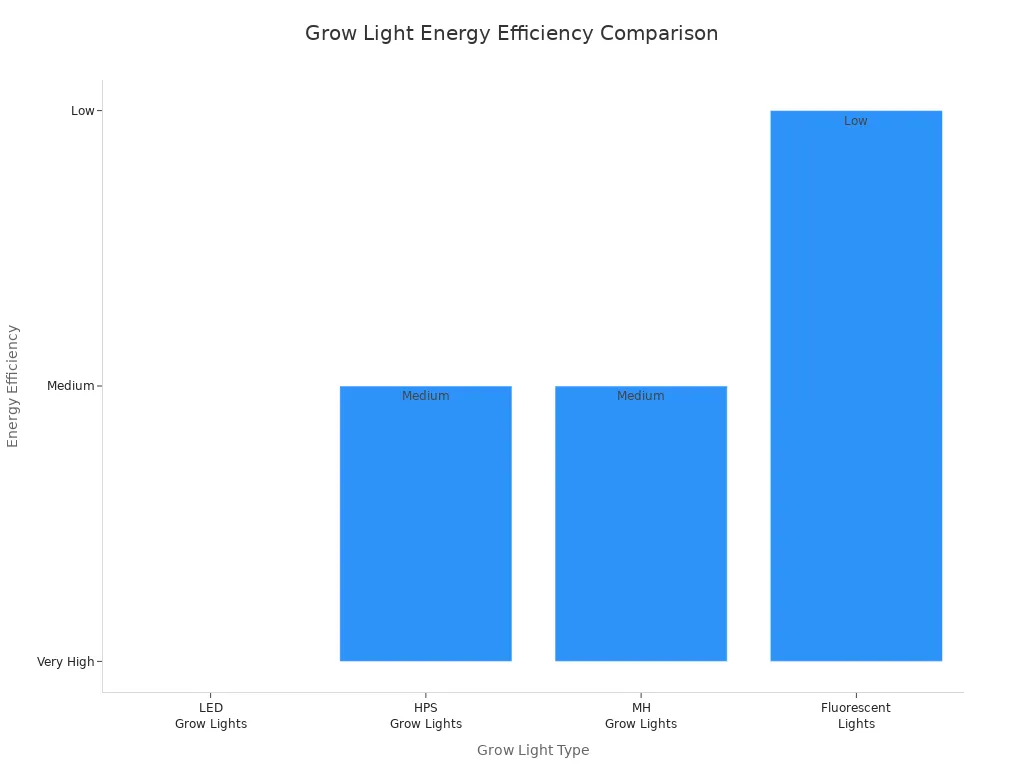
Commercial growers use special grow lights to help crops grow better. LED grow lights are popular because they save energy and work well. These lights use much less electricity than old types like HPS or MH lamps. This means growers pay lower energy bills. LED lights also make less heat, so the greenhouse stays cool. Stable temperatures help plants grow strong.
| Type | Lifespan (hours) | Light Spectrum | Energy Efficiency | Heat Output | Best Use Case |
|---|---|---|---|---|---|
| LED Grow Lights | 50,000-100,000 | Full-spectrum, customizable | Very High | Low | Most commercial greenhouses |
| HPS Grow Lights | 10,000-15,000 | Strong red spectrum for fruiting | Medium | High | Fruiting crops like tomatoes |
| MH Grow Lights | 8,000-12,000 | Strong blue spectrum for vegetative | Medium | High | Seedlings and young plants |
| Fluorescent Lights | 10,000-20,000 | Balanced white, strong blue | Low | Very Low | Small nurseries, microgreens |
LED grow lights have many helpful features for farms:
- You can change the light color for each crop stage.
- They give strong light for healthy plant growth.
- You can dim the lights to control brightness.
- Smart systems help set schedules and watch the lights.
Growers use LED lights to shine evenly on all plants. This stops some plants from growing faster than others. More plants can fit in small spaces because LED lights are small.
Tip: Keep LED lights spaced out and clean them often. This helps crops grow better and saves energy.
Switching to LED lights helps farms spend less money. These lights last longer than old ones. Growers do not need to buy new lights often. The money saved on energy and repairs adds up fast.
Light Spectrum Control
LED lights let growers pick the best light color for plants. Each color helps plants in different ways. Blue light helps roots and leaves grow strong. Green light goes deep into the plant and helps all leaves grow. Red light helps flowers and fruit grow. Far-red light helps flowers bloom at the right time.
Growers can change the light color for each crop stage. This helps plants grow faster and makes more food. For example:
- Blue light helps young plants make roots and leaves.
- Green light helps lower leaves get bigger.
- Red light helps plants make flowers and fruit.
- Far-red light helps flowers bloom and buds form.
Growers save energy by using only the colors plants need. They do not use all colors all the time. This makes the greenhouse work better and wastes less energy.
Note: LED lights with color control help farms grow food all year. Crops stay good even when there is not much sunlight.
Longevity and Maintenance
LED grow lights last much longer than old greenhouse lights. Most LED lights work for 50,000 to 100,000 hours. HPS and MH lights need to be changed every year or two. Long-lasting lights mean less work and fewer breaks for growers.
| Lighting Type | Average Lifespan (hours) |
|---|---|
| Traditional HPS Lighting | 10,000 – 24,000 |
| Greenhouse LED Lighting | 50,000+ |
Taking care of LED lights is easy. Growers just clean the lights and check the wires. Dust can block light, so cleaning is important. LED lights do not get hot, so there is less chance of fire. Farms do not need extra cooling equipment.
LED lights help farms save money and work better. Growers do not need to fix or replace lights often. Using LED lights is good for the planet because they use less energy and make less pollution.
- Main reasons LED lights are good for farms:
- Lower energy and cooling costs
- Fewer replacements and repairs
- Safe and steady performance
- Help farms make more money and protect nature
Growers who use LED lights get the best light for every crop. This helps plants grow strong and healthy. Farms get more food and save money for a long time.
Technology Integration

AI and IoT
Smart greenhouses use AI and IoT to help crops grow. IoT sensors check light, temperature, and humidity in the greenhouse. These sensors send information to smart controls. The controls change the lights and other systems right away. AI lighting systems adjust how bright and how long the lights stay on. They use sensor data to do this. This gives plants the right light for each stage. The system can dim or turn off lights if the sun is bright or if no one is using that area. Machine learning watches what plants need and changes the light schedule. This helps crops grow better and saves energy.
Growers get many benefits from these tools:
- They can pick the best light colors for each crop.
- The system warns them if something needs fixing.
- Real-time changes help save power and keep plants healthy.
Smart greenhouses use these tools to help plants grow their best. AI and IoT let farmers run big greenhouses with great accuracy.
Automation
Automation gives steady control in smart greenhouses. Automated systems manage light, humidity, temperature, and airflow. Smart sensors and controllers watch the greenhouse and make quick changes. This helps save water and energy. Growers can check and change settings from far away. This saves time and work.
Key benefits of automation are:
- Farms can save 30-40% on water and fertilizer.
- Hydroponic systems use up to 90% less water than field farms.
- Special heating can lower costs in cold weather.
- Automation keeps humidity steady and stops mold.
- Crop yields can go up by 20-50% with stable light and conditions.
Smart lighting and automation help farmers grow good crops all year. These systems save money by cutting waste and growing more food. Smart greenhouses use automation to manage resources and energy well. This makes them a great choice for big farms.
Benefits
Energy Savings
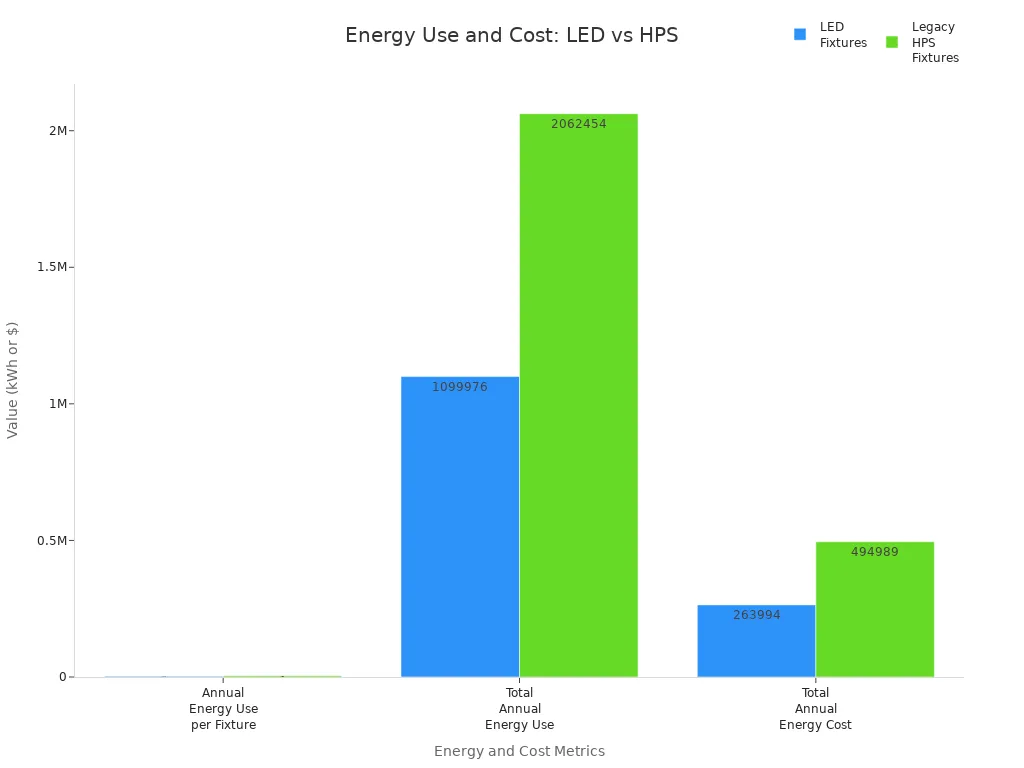
Smart greenhouse lighting systems help growers use less energy. Many greenhouses now use LED fixtures instead of old HPS lights. LEDs need less electricity and last longer. The Plymouth, MA greenhouse switched to LEDs and used 47% less energy. This saved about 962,479 kWh and $230,995 in one year. In five years, they saved over $1.3 million, including lower maintenance costs.
| Parameter | LED Fixtures (CT141 LEDs) | Legacy HPS Fixtures (1000W DE HPS) |
|---|---|---|
| Number of Fixtures | 436 | 436 |
| Annual Energy Use per Fixture (kWh) | 2,523 | 4,730 |
| Total Annual Energy Use (kWh) | 1,099,976 | 2,062,454 |
| Total Annual Energy Cost ($) | 263,994 | 494,989 |
| Annual Energy Savings ($) | – | 230,995 |
| Percentage Reduction in Energy Use | – | ~47% |
| Annual Energy Savings (kWh) | – | 962,479 |
| Projected 5-Year Savings (including maintenance) ($) | Over 1.3 million | – |
Canadian greenhouses are very good at saving energy. They use high-efficiency LEDs, smart climate controls, and thermal screens. Some Canadian growers cut energy use by half with these tools. Ontario has programs that help pay for these upgrades, so more people can use them.
Sustainability
Smart greenhouse lighting systems help farms be more sustainable. New research shows these systems help growers use fewer resources and lower pollution. Many greenhouses now use renewable energy and smart controls for light and temperature. These changes help growers deal with climate problems and save money.
Growers build greenhouses to use more sunlight and less artificial light. For example, they face greenhouses east-west to get more sun. They also insulate walls to keep heat inside. Some use geothermal heating and cooling to save even more energy. These steps lower bills and help the planet.
Canadian ideas show how smart lighting and climate control work together. Projects like Allegro Acres use LED lighting to grow crops all year and use less energy. These projects show smart greenhouses can make money and help the environment.
Water and Pesticide Reduction
Smart greenhouse lighting systems help growers use less water and fewer pesticides. IoT sensors and automated lights work with irrigation to give plants just what they need. A smart greenhouse model saved 16.5% more water than a regular one.
- IoT sensors check soil and plant health right away.
- Automated lighting and irrigation help stop waste.
- Special light wavelengths make plants stronger against pests.
Growers often use hydroponic or aquaponic systems with smart lighting. These systems let plants grow in water, not soil. Controlled lighting helps plants use water better and stay healthy. Stronger plants need fewer chemicals to fight pests. This means less pesticide use and cleaner crops.
Note: Smart greenhouse lighting systems help growers save energy, protect nature, and use resources wisely.
Challenges
Investment
Smart greenhouse lighting systems cost more at first than old systems. Commercial growers must buy advanced LED fixtures, automation controls, and sensors. Climate-controlled greenhouses also need special technology for temperature, humidity, and light. These costs are higher than High-Pressure Sodium or fluorescent lights. But smart systems save money over time. LED lights use less energy and last longer. They also help lower cooling costs. Over the years, growers get better crops and spend less to run the greenhouse. Many growers see their money come back through better work and more crops. Government programs, like subsidies and tax breaks, help make these systems more affordable.
Complexity
Growers face technical problems when using smart lighting systems. If sensors do not work well, the data can be wrong. This can cause bad readings about the greenhouse. If the network is weak or the power goes out, data can be lost. This makes it hard to make quick choices. Cybersecurity risks can threaten greenhouse control systems. Sometimes, AI systems are hard to understand or change. This makes it tough for growers to know what is happening. Adding smart lighting to old greenhouses often needs new wires and network parts. Growers must learn new skills to read data and fix problems.
Tip: Advanced lighting controls, like Daily Light Integral (DLI) methods, make things easier. Real-time sunlight checks and weather forecasts help growers plan and change lighting. Dimmable LED drivers and good wiring during setup make upgrades easier later.
Integration
Adding smart lighting to old greenhouse systems can be hard. Big farms like wired connections because they are steady and fast. Small farms often pick wireless systems because they are easy to set up. Manufacturers use encryption and backup plans to keep networks safe. Using hardware, software, and expert help together makes things less tricky. Training and consulting help growers learn new systems. Cloud platforms let growers watch and control greenhouses from far away. Utility programs help greenhouses use less power when it is expensive, without hurting crops.
- Key strategies for successful integration:
- Pick the right connection for your greenhouse size.
- Use strong security to keep systems safe.
- Mix hardware, software, and expert help.
- Join utility programs to save on energy bills.
Implementation
Assessment
Commercial growers need to check what their greenhouse needs before using smart lighting. Making a good plan helps stop expensive mistakes.
- Make a lighting plan to show where lights should go for even coverage.
- Look at different lights. Focus on small size, good cooling, and strong results.
- Figure out how much energy led grow lights can save, including less cooling.
- Choose if you want to replace all lights at once or do it in steps.
- Find out about loans, rebates, and check if the money saved is worth it, including hidden costs like wires and training.
- After putting in the lights, watch how plants grow and change water or other things if needed.
- Try a small test first to see how well the system works before buying everything.
Growers also need to know what light each crop needs. Some crops need more light than others. Even light helps all plants grow the same. Smart sensors and automation can help change light levels and timing for each plant.
Tip: Always follow safety and lighting rules to keep crops and workers safe.
Technology Selection
Picking the best lighting technology is important for success.
- Think about what kind of crop you have and what light it needs, like color and strength.
- Pick systems that let you control color, zones, and dimming to match changes.
- Work with companies that help you plan and check in often.
- Check how well the lights work by looking at PPE.
- Look for rebates to help pay for new lights.
- Dynamic led grow lights let you change light for each crop and season.
A table can help you compare choices:
| Feature | Importance for Growers |
|---|---|
| Spectrum Control | Matches crop growth stages |
| PPE Rating | Ensures energy efficiency |
| Automation | Saves labor and energy |
| Support & Training | Eases transition and use |
| Incentives Available | Reduces capital costs |
Maximizing ROI
To get the most money back, growers should use smart steps:
- Use automation to control when lights turn on, how bright they are, and what color for each crop stage.
- Watch systems from far away to fix problems fast and stop delays.
- Plan where to put lights so no energy is wasted and all plants get enough light.
- Keep up with regular checks to make sure lights work well.
- Teach workers how to use new systems and read sensor data.
Studies show led grow lights cost more at first but save money later and help crops grow better. Greenhouses in the Netherlands and Japan made more money and helped the planet after switching to smart lighting and automation. Avoid mistakes like bad power use, old parts, and not enough training. A smart plan helps crops stay healthy and brings long-term success.
Smart greenhouse lighting systems help farms grow more crops and better food. They also help save money on energy bills. These systems use LED lights, AI, and IoT to control things quickly and automatically. Growers get lights that last longer and use less power. This means they can make more money. In the future, farmers will use remote controls, change light colors, and study data to help plants.
Experts say to keep lights clean, put them in the right spot, and train workers often.
Growers can learn more from the DesignLights Consortium’s Hort QPL and by watching industry webinars.
FAQ
What crops benefit most from smart greenhouse lighting systems?
Tomatoes, lettuce, cucumbers, peppers, and herbs do well with smart lighting. These plants grow faster when the light is controlled. Farmers can get more crops and better quality by using special lighting for these plants.
How do smart lighting systems reduce energy costs?
LED fixtures use less power than old lights. Automated controls change brightness when there is sunlight. This helps save energy. Many greenhouses say their energy bills are up to 50% lower after switching to smart lighting.
Can smart lighting systems work with existing greenhouse setups?
Most smart lighting systems can be used in current greenhouses. Growers might need new wires or sensors. Many suppliers help with setup and planning. Getting expert help makes the change easier.
What maintenance do smart greenhouse lighting systems require?
Growers should clean LED fixtures often and check the wires. Most systems send alerts if something is wrong. LED lights last a long time, so they do not need to be replaced often. Regular checks keep the system working well.
Are there financial incentives for installing smart greenhouse lighting?
Many places give rebates, grants, or tax credits for energy-saving upgrades. Farmers can ask local utility companies or farm agencies for more information. These programs help make smart lighting systems cost less at the start.