

The right lighting changes how your plants grow and how your greenhouse works. When you choose greenhouse LED lighting systems that fit your crops, you help your plants grow faster and stronger. Smart controls and energy-saving lights can lower your energy use by up to 30%. These systems also let you grow crops all year, keep your greenhouse cooler, and raise your yield. You can make the most of your space and save money by asking the right questions before you buy.
Key Takeaways
- Pick LED lights that fit your plants’ needs for color and strength. Make sure the lights give enough light each day. This helps your plants grow strong and healthy. Measure your growing space with care. Put the lights in even spots. This stops dark areas and makes sure all plants get light. Use LED systems that save energy and have dimmable controls. This can save you up to 30% on energy. It also helps keep your greenhouse cooler. Hang the lights at the right height. Check the voltage and wiring often. This keeps your system safe and working well. Think about the first cost, warranties, and customer help. This helps you make a smart choice for your greenhouse lighting.
Plant Light Requirements

When you choose lighting for your greenhouse, you need to match the light to your plants’ needs. Plants use light for photosynthesis, growth, and flowering. The right spectrum, intensity, and daily light total help your crops grow strong and healthy. Each crop and growth stage needs a different kind of light. Let’s look at what you should know.
Spectrum and Wavelengths
Plants respond to different colors of light. Each color, or wavelength, affects plant growth in a special way.
- Red light (650–665 nm) helps plants grow and flower. It matches the main absorption peak for chlorophyll, which is the pigment plants use to make food.
- Blue light helps leaves grow strong and keeps plants from getting too tall and thin. Blue light also helps plants open their stomata, which lets them take in carbon dioxide.
- Green light can help some plants grow better, but too much green light can slow growth.
- Far-red light can help flowers form and can make plant canopies thicker, but too much can make plants stretch too much.
- UVA light in small amounts can help leafy greens have more antioxidants and better quality after harvest.
Tip: You can use full-spectrum LED lights with tunable settings. These lights let you adjust the color mix to match your crop and growth stage.
Here is a table that shows the best light spectrum and daily light needs for common greenhouse crops:
| Crop Type | Recommended DLI (mol/m²/day) | Light Spectrum Characteristics |
|---|---|---|
| Fruiting crops | 20 – 30 | Red-rich spectrum during flowering and fruiting; far-red for better flowering and canopy growth |
| Leafy greens | 12 – 17 | More blue light for compact growth and strong leaves |
Light Intensity
Light intensity tells you how much light reaches your plants. You measure it in PPFD (photosynthetic photon flux density), which is shown as µmol/m²/s. Different growth stages need different light levels.
| Growth Stage | PPFD Range (µmol/m²/s) | What It Does |
|---|---|---|
| Seedling Stage | 100 – 300 | Prevents stress; blue light helps leaves and stems |
| Vegetative Stage | 400 – 600 | Builds strong roots, stems, and leaves |
| Flowering Stage | 600 – 1000 | Boosts flower and fruit growth; red light is important |
If you give your plants too little light, they become weak and tall with thin stems. They do not make enough food, so they grow slowly. If you give them too much light, their leaves can turn white or yellow, curl up, or even get burned. Plants stop growing well if the light is too strong. You need to balance light with temperature, humidity, and CO₂. For example, high light makes plants lose more water, so you need to watch humidity. If you add more CO₂, plants can use more light and grow faster. Always check your plants for signs of stress and adjust the light if needed.
Daily Light Integral (DLI)
Daily Light Integral, or DLI, is the total amount of light your plants get each day. You measure it in mol/m²/day. DLI is important because it tells you if your plants get enough light to grow well.
You can calculate DLI with this formula:
DLI = PPFD × light hours × 3600 / 1,000,000
For example, lettuce grows best with a DLI of about 17 mol/m²/day. In winter, your greenhouse might only get 4 mol/m²/day from the sun. You need to add extra light to reach the target. If you use lights for 16 hours, you need a PPFD of about 226 µmol/m²/s to reach the right DLI.
Plants need different DLI levels at different stages:
- Seedlings: 6–8 mol/m²/day
- Leafy greens: 12–17 mol/m²/day
- Fruiting crops: 20–30 mol/m²/day
If you match the DLI to your crop and its growth stage, you help your plants grow faster and stronger. For example, tomato seedlings grow better and faster when you give them the right DLI and enough CO₂. This can save you money and time. If you give too much light, you waste energy and do not get better results. If you give too little, your plants grow slowly and may not flower or fruit well.
Note: Always check the DLI needs for your crop and adjust your lighting as your plants grow. This helps you get the best yield and quality.
Coverage and Distribution

Area Measurement
You need to know the exact size of your growing area before you set up your lights. Accurate measurement helps you avoid wasted energy and poor plant growth. Please tell us your room dimensions, and our engineers will design a planting layout that maximizes your yield and profit.
To check if your plants get enough light, follow these steps:
- Use a quantum sensor or PAR meter that matches the type of light you use. Some sensors work better with LED lights.
- Clean the sensor before each use to get accurate readings.
- Place the sensor at the same height as your plant canopy.
- Take readings at several spots across your growing area.
- Average the readings to see if light levels are even.
- Record your results and use them to plan your lighting setup.
Tip: Use meters that can log data over time. This helps you track daily light integral (DLI) and make better decisions.
Fixture Placement
Where you put your lights matters. Good placement gives every plant the same chance to grow. Here are some best practices:
- Place fixtures so they do not cast shadows on your plants.
- Use more than one light source in large areas for better coverage.
- Add reflective materials like white walls or mylar sheets to bounce light back onto plants.
- Keep lights at the right distance from the canopy to avoid burning or stressing plants.
- Move lights or adjust their height as your plants grow.
- Rotate your plants sometimes so all sides get light.
Avoiding Dark Spots
Dark spots can slow plant growth and cause uneven crops. You can prevent these problems by:
- Using reflectors on your fixtures to spread light evenly.
- Calculating how many fixtures you need based on your area and the light each lamp gives.
- Spacing lights using simple ratios, like keeping the distance between lights about 1.5 times the height above the plants.
- Hanging fixtures from strong supports, not from weak greenhouse parts.
- Checking your setup with a light map to spot any dim areas.
If you see dark spots, adjust your lights or add more fixtures. Even light helps all your plants grow at the same rate and makes your crop easier to manage.
Greenhouse LED Lighting Systems Features
Energy Efficiency
You want your greenhouse to use less energy and save money. Greenhouse LED lighting systems use much less power than old HPS or fluorescent lights. LEDs turn more electricity into light and waste less as heat. For example, a typical LED grow light uses about 165 watts, while an HPS fixture uses 400 watts. This difference can save you hundreds of dollars each year.
| Lighting System | Power Consumption (Watts) | Annual Energy Cost (USD) at $0.12/kWh |
|---|---|---|
| LED Grow Light | 165 | 371 |
| HPS Fixture | 400 | 900 |
Switching to high-efficiency LEDs can lower your energy bills by 30 to 40%. LEDs also last longer, often up to 50,000 hours, so you replace them less often.
Dimmable and Control Options
Modern greenhouse LED lighting systems give you control over light intensity and color. You can dim the lights or change the spectrum to match your plants’ needs. Some systems let you set custom light recipes for each crop or growth stage. Automated controls adjust light levels based on sunlight, saving even more energy. These features help you grow better crops, use less power, and keep your greenhouse running smoothly.
Tip: Use lighting systems with zone controls and sensors. These tools help you give each plant the right amount of light and save energy at the same time.
Heat Output
LEDs produce much less heat than HPS or metal halide lights. An LED fixture usually gets only as hot as 50–60°C, while HPS lights can reach 150°C. Less heat means your greenhouse stays cooler, your plants feel less stress, and you spend less on cooling. You can also place LEDs closer to your plants without burning them. This helps you use your space better and grow healthier crops.
- LEDs lower the risk of plant disease by keeping temperatures stable.
- You can run lights longer without overheating your plants.
- Less heat means you need less water and ventilation.
Installation and Maintenance
Mounting and Height
You need to mount your LED lights at the right height to give your plants the best light. The type of mounting hardware you use can make installation easier and safer. Here is a table that shows common mounting options:
| Hardware Type | Description | Key Features |
|---|---|---|
| Solid Decking Mounting Brackets | Metal brackets for direct attachment | Durable, stable |
| Rope Clip Hanger | Rope with locking ratchet and steel hooks | Adjustable, holds up to 150 lbs |
| LED Brackets | Brackets designed for LED fixtures | Easy to install, sturdy |
| Adjustable Hanging Kit | Kit allowing height adjustment | Secure, flexible |
| Strap Ratchet Hangers | Ratchet mechanism for height changes | Impact-resistant, rust-resistant |
The height of your lights depends on the plant growth stage. For seedlings, keep lights 24–36 inches above the canopy. Lower the lights to 12–24 inches for vegetative growth, and 12–22 inches for flowering. Adjust the height if you see signs of light burn or weak growth. Dimmable LEDs let you change both height and intensity for better results.
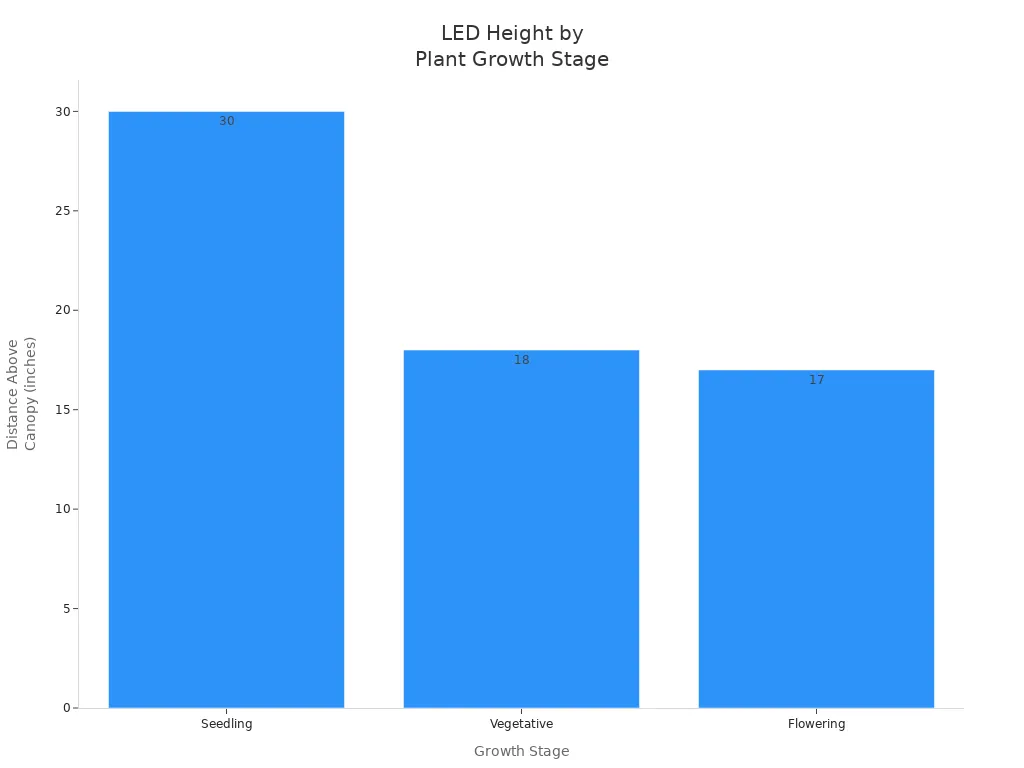
Mounting height affects how evenly light spreads. If you hang lights too high, you get dark spots. If you hang them too low, you risk burning plants. Use a PAR meter to check light levels and follow the manufacturer’s PPFD map for your greenhouse LED lighting systems.
Voltage and Compatibility
You must check the voltage and power needs before installing your lights. Each LED fixture has a specific voltage range and power rating. If you use the wrong voltage, your lights may flicker, dim, or even fail. Voltage mismatches can also cause safety problems like shocks or fires. Always match your power supply to the LED’s needs and use the right wire size. Good wiring and secure connections help prevent problems and keep your system safe. Regular checks by a professional can catch issues early.
- Voltage drops can cause dimming at the end of LED strips.
- Loose connections shorten LED lifespan.
- Overloaded circuits increase fire risk.
- Use parallel circuits and high-quality materials for safety.
Lifespan and Upkeep
LED lights last much longer than old HPS lights. Most greenhouse LED lighting systems work for over 50,000 hours, while HPS lights last only 10,000 to 24,000 hours.
| Lighting Type | Average Lifespan (hours) |
|---|---|
| Traditional HPS Lighting | 10,000 – 24,000 |
| Greenhouse LED Lighting | 50,000+ |
LEDs need less maintenance. You should still clean the fixtures and check for dust or water buildup. Make sure all wires and connections stay tight. Fewer repairs mean you save time and money. Lower heat output also reduces the need for cooling and cuts water use. Many systems come with warranties, so you get extra peace of mind.
Cost and Support
Upfront and Ongoing Costs
When you plan greenhouse lighting, think about all costs. You pay more for LED fixtures than old lights, but they last longer. You might need to pay workers to install the lights. Sometimes, you have to upgrade your electrical system. LEDs use less energy than HPS lamps, so your bills are lower. You save money every month because of this. LEDs last longer, so you do not need to replace them often. This means you spend less on repairs. Your electricity bill depends on how long you use the lights and local prices. Some power companies or governments give rebates or deals to help with costs. LEDs make less heat, so in winter you may pay more for heating. But you save money on cooling in summer. Making a cost chart helps you see what you spend and save. This helps you pick the best choice for your budget. You pay more at first, but LEDs save you money over time. Greenhouse LED lighting systems can cut yearly costs by about 43% compared to HPS lights. You also get about 35% energy savings and lower HVAC bills.
Before you buy greenhouse LED lighting systems, review your plant needs, area size, energy use, and budget. Use this checklist:
- What spectrum and intensity do your plants need?
- Does the system cover your growing area?
- Can you control light levels and heat?
- What is the warranty and support?
Choose lighting that matches your greenhouse goals. Ask experts if you need help. Use these questions to make a smart choice.
FAQ
What is the best spectrum for most greenhouse crops?
You should use a full-spectrum LED light. This type of light gives your plants red, blue, and some far-red wavelengths. Full-spectrum lights help most crops grow strong and healthy.
How often do you need to clean LED fixtures?
You should clean your LED fixtures every month. Dust and water spots can block light. Use a soft cloth and avoid harsh cleaners. Clean lights help your plants get the most energy.
Can you use LED lights with any greenhouse size?
Yes, you can use LED lights in any greenhouse. You need to measure your space and choose the right number of fixtures. Small and large greenhouses both benefit from LED lighting.
Do LED lights work in cold weather?
LED lights work well in cold weather. They turn on right away and do not lose brightness. You do not need to worry about them failing in winter.
How do you know if your plants get enough light?
You can use a PAR meter to check light levels. Watch your plants for signs like slow growth or pale leaves. Healthy plants with strong color show you that your lighting works well.