

Choosing the best greenhouse grow lights means you match the right type, spectrum, and features to your plants, greenhouse size, and budget. You give your plants the light they need when natural sunlight is not enough. Studies show that using supplemental LED lighting can boost tomato yields by up to 40% and improve fruit quality. You also help plants grow larger leaves and increase their photosynthetic capacity.
With the right greenhouse grow lights, you set your plants up for healthier growth and bigger harvests.
Key Takeaways
- Choose grow lights that match your plants’ needs, growth stage, and greenhouse size for best results.
- LED grow lights save energy, last long, and let you control light color and intensity precisely.
- Use blue light for strong leaves and stems, red light to encourage flowers and fruit, and adjust light hours to 12–16 daily.
- Place lights at the right height and spread them evenly to avoid dark spots and leaf damage.
- Group plants by light needs and use timers or automation to keep a steady light schedule and save energy.
Why Use Greenhouse Grow Lights
Light and Plant Growth
Plants need light to grow, but not all light is the same. You give your plants the best chance to thrive when you provide the right kind of light. In a greenhouse, sunlight may not always meet your plants’ needs. That is where greenhouse grow lights come in.
Tip: Plants use light for photosynthesis, which helps them make food and grow strong.
Different colors of light affect plants in different ways. Blue light helps leaves grow and keeps stems short and sturdy. Red light encourages flowering and fruiting. Plants absorb light best in the 400-700 nm range, called Photosynthetically Active Radiation (PAR). If you use LED grow lights, you can choose the exact colors your plants need. This helps you control how fast your plants grow and when they flower.
You also need to think about how bright the light is. If the light is too weak, your plants may become tall and thin. If the light is too strong, it can damage leaves. Most plants need 12-16 hours of light each day to grow well. By adjusting the light spectrum, intensity, and duration, you help your plants grow faster and healthier.
- Key benefits of using artificial grow lights:
- Support plant growth during low-light seasons
- Allow year-round harvests
- Increase crop yields and quality
- Enable precise control over plant development
When Extra Light Is Needed
You may notice your plants struggle during winter or on cloudy days. In these times, natural sunlight does not provide enough energy for healthy growth. Supplemental lighting becomes critical in places with short days, frequent clouds, or high latitudes. For example, greenhouses in northern states need much more artificial light in winter than those in sunny regions.
🌱 Note: Supplemental lighting helps you keep your plants growing strong, even when the weather outside is gloomy.
Greenhouse grow lights let you adjust the amount and type of light your plants receive. This means you can grow crops all year, no matter the season or weather. You can also use timers to make sure your plants get the right amount of light each day. This control helps you avoid plant stress and supports better yields.
Types of Greenhouse Grow Lights

Choosing the right type of greenhouse grow lights helps your plants get the best start. Each light type has its own strengths and best uses. Here is a quick comparison:
| Grow Light Type | Energy Use | Lifespan (hours) | Heat Output | Best For | Notes |
|---|---|---|---|---|---|
| LED | Very low | Up to 50,000 | Low | All growth stages, large and small spaces | Customizable spectrum, higher upfront cost, long-term savings |
| Fluorescent | Moderate | 7,000–15,000 | Low | Seedlings, herbs, leafy greens | Gentle light, not strong enough for flowering or fruiting |
| HID/HPS | High | Shorter than LED | High | Flowering, tall plants, large greenhouses | Strong light, needs cooling, higher energy bills |
LED Grow Lights
LED grow lights are the most energy-efficient choice. You save up to 85% on energy compared to older lights. LEDs last much longer—up to 50,000 hours—so you do not need to replace them often. They produce very little heat, so you can place them close to your plants without burning leaves. You can also pick the exact light spectrum your plants need, which helps at every stage of growth. While LEDs cost more at first, you save money over time because they use less power and last longer.
🌟 Tip: LEDs work well for all plant types and greenhouse sizes. They help you control light for better growth and bigger harvests.
Fluorescent Lights
Fluorescent lights, like T5 or CFL bulbs, use less energy than old-fashioned bulbs. They give off gentle, cool light, making them perfect for seedlings and young plants. You can place them close to your plants without worrying about heat damage. Fluorescents have a moderate lifespan and cost less than LEDs. However, they do not provide enough light for mature or fruiting plants. They work best for starting seeds, growing herbs, or leafy greens in small greenhouses.
- Fluorescents are easy to set up and move.
- They support healthy roots and leaves but may not help with flowering.
HID and HPS Lights
HID (High-Intensity Discharge) and HPS (High-Pressure Sodium) lights give off very strong light. Many large greenhouses use them for flowering plants and tall crops. HPS lights work well for plants that need lots of light, especially during blooming. However, these lights use a lot of energy and get very hot. You need good ventilation to keep your greenhouse cool. HID and HPS lights cost less to buy than LEDs, but you may pay more for electricity and cooling.
- HID and HPS lights shine over long distances, good for tall plant canopies.
- They are less flexible with light spectrum and need more maintenance.
Key Factors for Choosing Grow Lights
Light Spectrum
You should pick the right light spectrum for each plant stage. Plants use different colors of light for different things. Blue light helps young plants grow strong stems and leaves. Red light helps plants make flowers and fruit. Green light goes deeper into the plant and shapes how it grows. Some growers use a little ultraviolet or far-red light to make plants look better or taste better.
Here is a table that shows how each part of the light spectrum affects plant growth and flowering:
| Light Spectrum Range | Effect on Plant Growth and Flowering | Practical Implications |
|---|---|---|
| Blue Light (400–500 nm) | Promotes vegetative growth, stomatal opening, results in shorter stems and thicker leaves. Inhibits excessive elongation. | Ideal during seedling and vegetative stages to build strong roots and stems. |
| Red Light (600–700 nm) | Highly effective for photosynthesis, encourages stem elongation, leaf expansion, and flowering initiation. Peaks around 660 nm. | Crucial during flowering stage to initiate and regulate bloom development. |
| Green Light (500–600 nm) | Penetrates canopy, promotes shoot growth, inhibits root growth, contributes to plant architecture. | Useful in controlled environments to manage plant structure. |
| Ultraviolet Light (100–400 nm) | Enhances plant quality by increasing compounds like carotenoids, improves flavor and color; excessive UV is harmful. | Small amounts improve nutritional value and aroma; overexposure damages plants. |
| Far-Red Light (700–850 nm) | Influences flowering timing and bud size; works with red light to optimize photosynthesis. | Increased during flowering to improve flower yield and size; must be balanced to avoid excessive stretching. |
| Full-Spectrum LED Lights | Mimic natural sunlight, support all growth stages by providing balanced wavelengths. | Suitable for growers wanting one light source for entire plant lifecycle. |
| Targeted-Spectrum LED Lights | Emit specific wavelengths (mainly blue and red) to optimize particular growth phases, reduce energy waste and heat. | Allow customization for vegetative or flowering stages, improving efficiency and yield. |
Try to find greenhouse grow lights with a full spectrum or adjustable spectrum. The best color temperature for most plants is 4000K to 6500K. This range is like daylight and gives plants the blue light they need. Many LED grow lights let you change the color temperature. This helps you give your plants what they need at every stage.
🌱 Tip: Use dimmable lights to control how bright they are. If leaves look pale or brown, move the lights up or turn them down.
Energy Efficiency
You want to save energy and pay less for power. LED grow lights use the least energy in greenhouses. Studies show LED toplights can save over half the energy compared to old lights. These lights also meet strict energy rules and might get you rebates. Over time, you spend less money and your plants get more light.
💡 Note: Energy-efficient greenhouse grow lights help you grow more crops with less electricity. This saves money and helps the planet.
Coverage and Placement
You need to make sure all your plants get enough light. Measure the area your plants cover, not just the greenhouse size. For example, if your plants fill a 4′ x 4′ space, use that number. Most flowering plants need 20-30 watts for each square foot. Multiply your plant area by this number to know how much light you need.
To cover your plants well, follow these steps: 1. Put your lights at the right height above your plants. Check the guide for each light type. 2. Use more than one light if your area is big. This stops dark spots. 3. Add shiny materials, like mylar, to reflect light back to your plants. 4. Move your lights or raise them as your plants get taller. 5. Turn your plants so every side gets light.
📏 Tip: Use a light meter to check if your plants get enough light. This tool helps you find the best spot for your lights.
Heat Output
Different grow lights make different amounts of heat. LEDs make very little heat, so you can put them close to plants. Fluorescent lights make a bit more heat but are still safe for young plants. HID and HPS lights get very hot and need to be farther away. Too much heat can burn plants and make your greenhouse too warm.
Here is a table comparing heat output:
| Grow Light Type | Heat Generation | Implications for Greenhouse Climate Control |
|---|---|---|
| LED Grow Lights | Minimal heat | Energy-efficient; suitable for close proximity to plants and vertical systems; reduces climate control complexity |
| High-Intensity Discharge (HID) Lights (Metal Halide, High-Pressure Sodium) | Significant heat | Complicates temperature management; risk of plant burn; unsuitable for limited vertical clearance; requires additional cooling or ventilation |
| Fluorescent Lights | Moderate heat (less than HID, more than LED) | Suitable for seedlings and low-light plants; can be placed close to plants without burning |
| Incandescent Lights | High heat | Inefficient; excessive heat output; generally not recommended for greenhouses |
🔥 Alert: If you use HID or HPS lights, make sure your greenhouse has good airflow or fans to stop overheating.
Durability and Lifespan
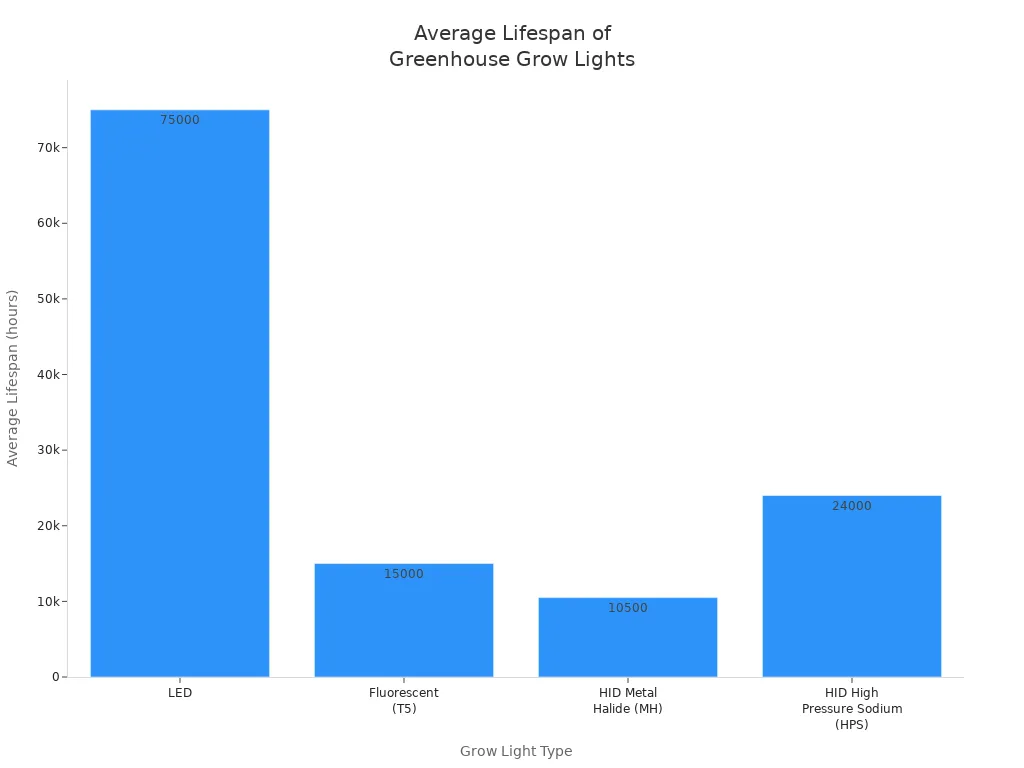
You want lights that last a long time and do not need to be replaced often. LED grow lights can last up to 100,000 hours, which is 5 to 10 years. Fluorescent lights last about 10,000 to 20,000 hours. HID lights last 6,000 to 24,000 hours, but they get dimmer over time. Longer-lasting lights save you money and make less trash.
🕒 Note: Pick high-quality greenhouse grow lights with a good warranty. This protects your money and keeps your plants healthy.
Budget
You need to think about your budget and your growing plans. LED lights cost more at first, but they save money because they use less energy and last longer. HPS and HID lights are cheaper to buy but use more power and need new bulbs often. Over five years, LEDs can save you a lot of money for big greenhouses.
Here is a table comparing costs:
| Aspect | LED Lighting | HPS Lighting |
|---|---|---|
| Initial Cost | Higher upfront | Lower upfront |
| Energy Consumption | Reduced by nearly 47% compared to HPS | Higher energy use |
| Annual Energy Savings | $230,994.89 | N/A |
| Bulb Replacement Cost (Annual) | None | $32,242.20 |
| Bulb Replacement Cost (5 Years) | None | $161,211.00 |
| Payback Period | 1 to 2 years | N/A |
| Warranty Period | Typically 5 years | N/A |
| Total 5-Year Savings (Energy + Maintenance) | ~$1,316,185.46 | N/A |
| Environmental Impact | 682 metric ton CO2 reduction over 5 years | Higher emissions |
💰 Tip: Think about both the starting price and the money you save later when picking greenhouse grow lights. LEDs usually pay for themselves in a few years.Choosing LED grow lights made in China will shorten the payback period.
Matching Lights to Plant Needs

Seedlings vs. Mature Plants
You must use the right lights for each plant stage. Seedlings and mature plants need different things. Seedlings like gentle, cool light and do not need much intensity. Too much light can make seedlings weak or stressed. If they do not get enough light, they grow tall and thin. Fluorescent lights are good for seedlings because they stay cool and have a balanced spectrum.
When plants get bigger, their leaves spread out more. Mature plants need stronger light to reach all their leaves. When plants start to flower or make fruit, they need even more light. They especially need more red light. LED or HID lights give mature plants the strong and red light they need.
- Seedlings need:
- Less intense light
- Cooler spectrum with more blue light
- 12-16 hours of light each day
- Mature plants need:
- Stronger light
- More red light for flowers and fruit
- 12-16 hours of light, depending on the plant
🌱 Tip: Try to keep seedlings and mature plants apart. This way, you can give each group the best light.
If you put mature plants above seedlings, the lower ones may not get enough light. It is better not to do this in your greenhouse.
Grouping by Light Requirements
You can make your greenhouse work better by putting plants with similar light needs together. Plants need different amounts of light each day. Some need a lot, and some need less. If you group plants by their light needs, it is easier to control the lights. This helps all your plants grow well.
- Low-light plants: Ferns, lettuce, and some herbs. These need less light and shorter times.
- Moderate-light plants: Leafy greens, many vegetables, and some flowers. These need medium light and time.
- High-light plants: Tomatoes, peppers, cannabis, and many fruit crops. These need strong light for longer times.
You can also group plants by how they react to day length:
- Long-day plants: Need long days to flower. Use low-intensity lights to make days longer.
- Short-day plants: Flower when days are short. Use blackout cloth to make days shorter.
- Day-neutral plants: Flower no matter how long the day is. You can group these any way you want.
| Factor | Description | Plant-Specific Considerations |
|---|---|---|
| Light Spectrum Type | Pick full-spectrum LEDs or targeted-spectrum LEDs | Full-spectrum works for most; targeted spectrum helps special crops or stages |
| Red and Blue Light Balance | Red light helps flowers; blue light helps growth | Change the mix for more blooms or compact plants |
| Additional Wavelengths | Far-red and UV can help flowers and quality | Use carefully so plants do not get stressed |
| Daily Light Integral (DLI) | Total light plants get each day | Leafy greens need medium DLI; fruiting plants need high DLI |
| Light Intensity and Growth Stage | Seedlings need less light; mature plants need more | Change light as plants grow bigger |
| LED Fixture Placement | Height and spacing change coverage | Keep lights higher for seedlings, closer for mature plants |
| Uniform Light Distribution | Stop shadows and hot spots | Move lights as plants grow taller |
| Heat Output | LEDs stay cool; HIDs get hot | Pick what works best for your greenhouse |
| Photoperiod Management | Use timers to control day length | Helps manage when plants flower and grow |
💡 Note: Grouping plants by light needs saves energy and helps your greenhouse grow lights work better.
Timers and Automation
Timers and automation make greenhouse lighting much easier. You can set timers to turn lights on and off every day. This keeps plants on a regular schedule and helps them grow well. Automated systems can change light intensity and spectrum for each stage. Some smart systems even change lights based on sunlight, saving up to 40% on energy.
- Benefits of timers and automation:
- Keep lighting schedules steady
- Use less energy and save money
- No need to switch lights by hand
- Change light for different plant groups or stages
- Control and check lights from your phone or computer
- Work with other systems like temperature and humidity
🕒 Tip: Automated lighting systems help you make the best place for your plants, get bigger harvests, and save time.
With timers and smart controls, you can switch crops fast without moving lights. Automation also helps you avoid mistakes and keeps plants healthy, even if you are not at the greenhouse.
Recommendations and Tips
For Seedlings
Starting seeds with the right light helps you grow strong, healthy plants. You should use full-spectrum LED grow lights that mimic sunlight. Place the lights about 6 inches above your seed trays. Raise the lights as the seedlings grow. Give your seedlings 12 to 18 hours of light each day. Use a timer to keep the light schedule steady.
- Begin using grow lights as soon as you plant seeds or when seedlings appear.
- Keep lights close to seedlings, but not so close that leaves burn.
- Watch for signs of trouble. If stems look long and thin or leaves turn pale, your seedlings need more light. If leaves look brown or dry, move the lights higher.
- Rotate seed trays if the light does not cover all seedlings evenly.
- Expand your lighting setup if you grow many seedlings or need longer indoor growing periods.
💡 Tip: LED grow lights work well for seedlings because they use less energy and do not get hot.
For Vegetables
Vegetables need strong, steady light to grow big and healthy. You can choose from several high-quality LED grow lights that support all growth stages. Look for features like full-spectrum light, dimmable settings, and good heat control. These features help you get the best results for leafy greens and fruiting crops.
| Product Name | Key Features | Best Use Case |
|---|---|---|
| MARS HYDRO TSW 2000 | High-efficiency white light, large coverage, dimmable, cool operation | Large hydroponic setups, leafy greens, fruit crops |
| VIPARSPECTRA P2000 | Full spectrum, dimmable, energy-efficient, quiet fans | Small to medium gardens, all growth stages |
| Spider Farmer SF-2000 | Full growth cycle support, optimal intensity and spectrum | Indoor grows with little sunlight, vegetables and flowers |
| Mars Hydro TS 1000 | Full-spectrum, energy-efficient, compact | Small to medium gardens, herbs, leafy greens |
| Viparspectra XS2000 | Advanced LED tech, dimmable, energy-saving | Small to medium spaces, customizable intensity |
| HLG 550 V2 Rspec | Full-spectrum with deep red, large coverage, high efficiency | Large hydroponic setups, leafy greens, fruit crops |
You should pick energy-efficient lights to save money and keep your greenhouse cool. Many LED systems let you adjust the light for each crop. Some even connect to software for real-time control. This helps you give each vegetable the right amount of light and spectrum.
🥦 Note: Full-spectrum or adjustable LED lights help you grow vegetables year-round and boost your harvest.
For Flowers
Flowering plants need special light to bloom well. The right spectrum makes a big difference. Blue light helps flowers grow thick stems and strong leaves. Red and far-red light help flowers open and grow bigger. Too much red light can make stems long and weak, so you need a good balance.
- Use LED grow lights with adjustable spectrum to control blue, red, and far-red light.
- Give your flowers at least 5-30 μmol/m2/s of blue light for strong growth.
- Keep the red to far-red ratio below 2 for better flowering, especially for short-day plants.
- Add a little green light to help lower leaves get enough energy.
- Limit UV light to avoid plant damage, but a small amount can make flowers more colorful and compact.
🌸 Tip: Adjust your greenhouse grow lights as flowers develop. This helps you get more blooms and better quality.
| Grow Light Type | Cost-Effectiveness | Energy Efficiency | Heat Output | Suitable For Small-Scale/Hobby Use | Key Advantages |
|---|---|---|---|---|---|
| Fluorescent (T5) | High | High | Low | Yes | Versatile, low heat, good for seedlings and vegetative growth, budget-friendly |
| Incandescent | Moderate | Low | High | Limited | Budget starter, small spaces, but short lifespan and heat issues |
| LED (T5 LED, bars, strips) | High | Very High | Very Low | Yes | Long-lasting, energy-saving, tailored spectrum, easy installation |
| Metal Halide | Low | Moderate | High | No | Powerful, suited for large commercial operations, high heat output |
💰 Tip: Choose LED or T5 fluorescent lights for the best mix of price, energy savings, and plant health in your small greenhouse.
When you choose greenhouse grow lights, focus on these key points:
- Match light type and spectrum to your plants’ needs and growth stage.
- Adjust light intensity and placement to avoid stress or burns.
- Pick energy-efficient options that fit your greenhouse size and budget.
🌱 The right lighting setup can boost plant health, increase yield, and save energy. Take time to assess your space and crop needs. With smart choices, you set your greenhouse up for success!
FAQ
How close should I place grow lights to my plants?
Keep LED grow lights 6–12 inches above seedlings. For mature plants, use 12–24 inches. Fluorescent lights can sit closer, about 4–6 inches. Always check for leaf burn or stretching. Adjust the height as your plants grow.
🌱 Tip: Move lights higher if leaves look pale or burnt.
Can I use regular household bulbs for greenhouse plants?
Regular bulbs do not provide the right spectrum or intensity for healthy plant growth. Choose grow lights labeled as “full-spectrum” or “plant grow lights.” These lights give your plants the energy they need for photosynthesis.
How many hours per day should I run my grow lights?
Most plants need 12–16 hours of light each day. Use a timer to keep the schedule steady. Too much light can stress plants. Too little light can cause weak growth.
Do all plants need the same type of grow light?
Different plants need different light types and strengths. Leafy greens and herbs do well with fluorescent or LED lights. Fruiting plants like tomatoes need stronger, full-spectrum LED or HID lights.
How do I know if my plants get enough light?
Look for healthy, green leaves and sturdy stems. If plants look tall and thin or leaves turn yellow, they need more light. Use a light meter for accurate measurement.
💡 Note: Adjust light placement and intensity as your plants grow.