

If you want the best results for your indoor gardening, full spectrum led grow lights often work better for most plants. These lights mimic natural sunlight and support every stage of plant growth. Many growers prefer full spectrum options because they help you spot plant health issues and keep plants strong.
- Full spectrum led grow lights offer a broad range of wavelengths, which benefits both plant health and yield.
- Red/blue grow lights use less energy but work best in greenhouses where sunlight fills in the gaps.
- Full spectrum lights create a better environment for checking your plants and adjusting care as needed.
When you choose a plant light, think about your plant type, growth stage, and where you plan to use your grow lights. This comparison will help you find the right fit for your needs.
Key Takeaways
- Full spectrum LED grow lights provide all colors plants need, helping them grow strong leaves, flowers, and fruits indoors.
- Red/blue LED grow lights save energy and work well in greenhouses where sunlight fills in missing light colors.
- Adjusting the red and blue light ratio during plant growth stages boosts leaf growth, flowering, and fruit yield.
- Full spectrum lights improve plant health by reducing disease and stress with extra light colors like UV and infrared.
- Choose energy-efficient LED grow lights that fit your plants and space to grow healthy plants and save on costs.
Spectrum Basics

Full Spectrum LED Grow Lights
Full spectrum led grow lights give you a wide range of wavelengths, much like natural sunlight. These lights include blue light, red light, green, ultraviolet (UV), and infrared (IR). Each part of the spectrum helps your plants in different ways. Blue light encourages strong leaves and stems. Red light supports flowering and fruiting. Green light goes deeper into leaves, helping growth in lower parts of the plant. UV light can make plants tougher and improve flavors. Full spectrum led grow lights let you control the grow light spectrum, so you can match it to your plants’ needs at every stage. This broad spectrum coverage makes full spectrum grow lights a top choice for indoor gardening.
Red/Blue Grow Lights
Red/blue grow lights focus on the two main colors plants use for photosynthesis. Blue light, in the 400–500 nm range, helps with leaf growth and keeps stems short and strong. Red light, in the 600–700 nm range, is key for flowering and fruiting. These led grow lights target the red and blue spectrum, which plants absorb best. By using only these colors, red/blue grow lights save energy and work well in greenhouses where sunlight fills in the missing parts of the spectrum. The red blue spectrum supports the photosynthetic process, but it does not offer the full spectrum coverage that some plants need for best results.
Why Spectrum Matters
The grow light spectrum affects how well your plants grow. Plants use different wavelengths for different jobs. Blue light helps with healthy leaves and strong stems. Red light boosts flowering and fruiting. Green light, though less absorbed, reaches deeper into the plant and helps with overall growth. UV and IR light can improve plant color and strength. Research shows that using only red light or blue light can cause weak stems or poor flowering. Full spectrum led grow lights and other led grow lights with broad spectrum coverage help you avoid these problems. They give your plants the light quality they need for every stage. When you compare full spectrum grow lights to red/blue grow lights, you see that spectrum coverage is key for healthy, strong plants. This comparison helps you choose the right grow lights for your setup.
Growth Results

Vegetative Stage
During the vegetative stage, your plants need strong leaves and stems to support future growth. The type of grow lights you choose can make a big difference. Studies show that led grow lights combining red light and blue light help plants like basil, radish, and coriander grow more leaves and stems. When you use a mix such as 10% blue and 90% red, you can see up to a 26% increase in dry mass. Basil shoots reach their highest dry weight under a 30% blue and 70% red mix. Radish plants grow bigger roots and thicker stems with a 2:1 red to blue ratio. Coriander also produces more leaves with a 10:1 red to blue ratio.
- Mixed red and blue led grow lights increase plant growth and biomass.
- Pure red or pure blue light alone does not work as well and can even harm plant growth.
- Blue light helps leaves grow larger and keeps plants compact.
- Red light supports strong stems and overall plant structure.
If you want the best results, use a led growth lamp that lets you adjust the red and blue light ratio. This way, you can match the light to your plant’s needs during the vegetative stage.
Flowering and Fruiting
When your plants move to the flowering and fruiting stage, the right plant light becomes even more important. Full spectrum led grow lights give your plants a balanced mix of wavelengths, just like sunlight. This helps your plants grow more flowers and bigger fruits. Red/blue led grow lights focus on the key colors for photosynthesis and flower production. Red light triggers the plant flowering phase and increases both flower size and fruit yield. Blue light keeps the leaves healthy and supports continued growth.
- Red light at about 660 nm helps your plants produce more flowers and fruit.
- Blue light at about 450 nm keeps leaves strong and green.
- Adjusting the red-to-blue ratio during flowering can boost cannabis bud yields by up to 30% and make tomatoes larger and faster to harvest.
- Far-red light can make flowers denser and speed up flowering, which is great for crops like tomatoes and cannabis.
- A 2:1 or 3:1 red-to-blue ratio works best for flowering, especially in cannabis.
Full spectrum led grow lights let you fine-tune the light recipe for each stage. You can use more blue light for seedlings, a balanced mix for vegetative growth, and more red light for flowering. This flexibility leads to healthier plants and better yields. Red/blue led grow lights can speed up flowering and increase yields, but they often cause plants to stretch more and may miss out on some benefits of green and yellow light.
Tip: If you want compact plants with lots of flowers, choose a full spectrum led growth lamp. It gives you more control over plant growth and flowering.
Overall Plant Health
Healthy plants need more than just red and blue light. Full spectrum grow lights include green, yellow, UV, and infrared light, which all play a role in plant health. UV light helps your plants fight off diseases by making them produce natural defense chemicals. This can cut down on fungal infections and pests like aphids by up to 40%. Infrared light helps roots grow deeper and stronger, which means your plants can take up more water and nutrients. When you use both UV and infrared light, your plants become even healthier and more resistant to stress.
| Light Spectrum | Effect on Plant Health | Disease Resistance & Pest Management | Leaf Quality & Growth |
|---|---|---|---|
| UV Light (280-400 nm) | Boosts natural defenses | Up to 40% less fungal and insect problems | More antioxidants, better leaf health |
| Infrared (700-1200 nm) | Stronger root systems | Indirectly supports disease resistance | 15% taller plants, more vigor |
| Blue Light (450-495 nm) | More chlorophyll, bigger leaves | N/A | 20% larger leaves, 15% more nutrients |
| Red/Far-Red Light | Better flowering and fruiting | N/A | 25% bigger fruit and higher yield |
Full spectrum led grow lights also reduce plant stress. They give a balanced mix of light that helps roots grow and keeps leaves healthy. Blue light controls plant hormones, which helps plants handle stress and grow strong. Red light triggers growth hormones that make roots longer and stronger. Led grow lights with adjustable spectrums let you create the best conditions for your plants, leading to better plant growth, stronger roots, and less stress.
If you want your plants to stay healthy and resist disease, choose a plant light that covers the full spectrum. This will help your plants grow better leaves, stronger roots, and more flowers and fruit.
Energy and Cost
Efficiency of LED Grow Lights
When you choose led grow lights, you want the most energy-efficient option. Energy efficiency means you get more light for your plants while using less electricity. Most modern grow lights use LEDs because they are energy-efficient and last a long time. The best led grow lights have a high photosynthetic photon efficacy (PPE). PPE measures how much usable light your plants get for each watt of power.
Red and blue led grow lights often show higher PPE numbers. They focus on the main colors plants use for photosynthesis. This makes them very energy-efficient. Full spectrum led grow lights include extra colors like green and far-red. These extra wavelengths help your plants grow better, but they can lower the measured PPE. Even so, full spectrum led grow lights still offer strong energy efficiency and support healthy, compact growth.
You should also look at how much power your grow lights use per square foot. Most led grow lights need 30 to 50 watts per square foot for standard growth. Flowering or light-hungry plants may need 50 to 75 watts per square foot. The actual energy use depends more on the quality and efficiency of the led grow lights than on the spectrum alone.
Tip: Choose energy-efficient led grow lights with high PPE for lower power bills and a smaller environmental impact.
Cost Comparison
When you compare the cost of led grow lights, you need to think about more than just the price tag. Energy-efficient grow lights save you money over time. Red/blue led grow lights often cost more at first, but they use less energy and last longer. Full spectrum led grow lights may have a lower upfront cost, but they can use more energy and may not last as long if they run hot.
Here is a quick comparison:
| Factor | Full Spectrum LED Grow Lights | Red/Blue LED Grow Lights |
|---|---|---|
| Upfront Cost | Lower | Higher |
| Energy Consumption | Higher | Lower |
| Heat Emission | Higher | Lower |
| Lifespan | Shorter | Longer |
| Maintenance | More frequent | Less frequent |
| Replacement Costs | Higher over 5 years | Lower over 5 years |
Energy-efficient led grow lights with good heat management last longer and need less maintenance. This saves you money and helps the environment. When you make your comparison, think about energy efficiency, lifespan, and total cost over time. Choosing the right grow lights will help you grow healthy plants and keep your costs low.
Suitability
Full Spectrum Grow Lights for Houseplants
You want your houseplants to look healthy and grow well. Full spectrum led grow lights give your plants all the colors they need, just like sunlight. These lights support every stage of plant growth, from strong leaves to bright flowers. Many users like models with adjustable spectrums, such as the Pulsar 800W and Quantum Board LED Grow Light. These options let you change the light for different plant types and growth stages. You can place these lights close to your plants because they do not get too hot. This helps your plants get enough light without burning. Full spectrum grow lights also make your plants look natural and bright, which makes your indoor gardening space more comfortable for you.
- Full spectrum led grow lights provide blue, red, green, UV, and IR light.
- Blue light helps leaves and stems grow strong.
- Red light supports flowering and fruiting.
- UV and IR light help plants resist stress and grow taller.
- These grow lights keep your houseplants healthy and colorful.
Red/Blue Grow Lights for Greenhouses
If you grow plants in a greenhouse, red/blue grow lights can save you money and energy. Greenhouses already get sunlight, so you only need to add extra light when needed. Red/blue grow lights use less electricity and give your plants the main colors for photosynthesis. Commercial growers like these lights because they lower costs and work well for large groups of plants. You can use fewer fixtures and still get good plant growth. These led grow lights also last a long time and do not get too hot, so you can place them close to your plants.
Tip: Use red/blue grow lights as extra lighting in greenhouses to boost plant growth and save on energy bills.
Light for Different Plant Types
Different type of plants need different light. Leafy greens and herbs like more blue light for strong leaves. Flowering plants and fruiting crops need more red light to make flowers and fruit. Full spectrum grow lights work best if you have many types of plants or want to see natural colors. Red/blue grow lights work well for fast-growing crops in greenhouses. If you care about how your plants look and want a comfortable room, choose full spectrum led grow lights. These lights make your plants look green and healthy, and they create a pleasant space for you.
| Plant Type | Best Grow Light Type | Why It Works Well |
|---|---|---|
| Houseplants | Full spectrum grow lights | Natural color, supports all growth stages |
| Leafy greens/herbs | Red/blue grow lights | Strong leaves, energy savings |
| Flowering/fruiting | Full spectrum grow lights | More blooms, better fruit |
Grow lights that match your plant’s needs help you get the best results in indoor gardening. Choose the right led plant lights for your space and enjoy healthy, beautiful plants.
Choosing the Right Grow Light
Matching Light to Growth Stage
You can boost plant growth by matching your LED grow light spectrum to each stage. Seedlings need more blue light for strong roots and compact leaves. As your plants enter the vegetative stage, they use both blue and red light for healthy stems and leaves. Flowering plants need more red and far-red light to make bigger flowers and fruit. The table below shows the best spectrum for each stage:
| Growth Stage | Red : Blue Ratio | Extra Spectrum | Light Intensity & Hours | Notes |
|---|---|---|---|---|
| Seedlings | 15% red : 35% blue | Low intensity, 24h | Start low, increase as leaves grow | MINI SUN-2 V1 is ideal |
| Vegetative | 60% red : 40% blue | Add green | Moderate-high, 16-18h | FOLD-600 V1 works well |
| Flowering | 100% red, low blue | Add far-red, UV | High, 12h darkness | SPECTRUM-X FS for flowers |
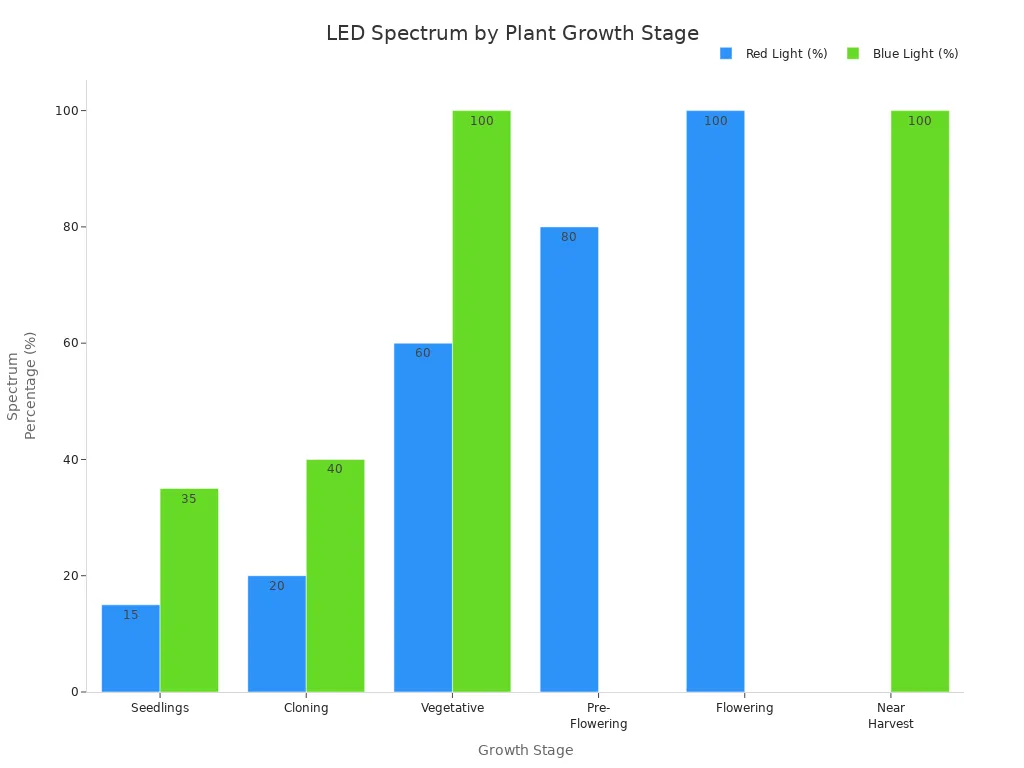
A customizable light spectrum lets you adjust the light as your plants grow. This helps you get the best results at every stage.
Budget and Setup
When choosing the right grow light, think about your budget and how easy the setup will be. Full spectrum LED grow lights cost more at first, but you only need one fixture for all stages. This makes setup simple and saves time. Red/blue LED grow lights cost less, but you may need extra lights for different stages. This can make your setup more complex and cost more in the long run.
| Model | Wattage | Spectrum | Coverage Area | Price | Best For |
|---|---|---|---|---|---|
| Spider Farmer SF 1000 | 100W | Full spectrum | 1m x 1m | $ | Beginners, small spaces |
| Mars Hydro TS 1000 | 150W | Full spectrum | 2-4 plants | $ | Hobbyists, energy saving |
Tip: For small spaces or if you are just starting, look for energy-efficient models like Spider Farmer SF 1000 or Mars Hydro TS 1000.
Practical Tips
You can get the most from your LED grow lights by following these steps:
- Place your lights 24–36 inches above your plants during bloom and up to 48 inches during vegetative growth.
- Keep room temperature between 83°F and 85°F. Lower it by 3–5°F in the last weeks of flowering.
- Adjust humidity to about 50%. Drop it below 40% in the last weeks to prevent mold.
- Use plain water every few waterings to avoid nutrient buildup.
- Prune large leaves to let more light reach flowers and fruit.
- Clean your lights often to keep them bright.
- Avoid cheap or regular LEDs. Always use grow lights made for plants.
Note: Start with the recommended settings and change them slowly. Take notes to see what works best for your plants.
When you choose a grow light, think about your plants and where you grow them.
- Full spectrum LED lights work best for indoor gardens. They give your plants all the colors they need and help you spot problems early.
- Red/blue LED lights save energy and fit greenhouses with natural sunlight.
- No single light works for every plant or setup.
- You get the best results by picking energy-efficient lights and making sure your plants get enough light each day.
Tip: Try different lights with your plants to see what helps them grow strong and healthy.
FAQ
What is the main difference between full spectrum and red/blue LED grow lights?
Full spectrum LED grow lights give your plants all the colors found in sunlight. Red/blue LED grow lights focus on just red and blue colors. Full spectrum lights help most plants grow better indoors.
Can you use red/blue LED grow lights for all plants?
You can use red/blue LED grow lights for many plants, especially leafy greens and herbs. Some flowering or fruiting plants may not grow as well. Full spectrum lights work better for a wider range of plants.
Do full spectrum LED grow lights cost more to run?
Full spectrum LED grow lights may use a little more energy than red/blue lights. The extra cost is small. You get better plant growth and healthier plants, which makes the extra cost worth it for most growers.
Are full spectrum grow lights safe for people and pets?
Yes, full spectrum LED grow lights are safe for people and pets. They do not give off harmful UV rays in large amounts. You should avoid staring directly at the lights to protect your eyes.
How close should you place LED grow lights to your plants?
You should place most LED grow lights 12 to 36 inches above your plants. Check your light’s instructions. Move the light closer for seedlings and farther away for mature plants. Watch your plants for signs of burning or stretching.