

LED grow lights for greenhouse use are now the most popular option, holding about 59.5% of the market. These grow lights for greenhouse setups use less energy than other types of lighting. They last longer and allow better control over light color compared to fluorescent and HPS lights, which don’t perform as well in these areas. Although LEDs cost more initially, they save money over time. Selecting the right grow lights for greenhouse environments helps plants grow more effectively, reduces cooling costs, and lowers labor requirements. Each type of grow light for greenhouse use has its own advantages, so choosing the best one ensures healthier plants and better harvests.
Key Takeaways
- LED grow lights save the most energy, last the longest, and help plants grow faster with better yields.
- Fluorescent lights work well for seedlings and small plants but do not suit large or flowering crops.
- HPS lights give strong red light for flowers and fruit but use more energy and produce a lot of heat.
- Choosing the right grow light depends on plant type, greenhouse size, climate, and budget for best results.
- Proper installation and maintenance of grow lights improve plant growth and save energy and costs.
Why Use Grow Lights for Greenhouse
Extending Seasons
Greenhouses help people grow crops when it is not the normal season. Sometimes, there is not enough sunlight in winter or on cloudy days. Scientists at Bath and Cambridge found that plants use red light best for photosynthesis. Sunlight has many colors, but plants cannot use them all. Some researchers made a coating for greenhouse glass. This coating changes blue and UV light into red light. With this new glass, basil crops grew 9% more in tests. These results show that better light inside greenhouses can help plants grow longer. Growers can pick crops for more months, even when it is not sunny.
Supplementing Sunlight
Sunlight helps plants grow strong, but it is not always enough. Studies say that extra LED lighting is needed when sunlight is low. Growers can change the color, strength, and time of light for plants. This helps keep crop growth steady all year. Experts say greenhouses should let in lots of sunlight and use extra lights when needed. Extra lighting, especially LEDs, helps plants get enough light each day. It also helps crops grow better and keeps them high quality. Growers can handle changes in seasons and keep growing crops.
Tip: You can change extra lighting when the weather changes. On sunny days, plants save more energy. This helps them grow even if it gets cloudy later.
Supporting Growth
Grow lights give plants the right light colors they need to grow well. LED lights give blue and red light, which are important for plants. Blue light helps plants make leaves and stems. Red light helps plants make flowers and fruit. Studies show that the right light colors help plants grow better and make more food. LED lights also help fruits and vegetables have more healthy things in them. Growers can change the light color and timing for each plant stage. This helps plants grow better and saves energy.
Types of Grow Lights for Greenhouse

Greenhouses use several kinds of grow lights to help plants. Each kind works in a special way and has good and bad points. The main types are LED, fluorescent, and HPS grow lights.
| Grow Light Type | Technology Category | Description & Characteristics |
|---|---|---|
| LED Grow Lights | Semiconductor-based | These lights save the most energy. You can change their color. They do not get very hot. They last a long time. You can use them for all plant stages. |
| Fluorescent Lights | Gas-discharge tubes | These lights come as tubes or CFLs. They do not get very hot. They work well for small plants and seedlings. They last a medium amount of time. |
| HPS Grow Lights | High-pressure gas discharge | These lights are very strong. They shine red light, which helps flowers grow. Big greenhouses use them. They make a lot of heat. |
LED Grow Lights
LED grow lights use special chips to make light. They use less energy and can last up to 50,000 hours. You can change the color and strength of the light for each plant stage. Some LEDs can copy sunrise and sunset. This helps plants feel less stress. LEDs do not get very hot. You can put them close to plants. Many greenhouses pick LEDs to save energy and keep things cool. Some LED systems change the light by themselves when the sun is bright.
Note: LED grow lights for greenhouse use can save up to 50% more energy than older lighting systems.
Fluorescent Grow Lights
Fluorescent grow lights use tubes filled with gas. They come in long tubes or small CFL shapes. These lights are good for young plants and seedlings. They do not get very hot and cost less than other lights. They last about 10,000 hours. Growers should put them 3-5 cm above the plants. Fluorescent lights have mercury inside, so you must throw them away safely. They use more energy and do not last as long as LEDs.
HPS Grow Lights
HPS grow lights use high-pressure gas to make light. They give off a strong red color. This helps plants make flowers and fruit. HPS lights are good for big greenhouses and farms. They make a lot of heat, so you need good airflow. HPS lights use more energy and do not last as long as LEDs. Many growers use HPS lights when they want more flowers or fruit.
LED Grow Lights

Features
LED grow lights use advanced technology to help plants grow in greenhouses. These lights give growers control over the color and strength of light. They can match the needs of different plant stages, such as germination, flowering, and fruiting. LED lights offer a full spectrum, including important wavelengths like red (610-700nm) and far-red (700-800nm), which boost photosynthesis and flowering. The lights produce very little heat, so growers can place them close to plants without causing damage. LEDs last a long time, often up to 50,000 hours, and need fewer replacements. Many LED systems allow growers to adjust the spectrum and timing for each crop. Some greenhouses use smart controls to change lighting based on sunlight or plant needs. Studies show that using LED lights can speed up plant growth and increase yields, such as tomatoes ripening faster and producing 16% more fruit.
Pros
- LED grow lights save 40% to 60% more energy than traditional HPS lights.
- They give off more photosynthetically active radiation (PAR), which helps plants grow better.
- Growers can fine-tune the light spectrum for each crop, improving color, taste, and nutrition.
- LEDs produce less heat, which lowers the risk of plant stress and reduces cooling costs.
- The long lifespan means fewer replacements and less waste.
- LED lights support smart greenhouse systems, allowing remote control and better energy use.
- They do not contain toxic materials like mercury and are fully recyclable.
- Using LEDs can lower the greenhouse’s carbon footprint and support sustainable farming.
Tip: Customizing the light spectrum with LEDs can help growers improve both the quality and quantity of their crops.
Cons
- LED grow lights cost much more at first, sometimes three to four times higher than other lights.
- Some LEDs do not provide the full range of light that plants get from the sun, which can limit growth.
- High-intensity LEDs can cause leaf burn if placed too close or used for too long.
- LEDs may disrupt the natural behavior of bees and other pollinators in the greenhouse.
- These lights do not fully copy the natural changes in sunlight, which can affect how plants grow and flower.
Fluorescent Grow Lights
Features
Fluorescent grow lights have tubes filled with gas that make light. These lights are good for small plants and seedlings. Many people use them when plants are just starting to grow. Fluorescent lights mostly give blue light, which helps plants make leaves and stems. Some special kinds give more red light, but they cost more and are not as bright. Most fluorescent lights need to be close to plants, about 6 to 24 inches away, because their light does not go far. They do not get very hot, so you can put them near gentle plants without hurting them. A fluorescent tube usually lasts about 10,000 hours.
| Feature | Description and How It Helps Plants |
|---|---|
| Energy Efficiency | Uses less power than old bulbs, saves energy, and makes less heat. |
| Spectral Output | Most types give more blue light; some add red but are dimmer and cost more. |
| Suitability | Best for young plants and seedlings; not good for big or old plants. |
| Light Intensity and Reach | Light gets weak past 24 inches, so keep lights close to plants. |
| Practical Advantages | Makes little heat, easy to set up, and lasts a fair amount of time. |
| Limitations | Does not last as long as LEDs or HPS; has mercury, which is dangerous if broken. |
| Cost and Trade-offs | Cheap for new growers; special types cost more and are not as bright. |
Pros
- Fluorescent grow lights use about half the energy of old lights.
- They cost less than most other grow lights, so they are good for people just starting.
- These lights work best for young plants like tomatoes and cucumbers.
- You can find them in many shapes and sizes to fit different plant spots.
- Fluorescent lights do not get very hot, so they almost never burn plants.
- The lights are easy to put up and move around.
Tip: Fluorescent lights help people start seeds inside before moving plants to the greenhouse.
Cons
- Fluorescent lights do not shine far, so they are not good for big or tall plants.
- They do not last as long as LEDs or HPS lights, so you need to change them more often.
- These lights have mercury, which can hurt people and nature if a bulb breaks.
- Special tubes that give more colors cost more and are not as bright as regular ones.
- Fluorescent lights are best for early plant growth, not for making flowers or fruit.
HPS Grow Lights
Features
HPS grow lights have been used in greenhouses for a long time. They make a strong orange and yellow light. These lights give off a lot of heat because of infrared radiation. The heat can make the area around plants warmer. Sometimes, this extra heat can hurt or stress the plants. HPS lights only give one kind of light, so they are easy to buy and set up. Most HPS bulbs last from 10,000 to 20,000 hours. They work best when you hang them high above the plants. This is good for big greenhouses with tall roofs. HPS lights shine over a wide area and cover many plants at once. But they do not give much blue or red light, which plants need most for photosynthesis. Because of this, some energy is wasted.
Note: HPS lights can help keep greenhouses warm in cold places, but growers need to watch for too much heat when it is warm outside.
Pros
- HPS grow lights shine evenly, so they are good for big greenhouses.
- The heat from these lights can help plants stay warm in cold weather.
- HPS lights cost less at first than LED lights, which helps people save money.
- They are simple to put in and change because they use just one kind of light.
- Many people still use HPS lights because they help plants make flowers and fruit.
Cons
| Disadvantage Aspect | Explanation |
|---|---|
| Radiant Heat Production | HPS bulbs can get hotter than 800°F, so growers must keep them far from plants to stop damage. |
| Heat vs. Light Trade-off | If you use lower wattage HPS lights, they make less heat but also less light, so they do not work as well. |
| Energy Efficiency | HPS lights are not as good as LEDs at turning electricity into plant light. |
HPS lights make a lot of heat, so it is harder to keep the greenhouse cool. Growers often need fans or air conditioners, which use more energy. The light from HPS bulbs does not match what plants use best, so some energy is wasted. Studies show that moving HPS lights can make plants grow less, like a 13.5% drop in tomato dry weight. HPS bulbs also need to be changed more often than LEDs, which costs more over time.
Tip: Growers should check the greenhouse temperature often when using HPS lights. This helps stop plant stress and keeps energy costs down.
Comparison
Growth and Yield
LED grow lights help plants grow faster and produce more food in greenhouses. These lights give plants the best mix of red and blue light, which helps with photosynthesis. Plants under LEDs often have stronger stems and more leaves. Tomatoes and other crops can ripen faster and give bigger harvests. LEDs also let growers put lights close to the plants, even under the leaves. This helps all parts of the plant get enough light.
HPS grow lights work well for plants that need a lot of light to make flowers and fruit, like tomatoes and peppers. They shine mostly yellow and red light, which helps with flowering. However, HPS lights make a lot of heat. This can stress plants and lower the amount of food they make if the greenhouse gets too hot.
Fluorescent grow lights are best for young plants and seedlings. They do not give enough light for big plants or for making fruit. Most growers use them at the start of the plant’s life.
Plants under LED grow lights for greenhouse use often grow faster and give higher yields than those under HPS or fluorescent lights.
Energy Use
LED grow lights use much less energy than HPS or fluorescent lights. They save about 40-60% more energy. For example, a 600-watt HPS light uses a lot of electricity every day. An LED system that gives the same amount of light uses much less power. This helps growers save money on their electric bills.
HPS lights use the most energy. They also make a lot of heat, so growers often need to run fans or air conditioners to keep the greenhouse cool. This adds even more to the energy cost.
Fluorescent lights use less energy than HPS but more than LEDs. They work well for small plants but are not as efficient for big greenhouses.
| Grow Light Type | Energy Efficiency | Typical Use Case |
|---|---|---|
| LED | Very high | All plant stages |
| Fluorescent | Medium | Seedlings, small plants |
| HPS | Low | Flowering, fruiting |
Heat Output
LED grow lights make very little heat. This helps keep the greenhouse cool and saves money on cooling. Growers can put LEDs close to the plants without burning them. This is important in warm places or in greenhouses that do not have much airflow.
HPS lights make a lot of heat. Growers must hang them high above the plants to stop leaf burn. In cold weather, this heat can help keep the greenhouse warm. In hot weather, it can cause problems and make cooling costs go up.
Fluorescent lights make some heat, but not as much as HPS. They are safe to use near young plants and do not need much extra cooling.
LED lights are the best choice for greenhouses where keeping the temperature low is important.
Lifespan
LED grow lights last the longest. Many LEDs work for 50,000 to 100,000 hours before needing replacement. This means growers do not have to change them often, which saves time and money.
HPS lights last about 10,000 to 24,000 hours. Growers need to replace them more often, which adds to the cost and work.
Fluorescent lights last between 8,000 and 15,000 hours. They need to be changed more often than LEDs but about as often as HPS lights.
| Grow Light Type | Average Lifespan (hours) |
|---|---|
| LED | 50,000 – 100,000 |
| HPS | 10,000 – 24,000 |
| Fluorescent | 8,000 – 15,000 |
Cost
LED grow lights cost more to buy at first. However, they use less energy, make less heat, and last much longer. This means growers save money over time on electricity, cooling, and replacement bulbs.
HPS lights cost less to buy. They use more electricity and make more heat, so growers pay more for power and cooling. HPS bulbs also need to be replaced more often, which adds to the cost.
Fluorescent lights are cheap to buy. They use more energy than LEDs and do not last as long. They are best for small projects or for starting plants.
| Cost Category | LED Grow Lights (20 units) | HPS Grow Lights (20 units) |
|---|---|---|
| Upfront Cost | $13,000 | $6,000 |
| Electricity Cost/Year | $7,570 | $10,500 |
| AC Cooling Cost/Year | $2,500 | $3,800 |
| Lamp Replacement Cost | None (lasts ~10 years) | $1,200/year |
| Rebates | $3,900 | Not eligible |
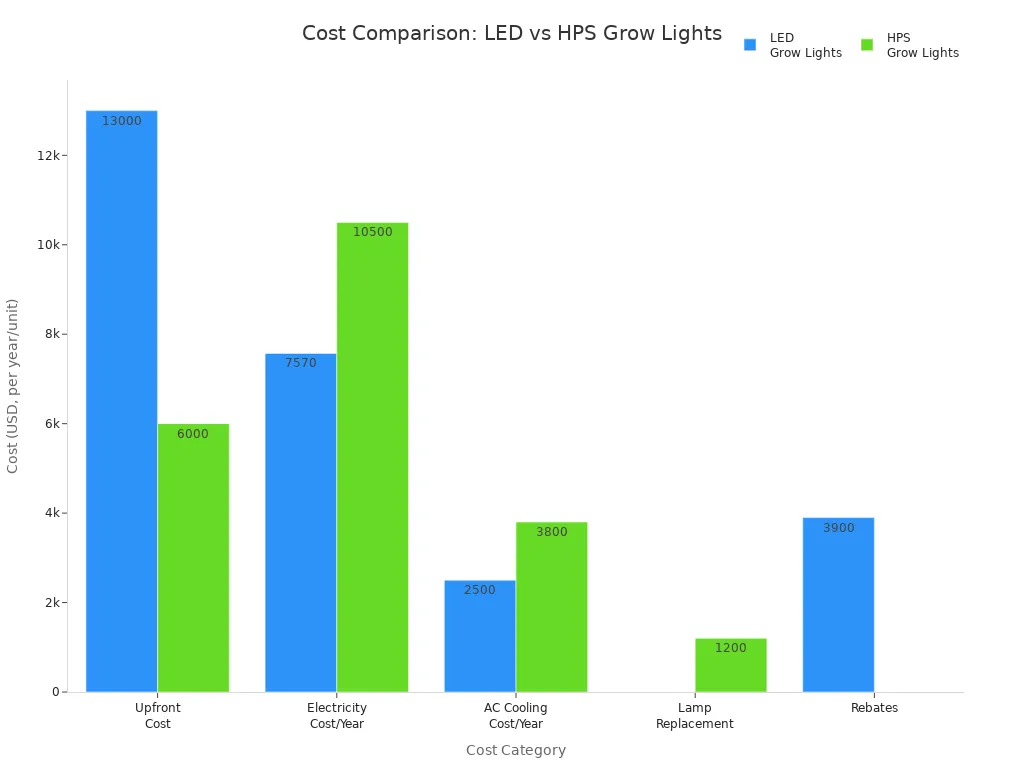
Over five years, LED grow lights for greenhouse use can save about 30% in operational costs compared to HPS lights.
Practical Tips
Installation
Setting up grow lights the right way helps plants grow better. Use chain-and-hook systems to move lights up or down as plants get taller. For seedlings, put lights about 2-3 inches above them. When plants get bigger, hang LED lights 30-60 cm above the plants. Seedlings need lights 60-90 cm above to stop stress. Keep lights 60-90 cm apart so all plants get light. Put LEDs in a grid to spread light evenly. Use a PAR meter to check how much light plants get. Fluorescent shop lights fit under shelves for growing on many levels. Wire shelves let some light reach lower plants. Timers or automatic controls help turn lights on and off at the right times.
| Installation Aspect | Recommendation Details |
|---|---|
| Height Placement | LEDs: 30-90 cm above plants; Fluorescents: 2-3 inches above seedlings; HPS: high above to avoid heat stress |
| Spacing | Fixtures 60-90 cm apart for uniform coverage |
| Light Cycle | Use timers for consistent cycles; 16 hours daily for seedlings |
Tip: Check for hot spots or dark spots and turn plants so they all grow the same.
Maintenance
Keep grow lights clean so they stay bright and safe. Wipe LED, fluorescent, and HPS lights with a soft cloth to remove dust and water. Always unplug lights and let them cool before cleaning. Use gentle cleaners on the cloth, not straight on the lights, to protect them. Look at lights for signs of heat damage, water, or loose wires. Waterproof lights and GFCI outlets help stop shocks. Change LED lights every 5-10 years, HPS bulbs every 1-2 years, and fluorescent tubes when needed. Store lights in cool, dry places to help them last longer.
Note: Throw away fluorescent bulbs safely because they have mercury inside.
Scalability
LED grow lights are easy to use in small or big greenhouses. They give lots of light, do not get hot, and last a long time. This makes them good for big farms. HPS lights work in large spaces but need more cooling and new bulbs often. Fluorescent lights are best for small projects or tests and are not strong enough for big greenhouses.
| Feature | LED Grow Light | HPS Grow Light | Fluorescent Grow Light |
|---|---|---|---|
| Scalability | High, easy to expand | Moderate, bulky | Low, best for small setups |
| Energy Efficiency | High | Low | Medium |
| Control Features | Advanced (timers, dimming) | Basic | Basic |
Growers should pick lights that fit their greenhouse size and future needs. LED systems are the easiest and most efficient to make bigger.
Choosing Grow Lights for Greenhouse
Plant Needs
Different plants and growth stages need specific types of light. Growers should match the light spectrum to the plant’s needs. Blue light helps seedlings and leafy greens grow strong roots and stems. Red light supports flowering and fruiting in crops like tomatoes and peppers. Far-red light can speed up flowering in some plants. Full-spectrum LED grow lights for greenhouse use work well for all plant types and stages. They mimic sunlight and support vegetables, herbs, flowers, and specialty crops.
| Plant Type / Stage | Best Grow Light Type | Key Benefit |
|---|---|---|
| Seedlings, leafy greens | Blue-rich LEDs, Fluorescent | Strong roots, compact growth |
| Fruiting plants (tomatoes, peppers) | Red-rich LEDs, HPS | More flowers, better fruit yield |
| All stages, mixed crops | Full-spectrum LEDs | Mimics sunlight, supports all |
Budget
Budget plays a big role in choosing grow lights. Fluorescent and HPS lights cost less at first. They suit growers who want to save money right away. However, these lights use more energy and need more replacements. This raises costs over time. LED grow lights cost more to buy, but they use less power and last much longer. Over several years, LEDs save money on electricity and maintenance. Growers with a long-term plan often choose LEDs for better value.
| Light Type | Upfront Cost | Energy Use | Lifespan | Best For |
|---|---|---|---|---|
| Fluorescent | Low | Moderate | Moderate | Seedlings, small projects |
| HPS | Low | High | Short | Flowering, large greenhouses |
| LED | Moderate(Made in China) | Low | Very Long | All stages, long-term savings |
Note: Growers should consider both the initial price and the total cost over time.
Greenhouse Size
The size of the greenhouse affects which lights work best. Large greenhouses need lights that spread evenly and use energy well. LEDs can cover wide areas with less heat and lower power use. They also allow growers to adjust brightness and spectrum for different zones. HPS lights can light up big spaces but make more heat and use more energy. Fluorescent lights work best in small greenhouses or for starting plants. In large spaces, LEDs help keep energy bills low and provide even light for all plants.
Climate
Climate impacts the choice of grow lights for greenhouse use. In cold areas, HPS lights add warmth, which can help plants. In hot climates, LEDs are better because they make less heat and keep the greenhouse cooler. This reduces the need for extra cooling. LEDs also work well in places with changing weather because growers can adjust the light spectrum and intensity. Choosing the right light helps plants grow well in any climate.
LEDs usually offer the best choice for most greenhouses. They use less energy, last longer, and help plants grow well. Each greenhouse has different needs. Growers should look at plant types, budget, and climate before choosing. Long-term savings matter more than just the first price. Readers can review their greenhouse setup and pick the best lighting for healthy crops.
FAQ
What is the best grow light for most greenhouses?
LED grow lights work best for most greenhouses. They save energy, last longer, and help plants grow well. Many growers choose LEDs for both small and large greenhouses.
Can growers mix different types of grow lights?
Yes, growers can mix LED, fluorescent, and HPS lights. Mixing lights helps match plant needs at different stages. For example, use fluorescent lights for seedlings and switch to LEDs or HPS for mature plants.
How close should grow lights be to plants?
LED lights should hang 12–24 inches above plants. Fluorescent lights can sit 2–3 inches above seedlings. HPS lights need to stay higher, about 24–36 inches, to prevent heat damage.
Do grow lights need special timers?
Timers help control when lights turn on and off. Using timers gives plants the right amount of light each day. Most growers use timers for better plant growth and to save energy.
Are LED grow lights safe for people and pets?
LED grow lights do not contain mercury or other toxic materials. They produce little heat and pose less risk of burns. Always follow safety instructions and avoid looking directly at bright lights.