

To do well in commercial vertical farming, you should use the best methods that top farms use now:
- Pick a good spot near your customers. This helps lower delivery costs and lets you reach more people.
- Use new tools like hydroponics, LED lights that save energy, and machines that help control temperature and water.
- Grow crops that are worth a lot, like leafy greens and herbs. These crops are popular and grow fast.
- Make a budget that saves energy. Look for ways to get money to help your farm make a profit.
- Keep your farm clean and control pests to keep your crops safe and high quality.
- Use sensors and software in the cloud to watch your farm. This helps you make smart choices using data.
If you plan well and use these tips, your commercial vertical farm can do well for a long time.
Key Takeaways
- Pick a spot near your customers. This helps you spend less on delivery and reach more people.
- Use tools that save energy, like LED lights and hydroponics. Automation can help you grow crops well and lower costs.
- Choose crops that grow fast and are worth a lot, like leafy greens and herbs. This helps you make more money.
- Keep your farm very clean. Use safe ways to stop pests so your crops stay good without using strong chemicals.
- Use sensors and smart systems to watch your farm’s environment. This helps you use data to make choices and get better crops.
Planning for Success
Project Goals
You need to know your goals before you begin. Most successful vertical farms care about using resources well and growing lots of crops. Some farms try to use less water and energy. They also want to make less pollution by checking what they use every day. Many farms try new ways to grow plants to save energy and get better crops. Setting these goals helps your business last longer. It also makes your farm better for the planet and ready for new changes.
Market Analysis
Market research is very important for vertical farms. You need to know who will buy your crops and what they want. Look at other farms nearby and see what they grow. This helps you find your place in the market. Cities often want more fresh, local food. Make sure there are enough buyers before you spend money. A good plan should talk about your customers, your competition, and your prices. This plan helps you make smart choices and not waste money.
Starting a Vertical Farm
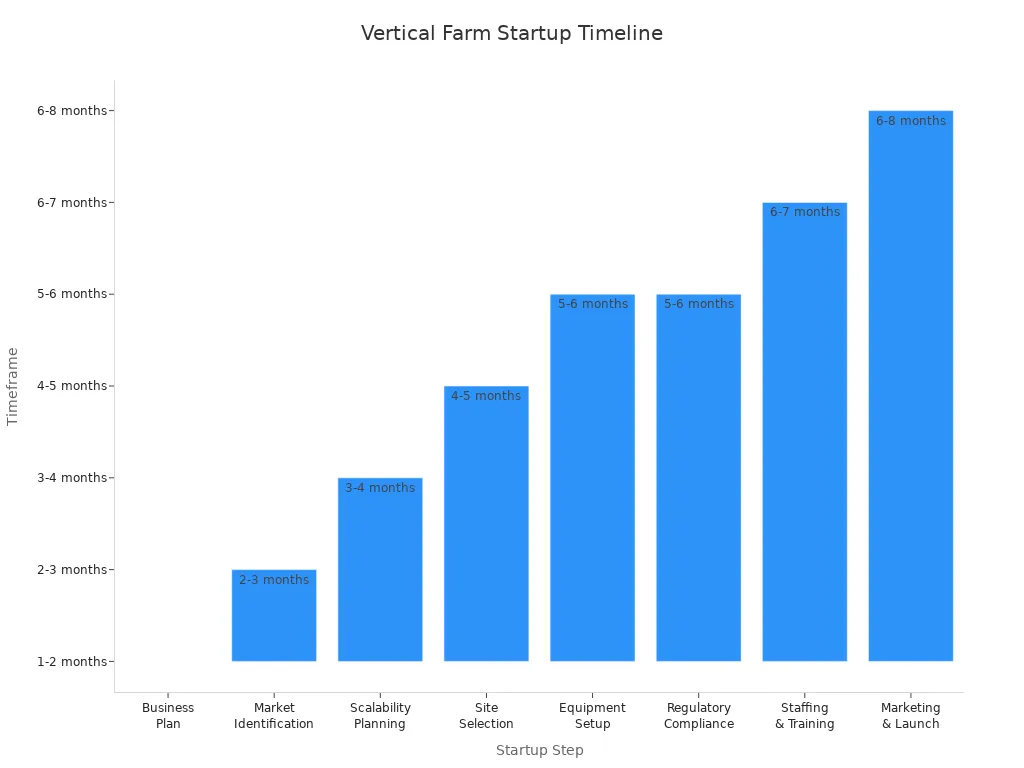
Starting a vertical farm needs careful planning and money. You need a strong plan that covers every step. Here is a table that shows the main steps, costs, and how long each takes:
| Step | Description | Timeframe |
|---|---|---|
| Business Plan | Write down your plan and money needs | 1-2 months |
| Market Identification | Find your customers and other farms | 2-3 months |
| Scalability Planning | Make your farm easy to grow bigger | 3-4 months |
| Site Selection | Pick a place and plan any changes | 4-5 months |
| Equipment Setup | Buy, set up, and test your equipment | 5-6 months |
| Regulatory Compliance | Get permits and follow safety rules | 5-6 months |
| Staffing & Training | Hire and teach your workers | 6-7 months |
| Marketing & Launch | Make a marketing plan and start your farm | 6-8 months |
You will need to buy hydroponic systems, LED lights, and software. Places in cities can cost a lot, so plan your money well. Most farms are ready in about 6-8 months. Here is a chart that shows how long each step takes:
You should get sales contracts before you start growing. This makes sure people want your crops and helps your business do well. Many farms start small and get bigger over time. A good plan, smart research, and wise spending will help your vertical farm succeed.
Crop Selection
Profitable Crops
You want to pick crops that make the most money. Leafy greens, herbs, and microgreens are good choices. These crops grow fast and do not need much space. You can also try strawberries or tomatoes. These crops need more care and take longer to grow. Many farms use hydroponic production to help plants grow faster. This method also uses less water. Think about what people near you want to buy. Some restaurants and stores pay more for fresh, local crops. Always check which crops sell best in your area.
| Consideration Type | Details |
|---|---|
| Operational – Facility | Use vertical racking and LED lights to save space and energy. Plan your facility for cannabis carefully. |
| Operational – Scaling | Use software to collect data and automate tasks for cannabis. This helps you grow more cannabis with less work. |
| Operational – Compliance | Follow SOPs to keep cannabis quality high and your cannabis production practices consistent. |
| Regulatory | Get the right license for cannabis. Track every cannabis plant. Follow all state and local cannabis rules. |
Tip: Always check your local cannabis laws before you start growing cannabis. Rules can change fast.
Substrate Choice
You need to choose the right base for your plants. Many vertical farms use rockwool, coconut coir, or peat moss. These substrates help plants get water and nutrients. Some farms use only water, which is called hydroponics. Your choice depends on your crops and how you grow them. If you grow cannabis, you may need a special substrate for strong roots. Good substrates help your plants grow healthy and strong. Try different options to see what works best for your crops.
Lighting & Climate

Lighting Design
Lighting is one of the most important parts of your vertical farm. You need to choose the right type for your crops and your budget. Many commercial farms use LED lighting because it saves energy and gives you control over the light spectrum. You can adjust the color and strength to help your plants grow faster and healthier. This is very helpful for crops like leafy greens and cannabis. LED lighting also produces less heat, so you spend less on cooling your farm. You can use smart controls to change the lighting for each stage of plant growth. This helps you get better yields and lower your energy bills.
Here is a table that compares the most common lighting types:
| Lighting Type | Upfront Cost | Energy Consumption | Heat Output | Lifespan | Crop Suitability | Impact on Plant Growth | Operational Cost Impact |
|---|---|---|---|---|---|---|---|
| LED | High | Low | Low | 50,000+ hours | Most crops, flexible | Custom spectrum boosts growth, flavor, and shelf life | Lower energy and cooling costs |
| HPS | Medium | High | High | 10,000-15,000 hours | Fruiting crops | Strong red light, more heat stress | Higher energy and cooling costs |
| Fluorescent | Low | Medium | Low | 7,000-15,000 hours | Leafy greens, herbs | Moderate growth impact | Moderate energy use, more replacements |
If you grow cannabis, you need to pay special attention to cannabis lighting. The right spectrum and intensity help you get the best yield and quality. Smart LED systems let you change the light for each crop, making your growing environment more efficient.
Airflow & Ventilation
Good airflow and ventilation keep your plants healthy. You need to move air evenly through your farm to avoid hot or cold spots. This helps prevent diseases and keeps humidity balanced. Use ceiling fans for gentle breezes and exhaust fans to control moisture. Place your shelves and crops so air can move between them. Smart airflow systems use sensors to check CO2 and humidity. They adjust the air to match what your plants need.
- Keep airflow uniform to stop mold and plant stress.
- Use fabric ductwork for even air distribution.
- Modular airflow solutions help you change your system as your farm grows.
- Airflow supports nutrient uptake and strong plant growth.
If you grow cannabis, proper airflow is even more important. It helps you avoid mold and keeps your cannabis plants strong.
Microclimate Control
You must control the microclimate in your vertical farm. This means you manage temperature, humidity, airflow, and CO2 levels. When you keep these steady, your plants grow at the same rate and stay healthy. Smart climate systems use sensors and automation to make small changes all day. This stops diseases and keeps your yields high.
A good microclimate helps you avoid hotspots and uneven humidity. It also makes sure your plants get enough CO2 for photosynthesis. Air purification systems remove germs and keep your crops safe. When you control the growing environment, you get better results and fewer problems.
Tip: Use automated systems to watch and adjust your climate. This saves time and helps you grow better crops.
Automation & Technology
Environmental Monitoring
It is important to watch many things in your vertical farm. Modern farms use sensors and smart systems to check temperature, humidity, CO2, and water use. These sensors send live data to your computer or phone. You can find problems early, like too much heat or not enough water. This helps keep food safe and builds trust.
- Main things to watch:
- Temperature and humidity in the air and soil
- CO2 levels
- Water and electricity use
- Plant health, disease, and pests
By watching these things, you use resources well and grow healthy crops.
Automation Systems
Automation helps you do farm work with less effort. Robots can plant seeds, pick crops, and pack them. Automated systems control climate, water, and lights. This means your plants always get what they need. These systems save money on workers and lower mistakes. You can grow more food in less space because robots use every inch. Automation also keeps crops fresh by handling them gently and on time.
- Why automation helps:
- Fewer workers needed
- Faster planting and picking
- Fewer mistakes and less waste
- Better crop quality and longer shelf life
You can make your farm bigger more easily when machines do hard jobs.
Data-Driven Decisions
Smart farms use data to make better choices. Tools like AI controls and cloud platforms help you change lights, water, and nutrients for each crop. You can see which crops grow best and where you can save energy. Robots and sensors collect data on plant growth, so you know the best time to harvest. Satellite pictures and AI find problems early, so you can fix them fast.
| Tool Type | Technology | Yield Increase | Resource Savings |
|---|---|---|---|
| AI Controls & Sensors | AI, IoT | 30–45% | 35–50% |
| Robotics | Machine Vision | 20–35% | 20–40% |
| IoT Management | Cloud | 15–25% | 30–55% |
“By 2025, automated vertical farms may grow up to 70% more crops than old methods.”
When you use data to help you, you grow more food, save money, and make your farm better for the planet.
Irrigation & Nutrients
Delivery Systems
There are different ways to give water and nutrients to your crops. Each system uses water in its own way. This can change how much you spend and how healthy your plants are. Here is a table that shows the most common irrigation delivery systems:
| Irrigation Delivery System | Description | Water Use Efficiency |
|---|---|---|
| Hydroponics | Plants grow in water with nutrients that moves in a loop. | Uses up to 90% less water than soil farming by recycling and reducing waste. |
| Aquaponics | Fish live in tanks and their waste feeds the plants. | Reuses fish tank water, creating a sustainable water cycle and reducing water use. |
| Aeroponics | Roots hang in the air and get sprayed with nutrients. | Very efficient; uses minimal water and reduces evaporation losses. |
| Drip Irrigation & Precision Watering | Water and nutrients go straight to the roots with special tools. | Reduces runoff and evaporation, ensuring precise water delivery. |
Pick a system that fits your crops and your money plan. Hydroponics and aeroponics save the most water. They work great for leafy greens and herbs.
Nutrient Management
Giving the right nutrients helps your crops grow strong and healthy. You can use systems like Nutrient Film Technique (NFT) to send nutrients right to the roots. NFT lets you control nutrients and pH very closely. This helps plants grow faster and better. Automation makes this job easier and saves time.
- Check nutrient levels and pH often.
- Use automation to give nutrients at the best time.
- Change nutrients, light, and temperature together for good results.
- Try adding more CO2 to get up to 30% more crops.
- Clean and check your system so it does not get blocked.
Some farms, like ones in Alaska, use these ideas to get steady, high-quality crops.
Water Conservation
Saving water is very important in vertical farming. Aeroponics can use up to 95% less water than hydroponics. Hydroponic systems also save a lot of water—up to 95% less than regular farming. Aquaponics reuses water between fish and plants, so nothing is wasted.
- Use closed-loop systems to recycle water.
- Pick aeroponics or hydroponics if you want to save lots of water.
- Aquaponics helps you reuse water and pay less for it.
These ways help you spend less on water. But remember, you still spend a lot on energy for lights and climate.
Tip: Use water-saving systems and energy-saving equipment together. This will help you spend less and protect the environment.
Pest & Disease Control
Prevention Strategies
You can stop pests and diseases before they become a problem. Clean your growing area often to keep it safe. Take away dead leaves and old plants right away. Use screens and filters to block bugs from getting inside. Put sticky traps near doors and vents to catch bugs early. These traps help you see if pests are there. Keep new plants away from others until you know they are safe. This stops pests from spreading to your main crops. Good air flow and the right humidity help protect your plants. If you grow cannabis, you must keep everything extra clean. These steps help you avoid strong chemicals and keep your crops safe.
Tip: Strong, healthy plants fight off pests better. Give your plants enough nutrients and water to help them grow well.
Indoor Pest Management
Indoor farms have their own problems with pests. You cannot use most regular pesticides, especially for cannabis. You need other ways to keep plants safe. Many farms use sensors and cameras to watch for bugs. Computer programs help you count pests and find problems early. Some farms use special plant care plans to stop pests and help pollination. These tools keep plants healthy without using chemicals. You can also use good bugs, like ladybugs, to eat bad bugs. This works well for cannabis and other crops.
- Common challenges:
- Not using chemical pesticides
- Making sure pollination happens
- Keeping pest numbers low
Safe Treatments
There are many safe ways to treat pests and diseases. Integrated Pest Management (IPM) uses different methods together. You can use biopesticides made from things in nature. These products protect plants and do not hurt the environment. Keep your area clean and water plants the right way to stop pests from spreading. Helpful insects or bacteria can attack pests without hurting your plants. Screens and other barriers stop bugs from getting in. Only use chemicals if nothing else works, and pick safe ones. Check your plants often to find problems early and change your plan if needed. These safe treatments work for all crops, even cannabis, and help you grow healthy plants all year.
| Safe Treatment | How It Works | Benefit |
|---|---|---|
| Biopesticides | Use natural materials to control pests | Safe for plants and people |
| Beneficial Insects | Eat harmful bugs | No chemicals needed |
| Physical Barriers | Block pests from entering | Prevents infestations |
| Sanitation | Clean tools and spaces | Stops disease spread |
Harvest & Distribution

Harvest Timing
It is important to pick crops at the right time. If you pick too soon, crops might not taste good or look nice. If you wait too long, crops can lose value and quality. Many vertical farms use sensors and data to watch plant growth. These tools help you know when to harvest for the best results. Workers should learn how to spot the best harvest time. This helps stop waste and damage. Precision agriculture tools, like cameras and sensors, let you check each crop closely. This helps you plan harvests and keep produce fresh.
Post-Harvest Handling
After harvest, you must keep crops safe and fresh. Vertical farms use sealed rooms to protect crops from pests and germs. You do not need to wash crops because they grow in clean places. This lowers the risk of water making crops unsafe. Check crop quality at every step, from planting to harvest. Use filtered water that only touches roots, not the parts you eat. Keep all tools and equipment very clean. Make sure workers follow hygiene rules. Some farms use UV light and machines to keep crops safe. Traceability systems help you track each batch from harvest to delivery. This lets you find problems and waste less. Cold storage with smart sensors keeps crops fresh longer by controlling temperature and humidity.
- Key post-harvest tips:
- Store crops in sealed rooms
- Do not wash produce
- Check quality at every step
- Keep tools and hands clean
- Use cold storage with sensors
Distribution Channels
There are many ways to get crops to customers. Some farms sell at local markets or online stores. Others work with grocery stores and restaurants. For example, Bowery Farming and Vertical Roots sell fresh vegetables to many stores, even big ones. Selling close to home cuts transport costs and keeps crops fresher. Building good relationships with local stores and markets helps your business grow. Automation and smart planning help deliver crops quickly and safely. Farms like InFarm show you can reach many customers by working with retailers and using smart delivery systems.
Tip: Sell to local markets and build strong partnerships. This helps you make a steady and profitable network.
Commercial Vertical Farming Profitability
Cost Management
You have to watch your spending to make money in commercial vertical farming. The biggest costs are for land, technology, building setup, permits, supplies, workers, and advertising. Each cost has its own problems and ways to save money. The table below lists the main costs and smart ways to lower them:
| Cost Driver Category | Estimated Cost Range | Key Cost Components & Notes | Cost Management Strategies |
|---|---|---|---|
| Real Estate & Lease | $200,000 – $500,000 | Urban locations, deposits, utilities | Negotiate leases, pick strategic sites |
| Hydroponic Systems & Technology | $30,000 – $150,000 (systems) + $10,000 – $100,000 (climate) + $30,000 – $100,000 (automation) + $2,000 – $20,000 (maintenance) | Nutrient delivery, HVAC, lighting, automation, maintenance contracts | Lease or buy refurbished equipment, bulk deals, modular automation |
| Facility Renovation & Setup | $10,000 – $100,000 (retrofit) + $100,000 – $300,000 (new) + $20,000 – $50,000 (compliance) | Modifications, climate control, safety, compliance | Use phased installations, modular builds, vendor partnerships |
| Licenses, Permits & Insurance | $20,000 – $50,000 (permits) + $20,000 – $55,000 (insurance) + $5,000 – $15,000 (workers’ comp) + $5,000 – $10,000 (fire safety) | Permits, certifications, insurance, workers’ comp | Group certifications, bundled insurance, tech-enabled compliance |
| Initial Inventory & Supplies | $10,000 – $25,000 (seeds) + $7,000 – $20,000 (nutrients) + $5,000 – $15,000 (tools) + $3,000 – $8,000 (sanitation) + $5,000 – $12,000 (packaging) | Seeds, nutrients, tools, cleaning, packaging | Bulk buying, local suppliers, vendor deals, inventory optimization |
| Staffing & Payroll | $40,000 – $70,000 (managers) + $30,000 – $50,000 (tech staff) + $10,000 – $20,000 (training) + $5,000 – $15,000 (benefits) | Managers, tech staff, training, benefits | Flexible staffing, part-time workers, cross-training, outsourcing |
| Marketing & Branding | N/A | Logo, website, campaigns, partnerships | Outsource design, low-cost platforms, organic social media |
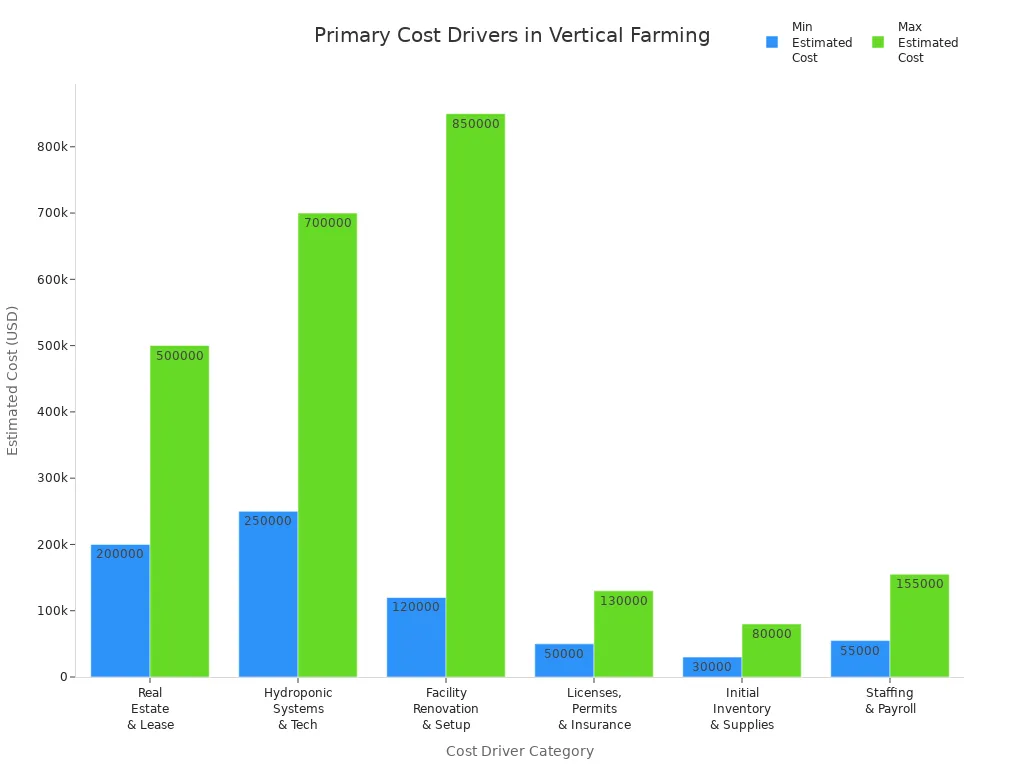
You can spend less by getting better lease deals and using used equipment. Buying supplies in big amounts also saves money. Hiring part-time workers and using smart ads help your business stay strong.
Energy Efficiency
Energy is one of the biggest bills for a commercial farm. Most energy is used for lights, heating, and keeping the air right. You can save money by using LED lights that use less power. These lights help your plants grow and cut down on energy use. Upgrading your HVAC system also saves energy. Using both LED lights and smart climate controls lowers your bills and helps your farm make more money.
Tip: Always check how much energy you use and look for ways to use less. Even small changes can save a lot over time.
Scaling Up
If you want your commercial vertical farm to get bigger, you will face new problems. You will need more power, more water, and better systems to keep crops good. Here are some things to remember:
- Power: Big farms need lots of electricity. Work with your city to make sure you have enough.
- Water: Clean and reuse water to save money and keep crops safe.
- Quality: Use machines and set rules so every crop is the same.
- Systems: Pick HVAC and other tools that fit your farm size and crops.
- Market: Build strong supply chains and find buyers before you grow bigger.
You also have to handle high startup costs and make sure your crops fit what people want. Winning comes from saving money, using the best tools, and working with good partners. Always plan your growth and learn from each step.
You can make your commercial vertical farm last a long time by using good methods and being ready for change. Top farms like AeroFarms, Plenty, and Gotham Greens show that having a solid plan, using smart technology, and checking data often help you grow more crops. Systems that can learn and change fast help you deal with new problems. If you keep making your farm better, it will get stronger and make more money each year.
FAQ
What crops grow best in a vertical farm?
You can grow leafy greens, herbs, and microgreens very well in a vertical farm. These crops grow fast and do not need much space. Some farms also grow strawberries or tomatoes, but these need more care.
How much does it cost to start a vertical farm?
Starting a vertical farm can cost from $500,000 to over $1 million. Costs depend on your location, equipment, and size. You spend money on land, lights, water systems, and staff. Careful planning helps you save money.
Do vertical farms use a lot of water?
Vertical farms use much less water than regular farms. Hydroponic and aeroponic systems recycle water. You can save up to 95% of water compared to soil farming. This helps you protect the environment and lower your bills.
Can you use organic methods in vertical farming?
Yes, you can use organic nutrients and natural pest control. Many vertical farms avoid harsh chemicals. You must follow organic rules if you want to sell your crops as organic.
What are the biggest challenges in vertical farming?
- High energy costs
- Finding the right crops
- Managing pests and diseases
- Getting enough buyers
You can solve these problems with good planning, smart technology, and strong partnerships.