

Commercial greenhouse lighting systems have changed how growers handle crops and money. The worldwide market for these systems was about USD 4.5 billion in 2023. It keeps getting bigger as more people use energy-saving LED lighting. Many groups say they save up to 75% on lighting energy costs. For example, Tropica Aquarium Plants and Oasis Springs Farm saved up to 50% on energy. They also grew 33% more crops after they improved their lighting systems.
Key Takeaways
- LED lighting uses up to 25% less energy. It helps growers save money. It also helps plants grow better and look nicer.
- Using the right light colors, like blue and red, helps plants grow strong. It helps them fight stress. It makes fruits and flowers better.
- Smart lighting controls and automation change light levels for plants. They use sunlight when possible. This saves energy and keeps plants healthy.
- Integrated systems connect lighting with heating, cooling, and watering. This makes the best place for plants. It also cuts down on waste.
- Modern greenhouse lighting can make crops grow up to 50% more. It lowers the need for repairs. Growers get their money back fast.
The Impact of Grow Lights on Plants

Photosynthesis Enhancement
Grow lights help plants make food better. They give the right kind of light and the right amount. This helps plants turn light into energy faster.
- LED grow lights are very good at giving plants useful light. They can reach 80–100% efficiency.
- Blue and red light are very important. Blue light helps plants make chlorophyll and grow strong leaves. Red light helps plants make flowers and fruit.
- Adding far-red light to full-spectrum lighting can make plants bigger. It also helps them make more food.
- New LED systems can act like sunlight. They let growers control the light very well. This helps plants grow better and make more food.
- Studies show blue and red LED lights can make crops like lettuce and cabbage healthier. They can have more antioxidants and better nutrition.
Note: Commercial growers use these lights to grow crops all year. They get more crops and better quality.
Growth Cycle Regulation
Different colors and strengths of light help control how plants grow. Using red and blue light together helps plants grow better and handle stress. This works for crops like roses and lettuce.
| Light Spectrum | Growth Performance | Stress Tolerance | Quality Effects |
|---|---|---|---|
| Red | Plants grow well | Low stress help | High color before stress |
| Blue | Plants grow well | Low stress help | High color before stress |
| Red + Blue | Growth stays steady | High stress help | Less color loss |
| White | Growth stays steady | High stress help | Less color loss |
LEDs let growers change the light for each plant and stage. This helps plants stay healthy, fight stress, and use resources well.
Crop Quality Improvement
New grow lights help growers make crops better and more even.
- LED lights can be changed for each growth phase. They can be dimmed and tuned.
- These lights make less heat. Growers can put them closer to plants. This saves energy.
- Research shows far-red light in LEDs helps lettuce heads form better. It does not change taste or cause early flowering.
- Changing light from far-red to blue can make plants have more good compounds. Anthocyanins are one example. They make crops healthier.
- Studies on thyme and lettuce show broad-spectrum LED lights help crops grow more and get better quality in greenhouses.
Commercial growers get faster growth, stronger roots, and better crops. They also save energy and make more money.
Commercial Greenhouse Lighting Systems
LED vs. HPS
Commercial greenhouse lighting systems have changed a lot lately. In the past, many growers used high-pressure sodium lights. These lights are bright but waste a lot of energy as heat. Studies show HPS lights use about 1558 kJ each hour. LED lights use only 378 kJ for the same amount of light. Over 49 days, LEDs can save up to 76% in lighting energy. But LEDs make less heat, so greenhouses may need more heating when it is cold. This means total energy savings are between 10% and 25%. The amount saved depends on the weather and how much energy is used for lighting.
When we compare features, LEDs turn more energy into useful light. They also last much longer than HPS lamps. LEDs make less heat, so plant temperatures stay steady. This also lowers cooling costs. HPS lamps need to be replaced often and need more care. This makes them cost more for growers.
| Feature | HPS Lighting | LED Lighting |
|---|---|---|
| Energy Efficiency | 30–35% | 50–60% |
| Heat Production | High | Low |
| Lifespan (hours) | 10,000–24,000 | 50,000–100,000 |
| Maintenance | High | Low |
Adaptive Controls
Modern greenhouse lighting systems often use adaptive controls. These controls change light levels using data from sensors. For example, AI can dim or turn off lights when sunlight is strong. It can also turn off lights in empty areas. This saves electricity and keeps crops healthy. Some systems use models to guess the best light by checking temperature and CO₂. These controls help plants get the right light at the right time. This helps plants grow better and saves energy.
Growers also use LED lights with pulse width modulation. This technology changes light strength quickly to match what plants need. Studies show adaptive controls can save about 25% on electricity. This does not hurt crop growth.
System Integration
Integrated greenhouse lighting systems connect lights with other controls. These include heating, cooling, and watering. These systems use wireless networks and smart controllers. Growers can move lighting schedules to times when energy is cheaper. Real-time changes from sensors help save energy and meet plant needs. Automation makes sure lights are on only when needed. This cuts down on waste. Integrated systems also help crops by giving the right light for each stage.
Commercial greenhouse lighting systems with these controls help growers make more money. They lower carbon footprint and support green growing. These systems help growers save money and grow better crops.
Commercial Greenhouse Lighting Benefits
Energy Savings
Commercial greenhouse lighting systems help growers use less energy. Many greenhouses now use centralized LED driver systems. These systems can lower starting costs by up to 35%. They save about 20% on yearly running costs. Centralized LED drivers also make less heat in the greenhouse. This means growers do not need as much cooling. Less heat keeps the greenhouse steady for crops and lowers HVAC use.
- Centralized LED drivers use less energy and make things easier.
- Less heat means cooling is not needed as much.
- Fewer parts mean fewer breakdowns and less maintenance.
Operational Cost Reduction
Growers spend less money after switching to energy-saving lights. LED grow lights use less energy than old HPS lamps. They last longer and make less heat. Many growers use software to watch and control energy use. Upgrading greenhouses with smart LED lights saves money and grows more crops. Government programs and utility rewards help pay for these changes.
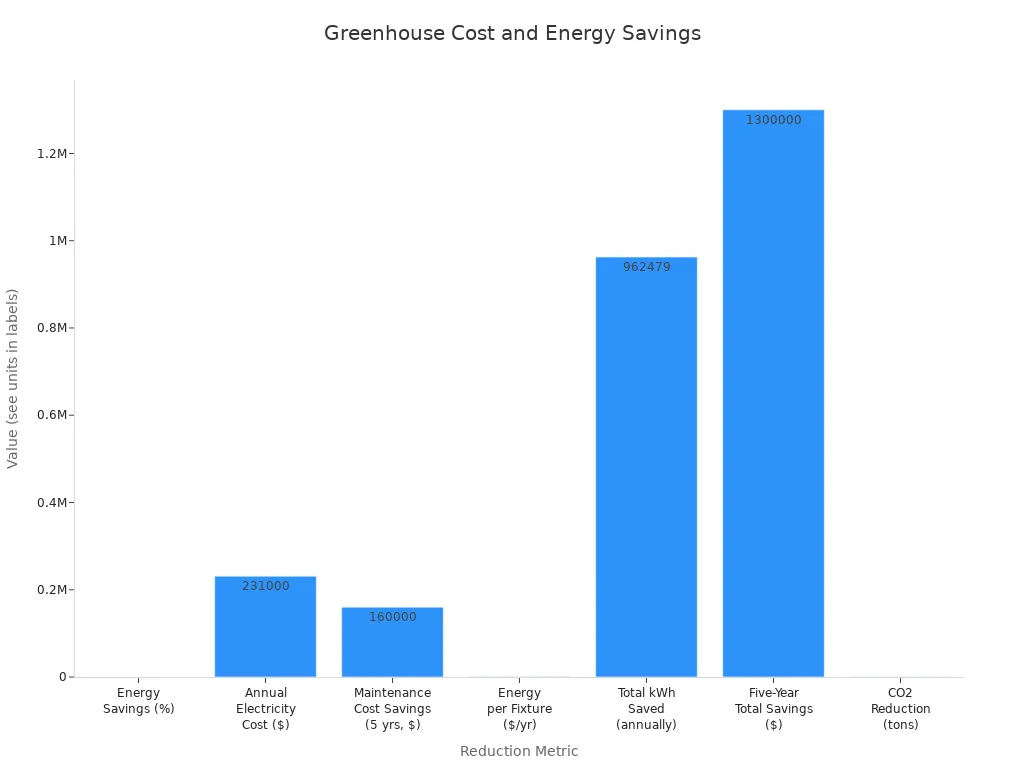
| Metric | Details |
|---|---|
| Energy Savings | Almost 47% less energy used after changing from HPS to LED lighting |
| Annual Electricity Cost Reduction | Costs dropped from about $495,000 to $264,000 in a 24,050 sq ft medicinal cannabis greenhouse |
| Maintenance Cost Savings | Over $160,000 saved in 5 years by not changing bulbs every year |
| Energy Consumption per Fixture | Went down from $1,135.30 to $605.49 each year (not counting maintenance) |
| Total kWh Saved | 962,479 kWh saved each year in the case study |
| Five-Year Total Savings | Over $1.3 million saved in five years from energy and maintenance |
| Additional Operational Benefits | Less cooling needed, better CO2 use, and new daylight harvesting technology |
| Environmental Impact | 682 metric tons less CO2 released, says the EPA |
Crop Yield and Quality Improvement
Modern greenhouse lighting helps growers get more crops and better quality. One tomato grower got 30% more tomatoes and used 40% less water after adding automation and lighting controls. A leafy greens grower worked better and cut costs by 25% using hydroponics and renewable energy. In Mediterranean greenhouses, extra LED lighting made tomatoes bigger and ripen faster. Each plant gave 24% more tomatoes in spring and 13% more in summer. Research shows the right lighting can make plants grow up to 50% faster and improve taste and shelf life.
Return on Investment (ROI)
Energy-saving lighting systems help growers make more money and protect the environment. Control systems guess sunlight and change lighting to save energy and keep crops growing well. Spectrum control lets growers pick the best light for photosynthesis. LEDs lower power and maintenance costs because they last longer. Smart lighting uses sensors to stop wasting energy. Many growers add renewable energy to save even more money and lower carbon emissions. These steps help growers grow good crops all year and make their businesses stronger and greener.
Smart Greenhouse Automation and Environmental Control

Intelligent Automation Systems
Automated Climate Control
Commercial greenhouses use automated climate control to keep things just right for plants. These systems control temperature, humidity, CO₂, and light. Heating, cooling, and ventilation work with smart lighting. This helps growers make the best environment for each crop. Automated irrigation and fertigation use soil moisture sensors. They give water and nutrients only when plants need them. This can cut water use by half and stops overwatering.
Sensor Networks and Data Analytics
Sensor networks gather real-time data about soil moisture, temperature, humidity, and light. AI and data analytics use this data to find the best times to plant and harvest. These systems also send alerts if pests or diseases show up early. This helps growers use fewer chemicals. Platforms like Farmonaut use satellite data, AI, and blockchain to help growers with advice and support.
Remote Monitoring and Management
Growers can check and control their greenhouses from anywhere. They use remote management tools. IoT sensors and cloud software let them see conditions and make changes right away. This helps them fix problems fast and keep crops healthy. Remote access saves labor and helps with better planning.
Integration with Lighting and Irrigation
Smart greenhouse systems link lighting and irrigation controls. Sensors check soil moisture and light levels. They change water flow and lighting schedules by themselves. For example, Netafim’s system uses cloud platforms to save up to half the water. AeroFarms uses sensors to control temperature, humidity, and CO₂. This gives higher yields and better crop quality.
Environmental Control Strategies
Temperature Regulation
Keeping temperatures steady helps plants grow and take in nutrients. Sensor-based systems keep root and canopy temperatures even. This lowers plant stress and helps them grow better.
Humidity Management
Automated humidity control keeps plants healthy and lowers disease risk. Systems turn on fans or dehumidifiers to keep humidity safe.
CO₂ Concentration Optimization
Smart systems watch and change CO₂ levels to help photosynthesis. This makes plants grow faster and produce more.
Adaptive Ventilation and Airflow
Automated ventilation uses sensors to control airflow. This keeps the greenhouse climate steady and helps plants grow strong.
Key things for commercial growers are good climate control, sensor use, and AI analytics. These systems help growers get 20–30% more crops, save resources, and make crops better. Setup costs and tech needs are high, but modular designs and government help make it easier. The future of smart greenhouses will have more AI, better IoT, and greener ways to grow good crops.
Commercial greenhouse lighting systems help growers in many ways.
- LED lighting made for each crop gives more and better crops.
- Using less energy by 10–25% saves money and helps profits go up.
- Lights that last longer mean less fixing and fewer problems.
Growers can:
- Ask experts to help make special lighting plans.
- Check their lights and pick LEDs to save more energy.
- Take care of their tools so plants get enough light.
Learning about new technology helps growers do well and protect the environment.
FAQ
What are the main benefits of LED lighting for commercial greenhouses?
LED lighting helps growers use less energy and save money. LEDs last longer than old lights. They make less heat, so greenhouses stay cooler.
How do adaptive lighting controls work in a commercial greenhouse?
Adaptive lighting controls use sensors to check light and temperature. The system changes the lights by itself. This gives plants the right light and saves energy.
Can commercial growers see a fast return on investment with new lighting systems?
Many growers get their money back in two to five years. They save energy, spend less on repairs, and grow more crops.
Do advanced lighting systems improve crop yield and quality?
Yes. Studies show advanced lighting can grow 30% more crops. These systems also help crops grow healthier and look the same.
What should commercial growers consider before upgrading their lighting systems?
Growers should look at how much energy they use now. They need to know what their crops need and how their greenhouse is built. They should compare lighting choices and check for rebates. Getting help from experts can help them pick the best system.