
Maximize Crop Yields with Smart LED Lighting in Greenhouses

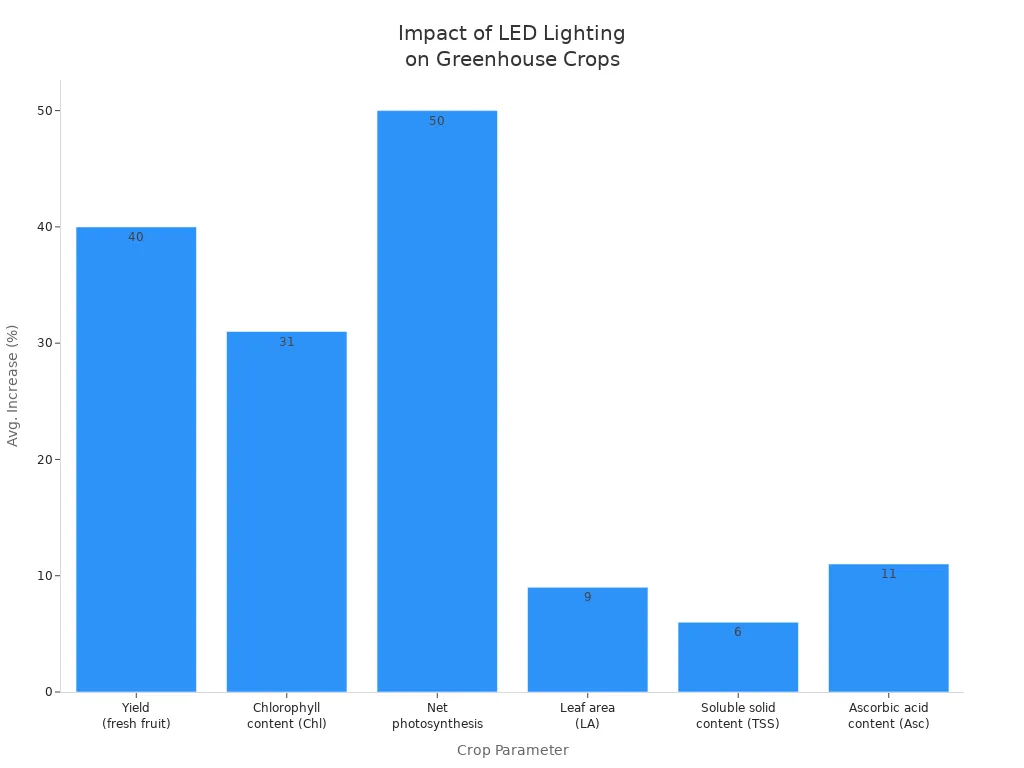
Smart LED lighting changes your greenhouse by letting you control light. You can pick the light quality and timing. This helps you grow more crops, up to 40% more. Your plants can also get healthier, as you can see in the table below.
| Parameter | Average Increase with Supplemental LED Lighting (%) |
|---|---|
| Yield (fresh fruit mass) | +40% |
| Chlorophyll content (Chl) | +31% |
| Net photosynthesis (PN) | +50% |
| Leaf area (LA) | +9% |
| Soluble solid content (TSS) | +6% |
| Ascorbic acid content (Asc) | +11% |
You can also save energy, up to 50%, when you use commercial greenhouse led grow lights. These systems let you change the light for each crop. This makes your greenhouse work better and grow more plants.
Key Takeaways
- Smart LED lighting can help crops grow up to 40% more. It also helps plants stay healthy by changing the light type and timing. LED grow lights save energy and make less heat. They last longer than old lights, so you spend less money and time fixing them. Picking the best light color and strength for each plant stage helps plants get stronger. It also helps them make better fruit. Waterproof and strong LED lights with smart controls are safe and work well. They let you set up lighting schedules automatically. Putting lights in the right spot and using shiny materials helps light reach all plants. Cleaning lights often also helps plants grow the same way everywhere.
LED Light Science

Light and Plant Growth
You might not realize it, but light does more than just help plants look green. It acts as both food and a signal for your crops. Different colors of light tell plants how to grow. For example, red light can make stems longer and delay flowering, while blue light helps leaves grow bigger and roots stretch deeper. When you use the right mix of red and blue, you can shape how your plants look and how much they produce.
Did you know? Greenhouse materials can block or change the light that reaches your plants. Smart LED systems let you adjust both the amount and type of light, so you can match what each crop needs. This means you can boost yield, improve quality, and even use less water and pesticides.
- Greenhouse structures change light intensity and color.
- LEDs let you fine-tune light for each crop and location.
- Knowing how plants sense light helps you grow more with less waste.
LED vs. Traditional Lighting
Switching to LED grow lights gives you more control and saves you money. LEDs use less energy and produce less heat, so you don’t need as much cooling. You can place them closer to your plants without burning them. Plus, LEDs last longer and need less maintenance.
| Aspect | LED Grow Lights | Traditional Lighting (HPS, MH, Fluorescent) |
|---|---|---|
| Energy Use | Up to 70% less | High |
| Heat Output | Low | High |
| Spectrum Control | Adjustable | Fixed |
| Crop Yield | Higher | Lower |
| Lifespan | ~50,000 hours | 10,000–24,000 hours |
| Smart Integration | Yes | No |
You can see that LEDs offer big advantages for your greenhouse.
Spectrum and Intensity
Plants need the right light spectrum and intensity to grow their best. Red and blue light are the most important for photosynthesis. Red light helps plants grow taller and make more leaves. Blue light controls flowering and helps plants stay strong. If you use only one color, your plants might not grow right. Mixing red and blue gives you the best results.
LEDs let you pick the exact spectrum and brightness your crops need. You can use sensors to measure light and adjust it in real time. This helps you get bigger harvests and better quality, all year long. 🌱
Choosing LED Grow Lights
Spectrum Selection
Picking the right LED spectrum can make a huge difference in your greenhouse. Every crop has its own needs. Some plants want more red light, while others do better with extra blue. You should always match the light to your crop and its growth stage.
Here’s a simple way to choose the best spectrum for your plants:
- Check the company’s reputation. Look for brands that share real test results, spectrum charts, and power data.
- Set your growing goals. If you grow in low sunlight, go for full-spectrum LEDs. For extra lighting, focus on blue and red. Want to control flowering? Add more red and far-red.
- Think about light spread. Make sure every plant gets enough light, not just the ones in the middle.
- Look for long-lasting lights. Good LEDs last over 50,000 hours and need little maintenance.
- Focus on output, not just wattage. The best lights deliver the right spectrum and intensity for your crop.
🌱 Tip: Blue light helps leaves and roots grow strong. Red light boosts flowering and fruit. Too much red alone can cause problems, so always balance your spectrum.
You might notice that some plants, like lettuce, love blue light for compact growth and bright color. Tomatoes and peppers often need more red for bigger yields. No single spectrum fits all crops, so adjust your lights as your plants grow.
Energy Efficiency
You want to save energy and money, right? The best way is to pick LED grow lights that use power wisely. Don’t just look at watts or how bright the light seems to your eyes. Plants care about something else—how many useful photons they get.
When you shop for LEDs, check these numbers:
- PPFD (Photosynthetic Photon Flux Density): This tells you how much plant-friendly light hits your crops.
- PPE (Photosynthetic Photon Efficacy): This shows how many photons the light makes for each watt of power (measured in μmol/J). Good LEDs score above 2.0 μmol/J.
Here’s a quick table to help you compare:
| Metric | What It Means | Good Value |
|---|---|---|
| PPFD | Light for plants | 200–800 μmol/m²/s (depends on crop) |
| PPE | Efficiency | 2.0 μmol/J or higher |
💡 Note: Some cheap LEDs use lots of power but give little useful light. Always check PPFD and PPE, not just watts or lumens.
If you run a large greenhouse, commercial greenhouse led grow lights with high PPE can cut your energy bills and keep your plants healthy. In cold places, LEDs work even better when you use them with thermal screens or insulation.
Waterproofing and Durability
Greenhouses get wet and humid. Your lights need to handle that. If water gets inside, your LEDs can fail or even cause safety problems. That’s why you should always check the waterproof rating before you buy.
Look for these features:
- IP Rating: This number shows how well the light keeps out water and dust. IP65 means the light can handle dust and even short dips in water.
- Strong Materials: Good lights use tough wires, safe adhesives, and waterproof connectors. These parts should have safety marks like DLC, UL, CE, or RoHS.
- Certified Safety: Some lights have extra safety checks from groups like CSA. These tests make sure your lights last a long time and stay safe in wet places.
🛡️ Pro Tip: Always ask for proof of waterproofing and safety. A good light will have clear labels and paperwork.
If you want your investment to last, pick LEDs built for tough greenhouse conditions. This way, you avoid costly repairs and keep your crops growing strong.
Commercial Greenhouse LED Grow Lights

Key Features
When you look at commercial greenhouse led grow lights, you notice they stand out from regular home grow lights. These lights are built for big jobs. They give you strong, even light across large spaces. You get a full spectrum, including blue, red, far-red, and even UV-A. This helps every crop, from leafy greens to tomatoes, grow better and faster.
Here’s a quick comparison to show you the difference:
| Feature | Commercial Greenhouse LED Grow Lights | Residential LED Grow Lights |
|---|---|---|
| Power Rating | 600W–1000W+ | Below 200W |
| Spectrum | Full, tailored (blue, red, far-red, UV-A) | Limited, often just red/blue |
| PPFD | 800–1500 μmol/m²/s | Lower, less even |
| PPE | 2.5–2.8 μmol/J | Below 2.2 μmol/J |
| Cooling | Advanced, keeps lights cool | Basic, less effective |
| Lifespan | 50,000+ hours, certified | Shorter, fewer certifications |
| Controls | Smart dimming, scheduling, app integration | Simple on/off or dimming |
| Suitability | Large-scale, vertical farms, greenhouses | Home use, small scale |
| Energy Efficiency | High, saves money | Lower, higher bills |
| Support | Strong, technical help | Limited |
You get more than just light. You get smart features, strong build, and support that keeps your greenhouse running. These lights last longer and handle tough, wet greenhouse conditions. You can trust them to work day after day.
💡 Tip: If you want to boost yield and save energy, choose commercial greenhouse led grow lights with high PPE and a full spectrum. Your plants will thank you!
Smart Controls
Smart controls make your life easier. With commercial greenhouse led grow lights, you can change light levels and spectrum in real time. You use apps, timers, or even connect to climate computers. This means you can match the light to what your plants need, every hour of the day.
Sensors track sunlight, temperature, and humidity. The system then adjusts the light for you. If the sun comes out, your lights dim to save power. If clouds roll in, the lights get brighter. You don’t have to guess or keep running back and forth. The lights do the work.
You can also set up zones. Maybe your tomatoes need more red light, while your lettuce likes more blue. You set each area just right. This helps you grow better crops and use less energy.

🌱 Note: Smart controls help you save money by using less electricity when you don’t need full power. They also help your plants grow strong by giving them the perfect light at every stage.
With features like real-time dimming and spectral adjustments, you get total control. You can even join energy-saving programs that lower your costs when electricity prices go up. Smart controls make your greenhouse more flexible and future-ready.
Cost Considerations
You might notice that commercial greenhouse led grow lights cost more at first. The price can feel high compared to old-style lights. But you save money over time. These LEDs use up to 60% less energy. They last much longer—often 50,000 hours or more. You also spend less on cooling because they don’t get as hot.
Several things affect the price:
- The type of LED technology
- How much you customize the spectrum
- Energy use and cooling needs
- If you add smart controls or software
- Whether you install new lights or retrofit old ones
Electricity for lighting can take up 20-30% of your greenhouse’s running costs. By switching to commercial greenhouse led grow lights, you cut those bills. You also get better yields and higher quality crops, which can help your profits.
⚡ Remember: Even though the upfront cost is higher, the savings on energy and maintenance add up fast. Many growers see a return on investment in just a few years.
If you want to keep costs low, look for rebates or government programs that support energy-efficient upgrades. Also, plan your lighting to match your crop needs and local energy prices. Smart planning helps you get the most from your investment.
Light Placement and Coverage
Height and Spacing
Getting the height and spacing of your LED grow lights right makes a huge difference in your greenhouse. If you hang your lights too close, you might see leaf burn or uneven growth. If you place them too far, your plants may stretch and look weak. You want to find the sweet spot for each crop and growth stage.
- For seedlings, keep your LEDs about 24–36 inches above the canopy. This prevents heat stress and keeps young plants safe.
- During vegetative growth, lower the lights to 12–24 inches. Your plants will get more energy and grow stronger.
- When your crops start to flower, set the lights at 18–24 inches. This helps flowers and fruit develop without burning the leaves.
- Always check your plants. If you see leaves turning pale or stretching, adjust the height.
- Use a light meter to measure PPFD (Photosynthetic Photon Flux Density). This tool helps you make sure every plant gets enough light.
🌱 Tip: LED lights give off less heat than old-style lamps. You can place them closer to your plants without worry.
Reflective Materials
You can boost your light coverage by using the right reflective materials. These materials bounce light back onto your plants, so nothing goes to waste. Here’s a quick look at some top choices:
| Reflective Material | Key Benefits |
|---|---|
| Mylar Films | Very reflective, helps plants grow faster and saves energy. |
| Aluminized Screens | Reduce heat loss, keep energy in, and reflect light well. |
| Thermal Foil Linings | Reflect both heat and light, making your greenhouse warmer and brighter. |
| Polycarbonate Panels | Spread light evenly and keep heat inside. |
| Light Diffusing Materials | Scatter light for even coverage, which helps prevent plant stress and burns. |
You can line your greenhouse walls or benches with these materials. Mylar films and aluminized screens are popular because they are easy to install and work well.
Minimizing Obstructions
You want every bit of light to reach your plants. To do this, keep your LED fixtures clean and free from dust. Dust can block light and lower your yields. Space your lights so they don’t crowd each other. This keeps air moving and stops heat from building up.
- Check your lights often for damage or dirt.
- Clean fixtures regularly to keep them shining bright.
- Make sure nothing blocks the light path, like tall equipment or overgrown plants.
- Upgrade old lights to new models with better coverage and control.
💡 Note: Good airflow and regular checks help your lights work their best. Your plants will thank you with healthy, even growth.
Lighting Schedules and Automation
Timers and Sensors

You don’t have to guess when to turn your greenhouse lights on or off. Timers and sensors do the work for you. With smart systems, you can set up lighting schedules that match your plants’ needs. Timers let you control exactly how long your lights stay on each day. You can even change the schedule from your phone or computer.
Sensors make things even easier. They check the light, temperature, and humidity in real time. If your greenhouse gets too bright or too dark, the sensors adjust the lights for you. This keeps your plants healthy and saves you time. You won’t need to run back and forth to flip switches or worry about missing the right moment.
- Smart grow systems automate lighting, climate, and watering.
- Timers set precise light schedules.
- Sensors adjust light based on real-time conditions.
- You save energy and help your plants grow better.
💡 Tip: Regularly clean your LED fixtures and check for wiring issues. This keeps your system safe and working well.
Growth Stage Adjustments
Plants need different light at each stage of growth. You can divide your greenhouse into zones for seedlings, growing plants, and flowering crops. Each zone gets its own light schedule and intensity. This helps every plant get just what it needs.
Here’s a quick guide:
| Growth Stage | PPFD (µmol/m²/s) | Light Duration |
|---|---|---|
| Seedling | 100 – 300 | Start low, increase slowly |
| Vegetative Growth | 400 – 600 | Up to 18 hours daily |
| Flowering | 600 – 1000 | Higher intensity, adjust as needed |
Watch your plants for signs of stress, like curling leaves or pale color. Adjust the lights if you see problems. Some plants need less light to flower, while others want more during growth. You can fine-tune your schedule for each crop.
Reducing Energy Waste
You want to grow strong plants without wasting energy. LED lights help you do that. They use less power and last longer than old-style lights. Adding reflectors or light diffusers spreads light better, so you need fewer fixtures.
Switching from high-pressure sodium to LED can cut your lighting energy use by about 40%. Even though LEDs give off less heat, you still save a lot overall. Smart controls and sensors make sure lights only run when needed. This keeps your energy bills low and your greenhouse efficient.
🌱 Note: Clean lights, good reflectors, and smart schedules all help you get the most from every watt you use.
Maximizing Efficiency
Vertical Growing
You can make the most of your greenhouse space by growing up, not just out. Vertical growing uses stacked plant racks, sometimes with four to sixteen layers. This setup lets you grow more crops in the same area. LED lights work perfectly here because they stay cool and last a long time—some even last up to 100,000 hours! You get steady light for every layer, which helps all your plants grow strong.
- Multilayer racks boost your yield per square foot.
- LEDs give stable, controllable light for each level.
- Air circulation and cooling systems keep temperatures just right.
- Closed systems like hydroponics or aeroponics recycle water and nutrients, saving resources.
NASA and big farms use these methods to control every part of the environment. They adjust light, temperature, and even CO₂ to help plants grow faster and healthier. You can do the same in your greenhouse and see better results.
Pruning and Canopy Management
You want every leaf to get enough light. Pruning helps by removing extra leaves that block the sun. With LED lights, you can also use under-canopy lighting. This means you shine light from below, so even the lower leaves get energy.
- Pruning opens up the canopy, letting more light reach lower buds.
- Under-canopy LEDs boost growth and reduce the need for heavy pruning.
- Better light means bigger, healthier crops and less disease.
If you combine pruning with smart lighting, you can see up to 25% more flowers or fruit. You also save time because you don’t have to prune as much.
Hybrid Lighting Strategies
You can mix LED lights with other types, like HPS lamps, to get the best of both worlds. LEDs use less energy and let you pick the right color of light for your plants. Dimmable LEDs help you adjust brightness when the sun comes out or when energy costs change.
- LEDs save energy and give you more control.
- Mixing lights helps you manage heat and light separately.
- You need to watch your plants and adjust things like temperature and humidity.
Some growers use screens to keep the right amount of heat and light. Hybrid systems help you switch to LEDs without changing everything at once. Over time, you’ll see lower bills and healthier plants. 🌱
Monitoring and Adjusting
Tracking Plant Response
You want your plants to thrive, so you need to keep an eye on how they react to your LED lights. Modern greenhouses use smart tools to make this easy. Here are some of the best ways to track plant response:
- Temperature sensors help you keep the greenhouse at the right warmth.
- Humidity sensors stop moisture problems before they start.
- CO₂ sensors check if your plants have enough carbon dioxide for photosynthesis.
- Light sensors measure how much and what kind of light your plants get. PAR sensors are great for checking the light plants use for growth.
- Soil moisture and nutrient sensors let you know when to water or feed your crops.
- Centralized software brings all this data together. You can see everything on your phone or computer and even get alerts if something changes.
Tip: Automated systems can adjust your LED lights in real time. This means your plants always get the best light, even if the weather changes.
Troubleshooting
Sometimes, things go wrong with LED grow lights. You can fix most problems if you know what to look for.
- Poor light levels? Check for dirty diodes or a faulty driver. Clean the lights and test the driver with a multimeter.
- Lights flickering or dimming? Loose wires or bad controllers might be the cause. Secure all connections and replace damaged parts.
- Complete failure? Drivers often fail first. Contact the manufacturer if your lights stop working.
- Overheating? Make sure your lights have good airflow. Clean them often and keep them away from water.
- Light leaks? Cover windows and use timers to keep light cycles steady.
Note: Using driverless LED systems can help you avoid many common failures.
Seasonal Adjustments
Seasons change, and so should your lighting. In winter, you need more supplemental light because the days are short. Use timers to add extra hours of light in the morning or evening. In summer, you might need to dim your LEDs or use shades to stop plants from getting too much light.
- Adjust light intensity and duration for each season.
- Use dimmable LEDs to save energy during bright days.
- Smart systems can change settings automatically based on sunlight and plant needs.
With these steps, you keep your plants healthy and your energy bills low all year long. 🌱
Smart LED lighting gives you more control over your greenhouse. You can boost yields, improve crop quality, and save energy by tuning light exactly how your plants need it. Recent studies show that smart LEDs help you grow healthier crops year-round while cutting costs. Remember to pick efficient fixtures, set up real-time controls, and keep checking your results with sensors and cloud tools. Try these strategies and watch your greenhouse thrive! 🌱
FAQ
How do you know which LED spectrum your plants need?
You can check the plant type and growth stage. Leafy greens like more blue light. Fruiting plants love extra red. Many LED brands share spectrum guides. You can also watch how your plants grow and adjust the light if needed.
Can you use LED grow lights with sunlight?
Yes! You can mix LED lights with natural sunlight. LEDs fill in gaps when sunlight is weak. This helps your plants grow strong, even on cloudy days or in winter.
How often should you clean your LED lights?
You should check your lights every month. Dust and dirt block light. Use a soft cloth to wipe the fixtures. Clean lights help your plants get the most energy.
Do smart LED systems save money?
Smart LED systems use less power and last longer. You spend less on electricity and repairs. Many growers see lower bills after switching to LEDs.