

Advanced spectrum control in commercial greenhouse LED grow lights greatly benefits greenhouse workers. Research shows that adjusting light intensity and spectrum with these commercial greenhouse LED grow lights helps plants grow more effectively. Additionally, these systems use less energy and save money. Currently, about 60% of greenhouses utilize these energy-efficient commercial greenhouse LED grow lights. These systems not only conserve energy but also reduce costs. Tailoring the light spectrum for each plant growth stage results in higher yields and increased profits, making commercial greenhouse LED grow lights essential for modern greenhouse operations.
Key Takeaways
- Adjusting LED light colors for each plant stage helps plants grow stronger and produce more fruit and flowers.
- Using the right mix of red, blue, and other light colors boosts crop yields and improves plant quality.
- LED grow lights save up to 70% energy and reduce cooling costs by producing less heat than old lamps.
- LEDs last longer and need less maintenance, helping growers save money and work more efficiently.
- Smart controls and clean greenhouse systems make growing easier, more efficient, and better for the environment.
Spectrum Control and Plant Growth

Growth Stage Optimization
Commercial greenhouse operators use spectrum control to help plants grow better. LED grow lights let them change light colors for each plant stage. Blue light is important for seedlings. It helps make chlorophyll and strong roots. This makes seedlings healthier. Operators use blue light (400–520 nm) for good leaves and strong stems. When plants grow bigger, blue and green light work together. This helps light reach more leaves and makes plants grow evenly. This way, less is wasted and resources are used well.
Red light is needed when plants flower and make fruit. It helps flowers start and controls how plants react to light. Far-red light (700–800 nm) helps flowers and fruit grow more. Growers use digital controls to set up special light plans for each crop and stage. Studies show that using the right light mix helps plants stay healthy and grow better. For example, a study on Glehnia littoralis found the best mix of red, green, and blue LED lights. This mix made plants grow more and have more antioxidants. These results show that spectrum control helps crops and supports sustainable farming.
Tip: Zone control and custom light recipes help growers use the best light for each crop. This makes growing more efficient and better for the environment.
Yield Improvement
Spectrum control helps greenhouses grow more crops and better quality plants. LED grow lights can change colors to match plant needs. This helps save energy and makes farming more efficient. Studies say red light is about 30% better for photosynthesis than blue light. Lights with many colors act like sunlight and help plants grow well. Too much red light can hurt plants and lower quality, so balance is important.
The table below shows how spectrum control improves crop yields with LED grow lights:
| Crop Type | Yield Improvement (%) |
|---|---|
| Strawberries | 22 |
| Mini Cucumbers | 16 |
| Eggplants | 137 |
| Tomatoes | 19.5 |
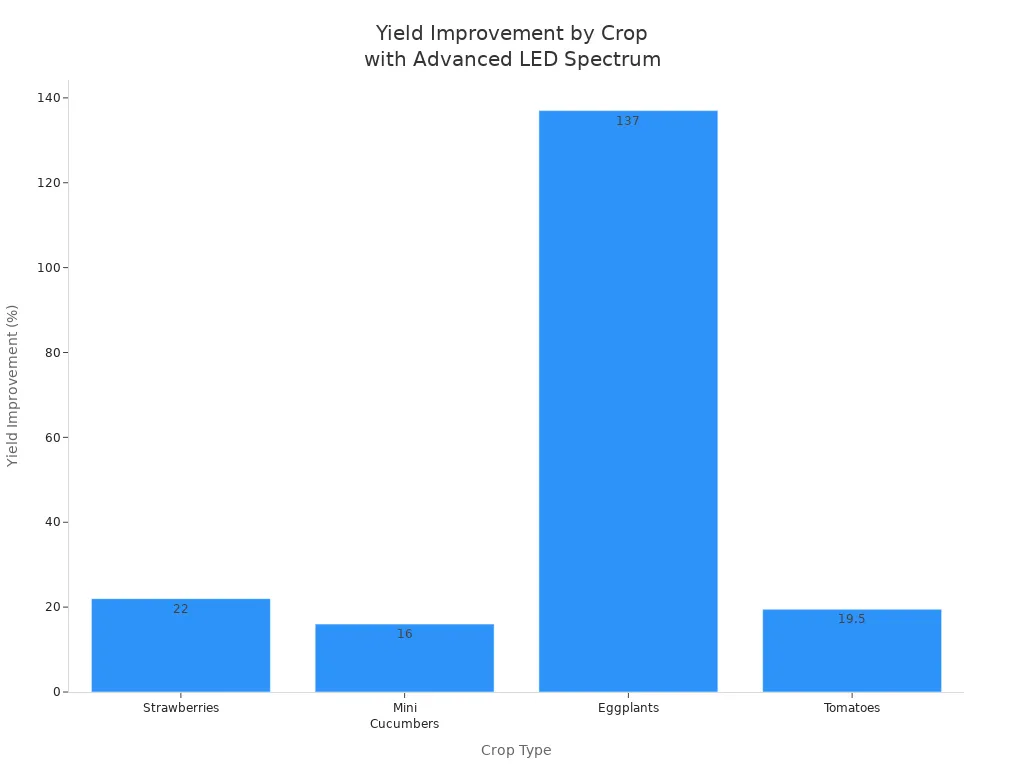
Growers see big increases in crop yields and quality with special light mixes. For example, lots of red light and some blue (R90B10) helps plants grow faster and makes more flowers. It also raises carbohydrate and anthocyanin levels, which makes crops worth more. More blue light raises chlorophyll and carotenoids but can lower yields. The table below shows how different red:blue mixes affect growth and quality:
| Red:Blue Ratio | Effects on Growth and Yield | Effects on Quality Parameters |
|---|---|---|
| R90B10 (90% red, 10% blue) | Better growth, faster flowering, most flower stems | More carbohydrates and anthocyanins, better photosynthesis |
| Higher blue ratios (e.g., R70B30) | Lower yield than R90B10 | More chlorophyll and carotenoids, but less carbohydrates and anthocyanins |
| Control (no supplemental light) | Least growth and yield | Most chlorophyll and carotenoids, but lowest yield |
Spectrum control helps growers get more crops and save energy and money. This makes farming more efficient and supports sustainable agriculture.
Commercial Greenhouse LED Grow Lights

Technology Overview
Commercial greenhouse LED grow lights have changed how growers raise plants. In the last ten years, LED lights have improved a lot. They used to be just red and blue lights. Now, they use white lights that cover more colors. This helps plants at every stage and saves money. LED lights are getting cheaper and work better each year. Today’s lights are very strong and use less energy than old HPS lamps. They turn more energy into light, about 40% better than HPS.
Some big changes in LED lights are:
- White diodes that help plants grow at all stages.
- Smart controls that let growers change light easily.
- Wireless tech that lets growers control zones without wires.
- Strong lights that spread light evenly.
- Lights that work with computers and sensors to save energy.
- Bigger diodes that need fewer parts, so they cost less to set up.
Now, companies make both fixed and adjustable LED lights. Some systems mix LEDs with HPS lamps. This helps growers switch slowly and save money. These new lights are easier to use and help more growers save energy.
Spectrum Adjustment
Changing the spectrum is a main feature of new LED grow lights. Old lights could not change color, but LEDs can. Growers can pick the best light for each plant and stage.Adjustable spectrum grow lights act like sunlight and help plants from start to finish.
Growers use digital tools to change how bright the lights are and how long they stay on. They can also pick what colors to use. This helps them grow more crops and get better plants. Far-red and UV light can be added to help flowers or make more oils. Good placement of lights makes sure all plants get even light.
LED systems are better than old lights because they can change colors. Growers can pick the best light for each crop and stage. This means more crops and better quality. These flexible lights help many kinds of greenhouses and make LED lights more popular.
Energy Efficiency
Lower Power Consumption
Commercial greenhouses save more energy when they use LED grow lights. LEDs use new technology to give more light but use less power. They use up to 70% less energy than old lights like HPS or metal halide lamps. This helps greenhouse owners save a lot of money.
LEDs last much longer than old lights, often over 50,000 hours. Old lights usually work for only 10,000 to 20,000 hours. Because LEDs last longer, growers do not need to replace them as often. This means less time and money spent on changing lights. Many growers say they use about 55% less energy after switching from HPS lights to LEDs.
Note: LEDs can work with smart farming systems. These systems help growers watch and control how much energy they use. This makes it easier to save energy and use it well.
The table below shows how much less power LEDs use compared to HPS lights:
| Lighting Type Comparison | Energy Savings on Power Usage |
|---|---|
| LED grow lights vs HPS | 35% to 50% reduction |
LEDs also let growers control light in different zones. This helps them give the right light to each crop. It saves even more energy and stops waste.
Reduced Cooling Costs
LED grow lights make much less heat than old lights. HPS lamps make a lot of heat, which makes greenhouses hotter. This extra heat makes cooling systems work harder and use more energy. LEDs give off little heat, and they use heat sinks and air to stay cool.
The U.S. Department of Energy says LEDs use 24% to 30% less electricity than old plant lights. This number includes saving energy from not needing as much cooling. Because LEDs do not get very hot, growers can put them closer to plants. This helps plants get more light and keeps them safe from heat.
| Aspect | LED Grow Lights | Traditional Lighting (e.g., HPS) |
|---|---|---|
| Power Consumption | Up to 70% less power usage | Higher power consumption |
| Heat Emission | Very low heat output | Significant heat generation |
| Cooling Demand | Reduced need for additional cooling | Increased cooling requirements |
| Placement Flexibility | Can be placed closer to plants | Requires more distance due to heat |
| Impact on Cooling Costs | Lower cooling costs due to less heat | Higher cooling costs due to heat output |
Because LEDs make less heat, water does not evaporate as fast. This means growers use less water for their plants. Using less water also saves energy because pumps and coolers run less.
Growers who use LED grow lights can control the greenhouse better. The temperature and humidity stay steady, so plants grow well and do not get stressed. Lower cooling costs and better energy use help growers save money and protect the environment.
Tip: LED grow lights help greenhouses use less energy and save money for a long time. They cut down on both direct and hidden energy use.
Cost Savings and ROI
Maintenance Reduction
Commercial greenhouse operators get many benefits from using LED lights. These lights need less care than old types of lights. LEDs last a long time, usually between 25,000 and 50,000 hours. This means workers do not have to change them as often. Less work is needed to keep the lights working. Operators can save about $850,000 each year on HVAC and lighting costs for a 20,000 sq. ft area. The cost to set up LEDs is also lower by $300,000. This is because LEDs make less heat and need fewer cooling changes.
| Lighting Type | Average Lifespan (hours) | Maintenance Implication |
|---|---|---|
| LED Grow Lights | 25,000 to 50,000 | Fewer replacements, reduced maintenance labor |
| Incandescent Bulbs | Around 1,000 | Frequent replacements, higher maintenance costs |
| CFL | 8,000 to 10,000 | Moderate replacement frequency |
| HPS | 10,000 to 24,000 | Gradual light degradation, moderate maintenance |
LEDs give off less heat, so cooling costs go down. These savings help operators spend less money and work more efficiently.
Tip: Needing fewer replacements and less care gives workers more time to focus on plants and keeps the greenhouse running smoothly.
Long-Term Investment
LED lights help commercial growers save money over many years. Even though they cost more at first, growers get their money back through energy savings and better crops. LEDs last longer, so they do not need to be replaced as much. This lowers costs over time. Operators can also dim LEDs to use less power and pay lower electric bills.
Programs like California’s Market Access Program help growers get their money back faster. Some growers see payback in just 12 to 18 months. Most growers get their money back in 2 to 3 years, depending on how much electricity they use.
| Factor | Details / Values |
|---|---|
| Initial Fixture Cost | Approximately $300-600 per premium efficiency LED |
| Typical Payback Period | 0.6 to 1.5 years |
| Annual Energy Savings | Around $525 per fixture |
| Cooling Cost Savings | $200 to $400 per 1000W HPS replacement |
| Total Annual Savings | Often exceeds $700 per fixture replacement |
LEDs use much less electricity to make the same amount of light. This means electric bills are lower. Their long life and low heat mean fewer replacements and less cooling is needed. All these benefits make LEDs a smart choice. They help growers earn more money and keep greenhouses ready for the future.
Case Studies
Real-World Examples
Commercial greenhouse operators get big benefits from using energy-saving greenhouse systems and LED lights. Many city farms in places like New York and Tokyo use LED grow lights all year. These lights help growers use space better and lower energy bills. Vertical farms depend on LEDs to give each crop the right light. This helps crops grow more and be healthier.
A greenhouse in Plymouth, MA, grew medicinal cannabis and changed 436 HPS lights to LED lights. This switch cut energy use by 47% and saved about $230,000 each year. In five years, the greenhouse expects to save over $1.15 million on energy and more than $160,000 on maintenance by not needing new bulbs. The greenhouse also lowered its carbon emissions by 962,479 kWh every year.
Urban vertical farms use LED lights to control the light for every plant stage. This helps plants grow better and gives higher yields. Commercial growers in cold places like Montreal and Copenhagen found LED toplights work best to use less energy and lower costs for each crop. These stories show that energy-saving systems help growers get better results and spend less money.
Note: Using LED lights on farm machines also makes them work better and safer. Workers can work longer hours and spend less on repairs.
ROI Data
Numbers show how LED lights help greenhouses save money. The Plymouth, MA, greenhouse cut its yearly energy bill from $494,989 to $263,994 after adding LEDs. In five years, it saved over $1.3 million on energy and maintenance. The table below shows these savings:
| Metric | LED Lighting Results |
|---|---|
| Energy Savings | 47% reduction in energy use |
| Annual Electricity Cost | Reduced by $230,995 |
| Maintenance Cost Savings | Over $160,000 in five years |
| Total kWh Saved | 962,479 kWh annually |
| Five-Year Total Savings | Over $1.3 million |
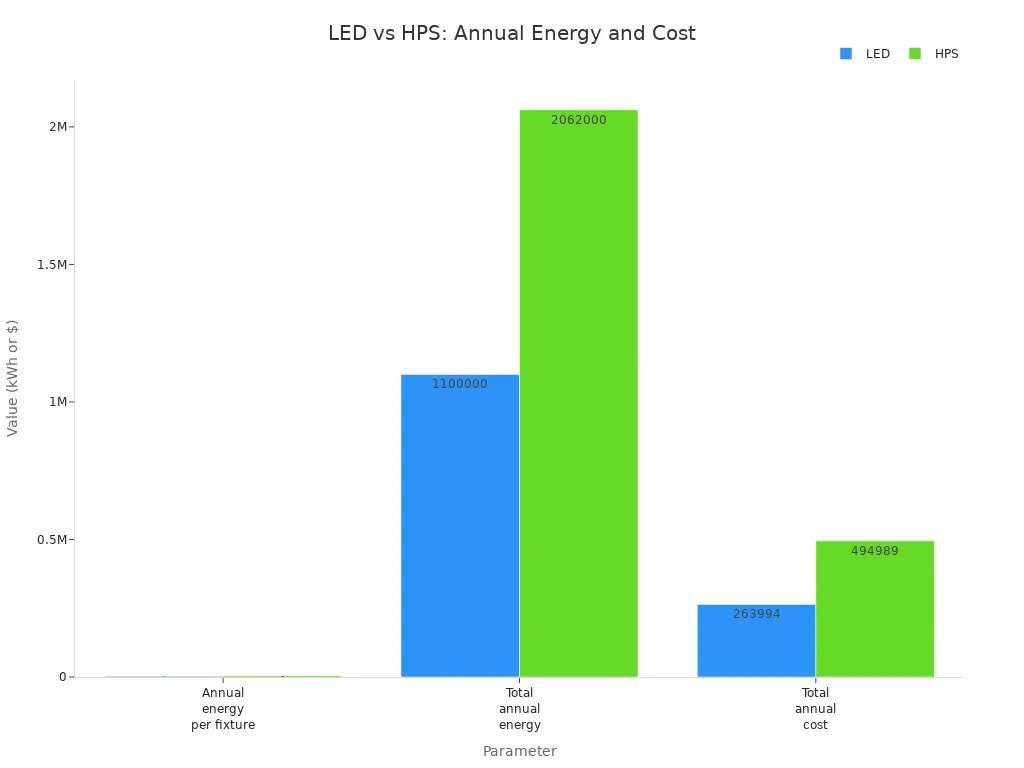
A vegetable grower in Quebec used LED interlighting to give more light to the middle and lower parts of plants. This raised yields by over 40% for each square meter without big changes to the greenhouse. Rebates and grants helped growers get their money back faster. Using spectrum control and smart schedules made crops grow better and helped growers make more money.
Energy-Efficient Greenhouse Systems
System Integration
Commercial growers get the best results by using energy-saving greenhouse systems with advanced LED grow lights. They use different ways to make their crops better and save energy:
- Growers move LED lights for each plant stage. They put lights higher for seedlings. They move them closer when plants flower.
- LEDs can go inside the plant canopy. This helps lower leaves get more light. It makes plants grow more.
- Timers and sensors help control how long lights stay on. This keeps energy use steady for each plant stage.
- Reflective surfaces and diffusers spread light around. This stops dark spots and helps all plants get enough light.
- Growers clean LED lights often. This keeps them bright and helps them last longer.
Dynamic LED lighting lets growers make zones for different crops. They can change the light color and strength for each crop. For example, they stop bronzing in peppers or make lettuce look better by changing the light. Smart controls let growers dim lights when there is sunlight. This saves energy and helps with changes in seasons. These systems help crops grow better and waste less. They also help farms be more sustainable.
Tip: Cleaning lights and using smart controls help growers get the most from their energy-saving greenhouse systems.
Climate Footprint
Energy-saving greenhouse systems help lower the climate impact of big farms. Some farms use Combined Heat and Power (CHP) units. These make power at the farm and cut down on using outside electricity. CHP units also give CO2 to plants. This helps plants grow and use less water. For example, a big tomato greenhouse used a 13 MW CHP system. It cut its carbon footprint in half and made the system 88% efficient.
Other tools like LED lights, thermal screens, and heat pumps help save energy. LEDs use less power and can be set for each plant. Thermal screens keep heat in during winter and out in summer. Automated controls use sensors to change air, light, and shade. This stops wasting energy. Studies show that using double climate screens, LED lights, and dehumidifiers can cut gas use by over 50%. These changes help farms use less energy and lower costs. They also help the environment by cutting greenhouse gases.
Sustainability is very important for commercial growers. By using new technology, they make systems that work well for a long time and protect the planet.
Advanced spectrum control and energy-saving LED lights help greenhouses right away and in the future. Operators get more crops, pay less for power, and spend less on repairs.
- LED grow lights work up to 60% better than old lamps. This means crops are better and money comes back faster.
- Rebates and special programs help pay for new lights. This makes it easier for growers to manage their money.
To get the most from their lights, operators should:
- Use advanced lights to keep daily light levels just right.
- Add extra light to places that do not get enough.
- Use smart controls to change lights quickly when needed.
Modern greenhouse systems now use AI, machines, and clean energy. These tools help growers run greenhouses that are good for the planet and make more money.
FAQ
What is spectrum control in commercial greenhouse LED grow lights?
Spectrum control lets workers change the color and strength of LED lights. This helps plants grow better at every stage. Growers use spectrum control to get more crops and save on energy bills.
How do LED grow lights lower energy costs for commercial greenhouses?
LED grow lights use new technology to make more light with less power. They do not get as hot, so greenhouses need less cooling. This helps growers spend less money on electricity and fixing lights.
Can commercial growers customize light recipes for different crops?
Yes. Commercial LED systems let growers pick special light plans for each crop and stage. They can change the color, how bright the lights are, and when they turn on. This helps plants grow better and gives more crops.
What is the typical payback period for LED grow light investments?
Most growers get their money back from LED lights in two or three years. Saving energy, doing less work, and getting more crops help them earn back the cost quickly.
Do LED grow lights require special maintenance in commercial settings?
LED grow lights need less care than old lights. Workers should clean the lights often and look for dust or dirt. Taking care of the lights helps them work well and last longer.