

You need different equipment to do well in vertical farming. Important things are LED lighting, growing systems, climate control, irrigation, monitoring tools, and strong parts for support. Vertical farming technology lets you control temperature, humidity, and CO2, which helps crops grow better by up to 25%. It also saves up to 95% of water compared to traditional methods. Indoor crop growing uses only 1% of the land, making indoor farming efficient and good for the planet. If you’re wondering how to start a vertical farm, begin by building a good indoor space. You can start small and gradually add more technology as you learn.
Key Takeaways
- Begin your vertical farm in a small indoor area that stays warm. You can make it bigger as you learn more. Use LED grow lights to use less energy. These lights help plants grow faster with the right colors. Pick easy growing systems like hydroponics at first. Later, you can try aeroponics or aquaponics. Use sensors and HVAC systems to control temperature, humidity, and CO2. This keeps your plants healthy all year. Add tools that water plants and check on them by themselves. This saves water, makes work easier, and helps you grow more crops.
How to Start a Vertical Farm
Room and Infrastructure
When you learn how to start a vertical farm, you need to pick the right space. Many people use multi-story buildings, empty warehouses, or even repurposed shipping containers. These spaces help you grow more crops by stacking them in layers. This method is called vertical farming. You can use automated racks to make the most of your space. Each layer holds plants, lights, and water systems.
You must build a strong structure to hold the weight of the racks, water, and plants. Good infrastructure includes sturdy floors, walls, and ceilings. You also need to think about insulation. Insulation keeps the temperature steady inside your indoor farm. Controlled environment agriculture depends on this. It lets you manage temperature, humidity, and airflow. This control helps your crops grow all year.
Tip: Start with a small room. You can expand your vertical farming setup as you learn more about how to start a vertical farm.
Power and Water Needs
Power and water are two of the most important needs when you plan how to start a vertical farm. Lighting uses the most energy. In fact, lighting can take up 65-85% of your total energy use. HVAC systems, which control temperature and humidity, use another 10-20%. Fans use less than 1%. You need a reliable power source to keep your indoor farm running.
Water use in vertical farming is much lower than in outdoor farms. You can track water use with flowmeters and sensors. These tools help you give plants just the right amount of water. Closed-loop systems recycle water and nutrients. This saves resources and keeps your farm efficient. Controlled environment agriculture uses these systems to help you grow healthy crops with less waste.
Remember, learning how to start a vertical farm means understanding your power and water needs. Careful planning helps you avoid problems and grow better crops.
Equipment for Vertical Farms
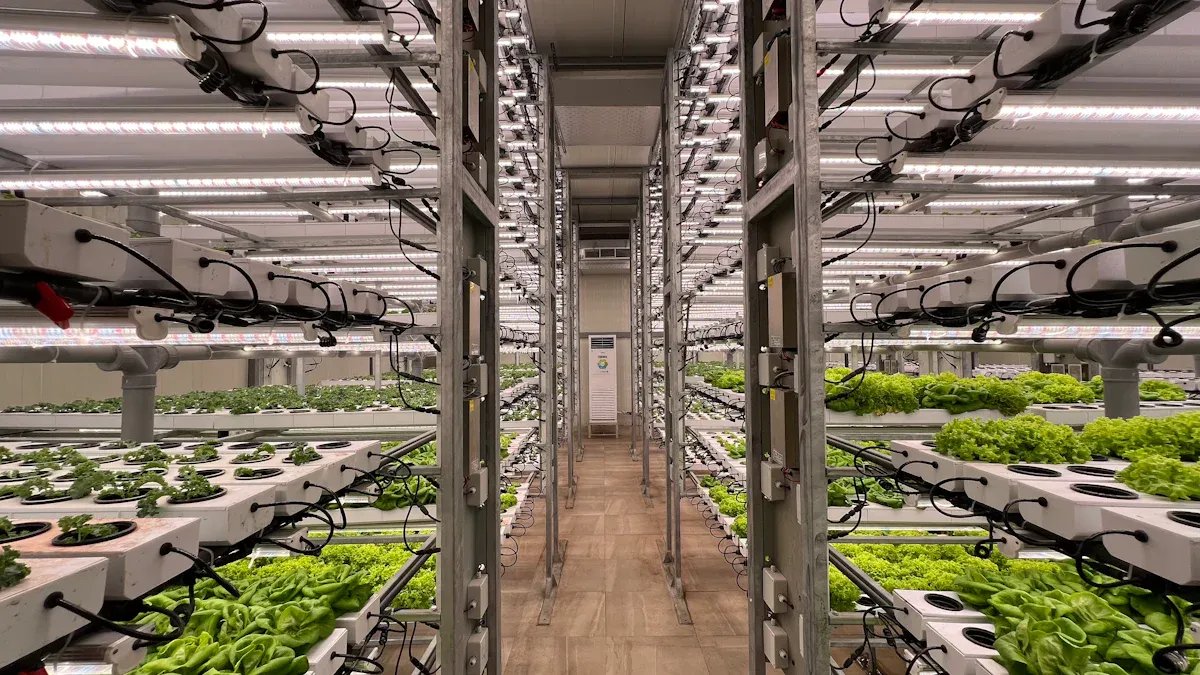
When you build a vertical farm, you must pick the right equipment for vertical farms. The main types are lighting, growing systems, and strong parts. Each one helps you grow healthy crops inside. Good technology can help you get more crops, use less, and make your farm work better.
Lighting
Lighting is very important equipment for vertical farms. Most people use led grow lights because they give plants the right light. These lights use less power than old bulbs. You can save 31% to 35% on power for each square foot with new led grow lights. The best led illumination system gives off light that helps plants grow fast and strong. Red light at 650-665 nm and blue light at 658-660 nm help plants make food and get more antioxidants.
| Indicator | Value / Range | Notes / Context |
|---|---|---|
| Electricity consumption | 31% to 35% reduction per sq. foot | Compared to conventional lighting (US DOE, June 2020) |
| Light output (PPF) | 5700 µmol | Example: Heliospectra MITRA X LED light output |
| Energy efficiency (µmol/J) | ~3.0 to 3.7 µmol/J | Efficiency range for advanced LED grow lights |
| Spectral wavelength | Red: 650-665 nm, Blue: 658-660 nm | Supports photosynthesis and antioxidants |
| Operational lifespan | 30,000 to 50,000 hours | Manufacturer claims; standardized testing needed |
| Initial investment cost | 2-3 times higher than HPS lighting | Higher upfront cost but energy savings and ROI |
| ROI considerations | Potential high returns despite cost | Market expects price declines and better affordability |
Led grow lights are about 41% of the total equipment cost for vertical farming. About 76% of indoor farms use led grow lights because they save energy and you can change their color. New products, like FY LED grow light modules, are 38% more efficient and are used in many big farms. Even though they cost more at first, you save money later and your crops grow better. Artificial lighting is needed to grow crops all year, especially where there is not much sun.
Tip: Use led grow lights that let you change color and brightness. This helps you give each plant what it needs and saves power.
Growing Systems
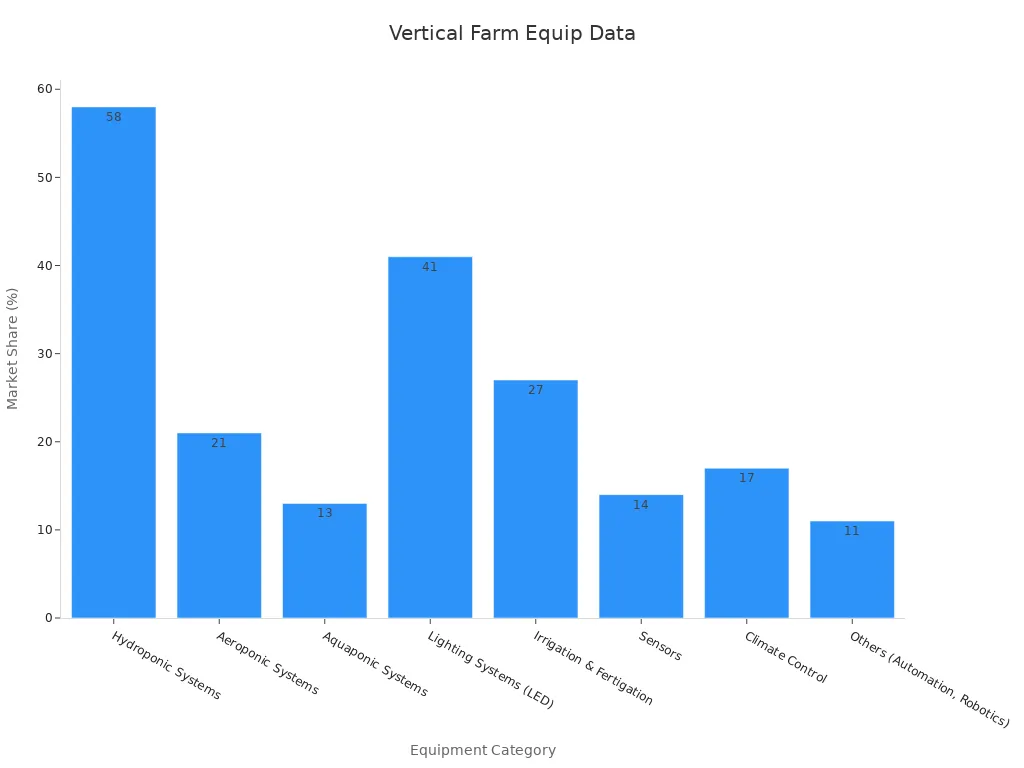
You can pick from different growing systems in vertical farming. The most common are hydroponic systems, aeroponic systems, and aquaponic systems. Each one has good points and works for different crops and farm sizes.
| Equipment Category | Market Share / Usage Details |
|---|---|
| Hydroponic Systems | Dominates with over 58% share; preferred for low setup complexity and 70% water savings; used by 63% of urban farms |
| Aeroponic Systems | Accounts for 21% usage; noted for ultra-efficient water and nutrient use; 45% higher yield per sqm than hydroponics |
| Aquaponic Systems | Represents 13% market; combines fish and plant cultivation; used by 29% of small/community farms for organic methods |
Hydroponic systems are the most used. They use water and nutrients instead of soil. You can save up to 70% of water compared to normal farming. Many city farms use hydroponic systems because they are easy to set up and use. Hydrofarm’s modular hydroponic system uses 47% less water and is in over 50 U.S. indoor farms.
Aeroponic systems spray a fine mist of water and nutrients on plant roots. This uses even less water and gives you up to 45% more crops per square meter than hydroponic systems. Aeroponic technology is good if you want to save the most and get more crops. Aeroponics is also great for leafy greens and herbs.
Aquaponic systems mix fish and plant farming. Fish waste gives food to the plants, and the plants help clean the water for the fish. About 13% of the market uses aquaponic systems, mostly in small or community farms that want organic ways.
Note: If you are just starting, try a simple hydroponic system. You can move to aeroponic or aquaponic systems as you learn more.
Structural Elements
Structural elements keep your vertical farm together. You need strong vertical grow racks, trays, and containers to hold your plants, lights, and water systems. A good setup helps you use all your space and makes your farm work better.
The MACARONS2 vertical farming system shows racks and trays can give you about 66% space use. This means you use most of your floor for growing crops. Modular frames and guide rails help you grow your farm up and out. You can move trays easily and reach every plant. Montel Inc. has a mobile vertical racking system that uses 42% more space. This system is already used in cities like Tokyo and New York.
| Tray System | Tray Length | Tray Width | Tray Height | Vertical Spacing (H/W) | Notes |
|---|---|---|---|---|---|
| Multi-rack tray | 160 cm | 67 cm | 72 cm | Above 45° at 10°N/20°N | Prevents shading, maximizes seedlings |
Tip: Pick vertical grow racks that are easy to move and change. This lets you change your setup as your farm gets bigger.
Always look for equipment for vertical farms that is easy to take apart and clean. This helps you grow your farm and keep it working well. When you pick the right strong parts, your vertical farm equipment lasts longer and works better.
Climate and Environmental Controls

HVAC and Airflow
You need to keep your indoor farm at the right temperature and humidity. HVAC systems help you do this. These systems use fans and smart controls to move air and keep it fresh. Good airflow stops mold and pests from growing. You can use variable refrigerant flow (VRF) systems for better temperature control. Smart sensors watch the air and make changes when needed. You can save energy by running fans during times when plants use the most light. Some farms use renewable energy and modular designs to make HVAC systems work better. When you design your shelves, make sure air can move around every plant.
Temperature and Humidity
Stable temperature and humidity help you get high yields in vertical farming. You can use sensors to check the air in every part of your farm. Studies show that with the right setup, you can keep temperature changes within 0.75°C and humidity changes within 1.59%. This helps your plants grow strong and healthy. Computer models help you find the best way to move air and keep the climate steady. You can use special ducts to stop air from getting stuck in one place. This keeps your controlled environments even and safe for crops.
CO2 and Sensors
Plants need CO2 to grow. You can use sensors to watch CO2 levels and add more when needed. Studies show that raising CO2 can make plants grow faster and bigger. For example, lettuce grows taller and has more leaves when you keep CO2 between 700 and 1200 ppm. Smart systems can change CO2, light, and temperature all at once. Some farms use AI to predict what plants need and adjust the environment. This helps you use less energy and get better yields. You can also grow foods like mushrooms that need less light, which saves even more energy.
Tip: Use sensors and smart controls to watch your farm. This helps you fix problems fast and keep your crops healthy all year.
Irrigation and Nutrient Delivery
Automated Systems
Automated irrigation systems are very important in vertical farming. Pumps and timers help send water and nutrients to plants. These systems save you time and help stop mistakes. In vertical farming, sensors check soil moisture, humidity, and temperature. When plants need water, the system turns on and gives just enough. This keeps crops healthy and stops over-watering.
There are different irrigation systems you can use. Drip irrigation gives water right to the roots. Closed-loop recirculating systems clean and reuse water. This can save up to 95% more water than old farming ways. Farms like Bowery Farming and Freight Farms use these systems. They cut water use by 90-95%. The table below shows how each system helps save water:
| Greenhouse System Type | Water Use Efficiency Improvement | Key Features and Automation Benefits |
|---|---|---|
| Open system | Baseline (lowest efficiency) | No water reuse; water drains away |
| Semi-closed system | Moderate improvement | Some water reuse and automation |
| Closed system | 10-50% better efficiency | Fully automated, recirculates water |
Tip: Begin with a simple drip irrigation system. Add sensors and timers later as you learn more about automated irrigation systems.
Nutrient Solutions
Plants in vertical farming need nutrients all the time. You mix a nutrient solution with water and send it through the irrigation system. Hydroponic setups use this to give plants what they need without soil. Automated irrigation systems can change the amount of nutrients for plant growth and seasons.
Sensors in advanced irrigation systems watch pH, electrical conductivity, and nutrient levels. This helps keep the nutrient solution balanced. Farms like Grow It York use digital tools to check and control nutrient delivery. This helps crops grow better and saves resources. You get more fresh crops and use water better when you use sensors and nutrient solutions together.
| Parameter | Sensor-Based Irrigation | Gravimetric Irrigation | Key Findings |
|---|---|---|---|
| Water Use Efficiency (WUE) | 13% higher overall | Baseline | Better WUE with sensors |
| Fresh Yield | 1.9 kg/m² | 1.8 kg/m² | 11.5% more yield with sensors |
| Dry Matter (DM) | 5.3-7 g/100g FW | Similar range | Higher DM at low irrigation |
Remember, always check your nutrient solution and irrigation system. This helps you stop problems and keeps your plants growing well.
Monitoring and Automation
Sensors and Software
You can make your vertical farming smarter with sensors and software. Smart sensors watch temperature, humidity, light, water quality, and nutrients. These sensors send information to your computer or phone. You can see what is happening right away and change things fast. This helps you stop mistakes and grow better crops.
Software like FY Automated Agricultural System gives you dashboards to check your farm. You can look at crop health, track every batch, and plan harvests. These tools help you make good choices and keep your farm working well. When you use sensors and software together, you can automate many jobs. This saves time and cuts down on work.
Smart sensors and software help you use less water and energy. Studies show farms with these tools can grow over 30% more and work 25% better. You can also spend less on workers because robots and machines can plant, water, and harvest.
| Benefit Category | Vertical Hydroponics (Estimated Values) | Traditional Soil-Based Farming (Estimated Values) | Improvement (%) |
|---|---|---|---|
| Space Utilization | 8–12 kg crops per sqm | 0.8–1.5 kg crops per sqm | 700–1000% increase |
| Water Efficiency | 10–35 liters per kg yield | 100–400 liters per kg yield | Up to 90% better |
| Crop Yield | 15–30 tons per 100 sqm per year | 1.5–2.5 tons per 100 sqm per year | 500–1000% increase |
| Resource Savings | 70–90% reduction | Baseline | Significant reduction |
| Labor Requirement | 8–20 hours per week | 20–40 hours per week | 50% less labor needed |
| Pest Incidence | 1–3 instances per month | 6–12 instances per month | 60–90% lower |
| Carbon Footprint | ~200–400 kg CO₂ per year | ~500–800 kg CO₂ per year | Up to 60% lower |
Tip: Begin with a few sensors and easy software. Add more as your farm gets bigger.
Control Systems
Control systems help you manage your vertical farming space. These systems use sensor data to change lights, fans, pumps, and heaters. You can set rules for when to turn on led lights or change the temperature. This keeps your crops healthy and growing fast.
Integrated control systems make your farm work better. You can see the changes in the table below:
| Metric | Improvement/Outcome | Impact on Operational Efficiency |
|---|---|---|
| Crop yield per square foot | Up to 40% increase | Maximizes space utilization and boosts revenue growth |
| Water usage efficiency | Up to 90% less water usage | Reduces operating costs and supports sustainability |
| Production cycle time | Reduced by nearly 20% | Ensures consistent supply and faster turnover |
| Energy consumption per produce | Reduced by up to 30% | Lowers energy costs and improves resource optimization |
| Crop yield growth (monthly) | At least 5% increase month-over-month | Supports continuous improvement and operational control |
| Energy efficiency improvements | Up to 30% improvement | Reduces resource wastage and operational expenses |
| Innovation adoption rate | 20-30% adoption correlates with performance | Drives crop yield and resource optimization improvements |
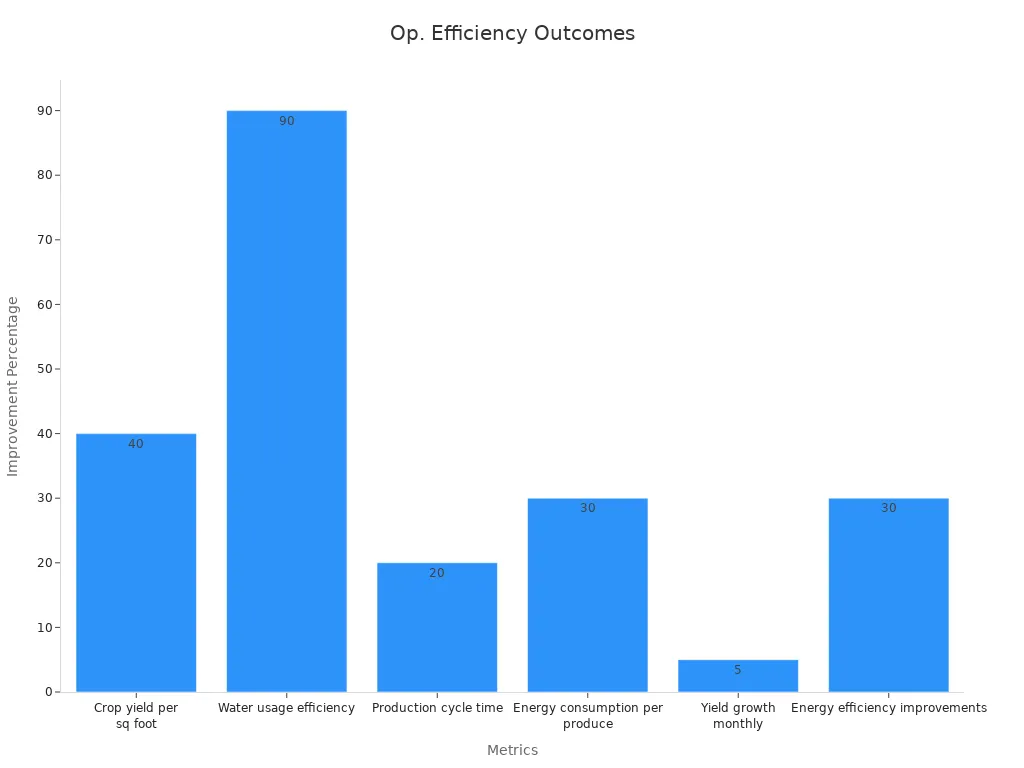
You can use automation to keep your farm running all day and night. Automated systems help you avoid mistakes and keep crops safe. Many farms get up to 40% more crops and use 90% less water with these systems. You can also use up to 30% less energy. This makes your farm greener and easier to run.
Using control systems and automation helps controlled environment agriculture. You can focus on growing your business while technology does the hard work.
You need special equipment and technology to do well in vertical farming. Begin with simple tools such as lighting, growing systems, and climate controls. When you get more practice, you can add automation and monitoring tools. These help you get better results. Research shows vertical farming saves more water and energy than other indoor farms. Try to make a space where you can control the environment. Keep reading guides and looking for resources to learn more about equipment for vertical farms.
FAQ
What crops can you grow in a vertical farm?
You can grow leafy greens, herbs, strawberries, and microgreens. Some farms also grow tomatoes and peppers. Most beginners start with lettuce or basil because these plants grow fast and need less care.
How much does it cost to start a small vertical farm?
A basic setup can cost $2,000 to $10,000. The price depends on the size, equipment, and technology you choose. You can start small and add more systems as you learn.
Do you need special training to run a vertical farm?
You do not need a degree, but learning helps. Many online courses and videos teach you about hydroponics, lighting, and climate control. You can join local workshops or farming groups for extra support.
How often should you check your sensors and equipment?
You should check sensors and equipment every day. This helps you spot problems early. Many farms use software alerts to remind you when something needs attention.
Can you use solar panels to power a vertical farm?
Yes, you can use solar panels. Solar energy can lower your power bills. You may need batteries to store extra energy for nighttime use. Many farms use a mix of solar and grid power for best results.